
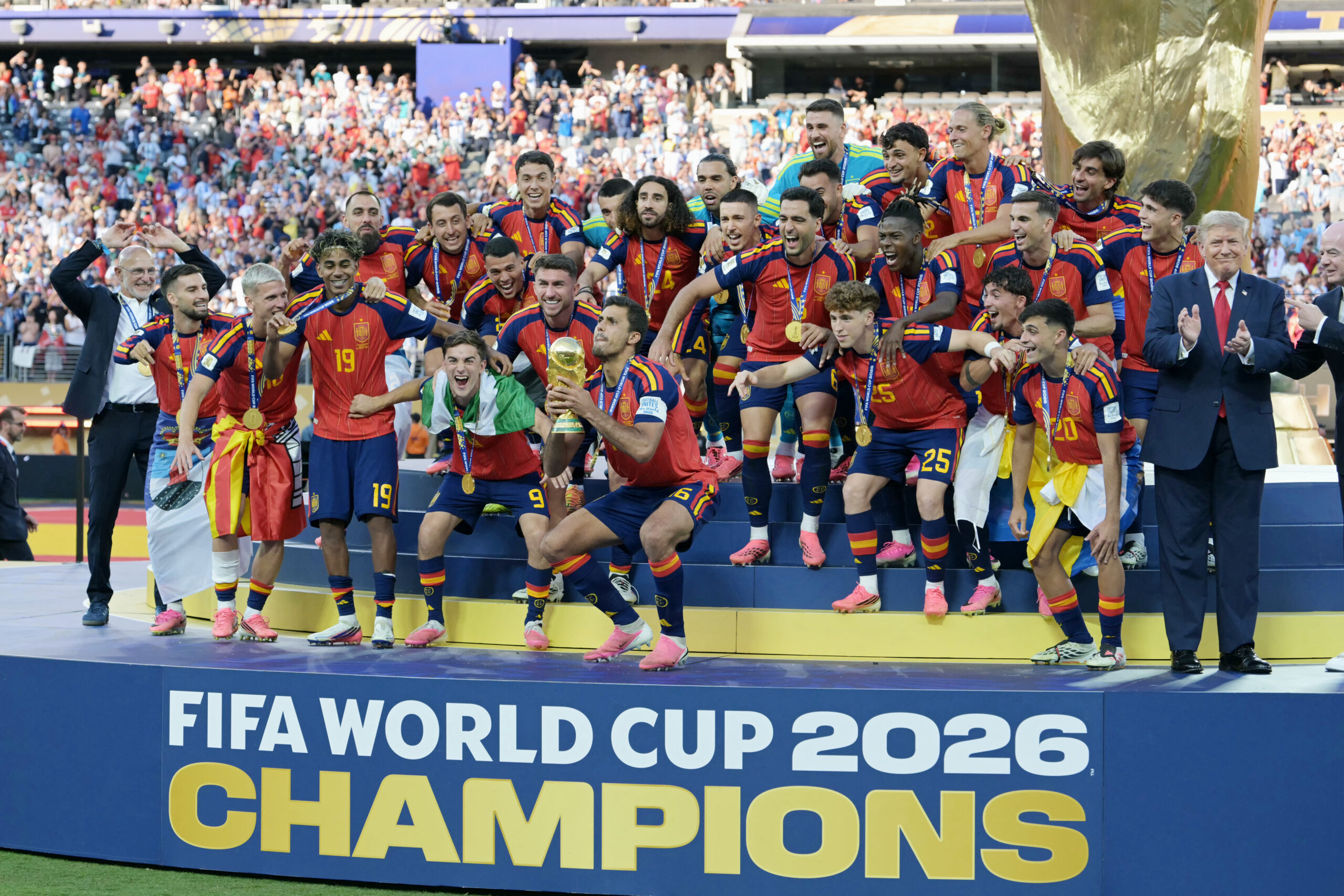
In a historic expansion, the 2026 FIFA World Cup in the United States, Canada, and Mexico featured 48 teams competing for the first time. The total financial distribution for this edition of the tournament reached a record high of $8.71 billion.
This includes over $100 million allocated in April to address the transportation and high accommodation costs associated with the three countries jointly hosting the event. Of course, the ultimate honor remains the World Cup trophy.
After the final whistle on Sunday, the champions celebrated with the trophy at the award ceremony. The original World Cup trophy is not permanently awarded. Instead, the winners receive a gold-plated replica that they can keep.
The following is a summary of the financial distribution and key information for this World Cup:
FIFA allocates $6.55 billion of the total amount as performance-based advancement bonuses. Each team’s earnings are composed of “initial funding” and “performance-based bonuses.”
Before even playing a match, each team receives $12.5 million, including $10 million for participating in the group stage and $2.5 million for pre-tournament training and preparations.
Champions (Spain):
$51 million (In addition to receiving the gold-plated replica of the trophy, they also receive championship rings for the first time)
Runners-up (Argentina):
$34 million
Third place (England):
$30 million
Fourth place (France):
$28 million
Quarter-finals (5th-8th place):
Each receive $20 million
Round of 16 (9th-16th place):
Each receive $16 million
Round of 32 (17th-32nd place):
Each receive $12 million
Group stage (33rd-48th place):
Each receive $10 million
Note: While the $51 million prize for this year’s champions is higher than the 2022 Qatar World Cup champions ($42 million), it is still lower than the $115 million received by last year’s Club World Cup champions Chelsea. Additionally, teams playing within the United States are subject to additional tax obligations, while Canada and Mexico are tax-exempt.
The World Cup was hosted across the three countries. The division of logistical expenses during the tournament period included:
Business class round-trip flights for delegations of 50 people from each football association (including players);
Accommodation and meals for the delegation for 5 days before the matches until 1 day after elimination;
Transportation costs within the host countries, including providing a dedicated fleet of vehicles (including equipment trucks).
Football associations are required to provide adequate insurance for delegation members, including but not limited to injury, accident, illness, and travel insurance;
Miscellaneous expenses at hotels;
Accommodation costs for additional accompanying personnel of the delegation.
The World Cup prize money is directly paid by FIFA to the national football associations, not to individual players. Football associations can decide internally how to distribute the funds to players, coaches, and youth development projects.
Equal Pay for Equal Work case study: The United States Soccer Federation (USSF) will retain 20% of the prize money, and the remaining 80% will be split equally between the men’s and women’s national teams as per the agreement reached in 2022, making it the world’s first national organization to commit to equal pay for men’s and women’s football.