
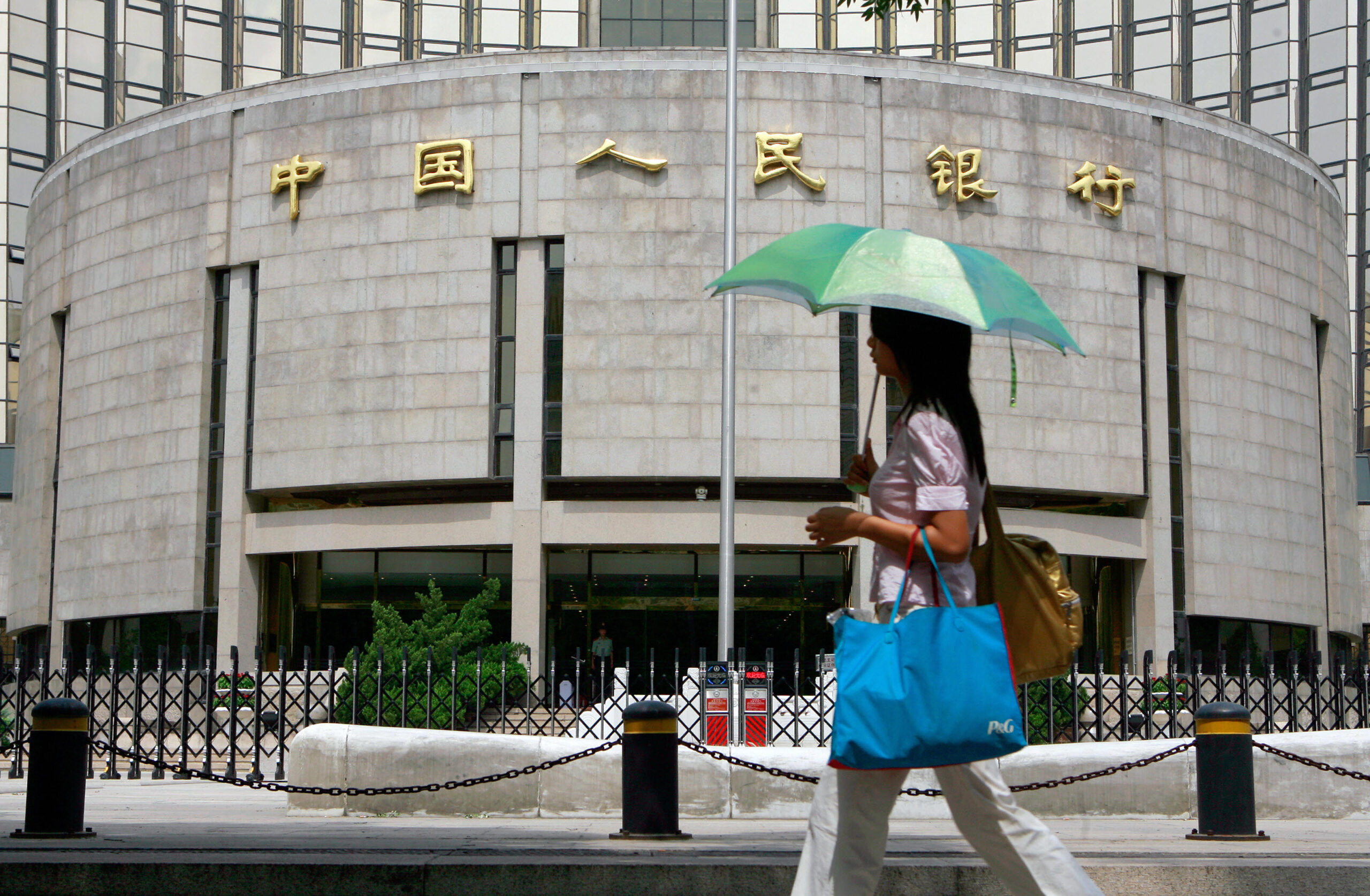
In a report from Epoch Times on July 20, 2026, it was disclosed that the stock prices of 42 listed banks in China have all fallen below their net assets. In response, bank executives and major shareholders have been increasing their holdings of their own stocks, but the capital market remains unconvinced. Xie Jinhe, Chairman of Cai Xin Media, wrote an analysis stating that the Chinese financial industry is displaying cancerous characteristics, with the situation only expected to worsen.
During the first half of 2026, data revealed that out of the 42 Chinese bank stocks, only 6 saw an increase while the rest experienced a decline, resulting in a total market value decrease from approximately 15.7 trillion yuan at the beginning of the year to 14.17 trillion yuan, evaporating 1.54 trillion yuan. All 42 listed banks fell below their net assets, with the price-to-book ratio dropping from 0.65 times at the start of the year to 0.57 times.
When a stock falls below its net asset value, it means that the market price per share is lower than its net asset value per share, resulting in a price-to-book ratio (PB) of less than 1. This usually reflects investors’ pessimistic expectations of the stock’s future profitability or a general market downturn.
Political observer Xia Yan explained that the primary asset of banks is the loans they have extended to others. Investors are concerned that due to the recent downturn in the real estate industry in the past few years, some real estate developers (such as Evergrande) have gone bankrupt, leaving vast loans unpaid to the banks. Although the assets are valued at 10 yuan on the books, investors suspect that 4 yuan of that might be bad debt that cannot be recovered, hence they are only willing to offer a lower price. This explains why all 42 listed bank stocks have fallen below their net assets.
According to a report on China Financial Network on July 19, facing the collapse in valuation, executives of listed banks have been scrambling to shore up the market. For instance, Chairman Wu Zhihui of Ruifeng Bank led a team in which 7 core directors and supervisors, along with key personnel from various departments and front-line branches, increased their holdings by 2.5 million shares using their own funds, amounting to over 12 million yuan. Similarly, the executive team of Changshu Bank increased their holdings by 550,000 shares, investing 3.8758 million yuan. The CEO and Vice CEO of Sunong Bank increased their holdings by 355,200 shares, investing 1.832 million yuan. Beijing Bank director Zhou Mochen bought 97,800 shares, investing 477,300 yuan.
In the first half of the year, the market value of bank shares plummeted by 1.54 trillion yuan, while executives and major shareholders increased their holdings by 30 billion yuan. However, when compared to the 1.54 trillion yuan loss, the 30 billion yuan increase is merely a drop in the bucket.
Some investors have raised questions on interactive platforms, expressing concerns such as, “Despite noticing insider buying by your company’s management recently, the plummeting stock prices have left people in panic, hitting new lows repeatedly.”
Regarding the current situation in the mainland banking sector, reports have analyzed three main factors:
1. Continuous narrowing of Net Interest Margin (NIM). By the first quarter of 2026, NIM had dropped to a historical low of 1.42%, squeezing the space for banks’ income from interest.
2. Rising retail risks. The non-performing risks of mortgage loans, credit cards, consumer loans, and business loans continue to increase. With fluctuations in residents’ income expectations and pressure on repayment capacity, the risk of bad debts is spreading.
3. The shadow of the real estate sector remains. Banks hold a large amount of assets related to real estate, and market concerns have not dissipated.
On July 18, Xie Jinhe, Chairman of Cai Xin Media in Taiwan, posted an article on Facebook titled “The Difficult Times of the Chinese Banking Industry.” Xie pointed out that all 42 listed banks in China had “fallen below their net asset value,” with the Bank of Minsheng having a price-to-book ratio of only 0.22 times, indicating that these banks are deeply mired in bad debt dilemmas.
Xie Jinhe cited the example of Japanese banks during the burst of the bubble in 1989, where major banks in Japan went bankrupt one after another, leading to the reorganization of financial control later on. Taiwan also underwent financial reforms from the first to the second phase. Currently, all 15 financial institutions in Taiwan have price-to-book ratios exceeding 1, indicating that the banking sector in Taiwan has significantly improved its financial status by aggressively disposing of bad debts.
Xie Jinhe analyzed that among the 42 listed banks in China, there are not many banks with a relatively robust financial structure, such as the central-level Bank of China. However, banks like Minsheng Bank, Huaxia Bank, and Beijing Bank are under substantial pressure from bad debts. Minsheng Bank’s largest client is Evergrande Group. Over the past few years, with the rapid growth of companies like Evergrande, Country Garden, Sunac, Greentown, and Vanke Group, they have relied on political influence to move money from banks. Now that some of them have collapsed, no one dares to address the bank’s bad loans. “This phenomenon is like a patient discovering cancer cells but not daring to remove the tumor, letting it continue to worsen! The Chinese banking industry is starting to face a difficult time!”