
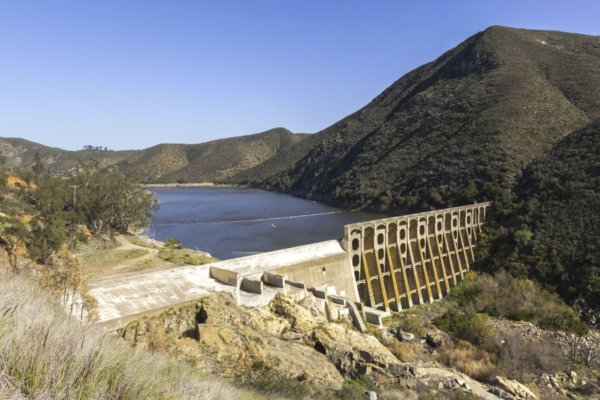
California State Auditor released a report on Tuesday (October 13) indicating that 57 dams in California are in poor or unsatisfactory condition, and the failure of just one high-risk dam could potentially endanger the lives of over 400,000 people and result in nearly $92 billion in economic losses.
The latest report cites the evaluation results of 1,222 dams in California by the Department of Water Resources (DWR). Auditors pointed out that among the 57 unsafe or unsatisfactory dams, 40 were classified as “high or extremely high hazard” level.
The report highlights that if these dams were to fail, it could potentially endanger the lives of up to 1.5 million people and lead to over $265 billion in economic losses. Moreover, poorly maintained and high-risk dams are mostly concentrated in densely populated areas such as the San Francisco Bay Area, San Diego, and Los Angeles.
The evaluation by the Department of Water Resources did not publicly list the names of these 40 high-risk dams. However, data on dam conditions released by the city government of San Diego indicates concerns regarding the safety of several local dams.
Among them, El Capitan Dam (built in 1935), Morena Dam (built in 1912), and Lower Otay/Savage Dam (built in 1918) were rated as “poor”; while Lake Hodges Dam (built in 1918) received a lower rating of “unsatisfactory”.
Data from the Department of Water Resources indicates that Castaic Dam (built in 1974) in the Los Angeles area was rated as “poor”. Concerns include the operational capacity of spillways during extreme flood periods, and the potential impact of large earthquakes on intake towers. The department is addressing these issues through a dam modernization program and states that based on the latest assessment, the dams are currently able to operate safely.
The report’s analysis identifies common causes for poor dam conditions, including aging without adequate maintenance, inability to afford repair costs, and failure to implement comprehensive safety standards during dam construction.
The Auditor General pointed out that despite the authority of the Department of Water Resources to take enforcement actions against dams, the department “only issues violation notices to dam owners without taking further measures, leading to the persistence of serious defects.”
The department mentioned that limited resources hindered efforts to complete repairs on dams before failures occurred.
Among the 1,222 dams, the Auditor General found that 60 dams with higher hazard levels had their owners not complying with California law by failing to submit emergency action plans. These plans aim to ensure the safety of people and property in case of dam structural failures.
Local Maintenance Agencies (LMAs) are responsible for maintaining levees to block or control water flow during flooding.
The report highlights deficiencies in levee maintenance by LMAs and the Department of Water Resources’ reluctance to intervene, thereby increasing risks faced by communities.
California Governor Gavin Newsom declared a state of emergency last month to prepare for the potential impacts of the El Niño phenomenon. El Niño could bring increased rainfall to Southern California and trigger sudden floods.
The greatest impacts of El Niño on the United States usually occur from October to May of the following year.
In the emergency declaration, Newsom specifically mentioned the risks posed by El Niño to dams. The declaration requires the Department of Water Resources to contact dam owners, reminding them of their responsibility to repair, maintain dams and other facilities, and ensure their safe operation.
Meanwhile, the report of California State Auditor also included the response of the Department of Water Resources to the draft report. The department criticized that the audit report displayed a “fundamental lack of understanding” of the complex issues involved in flood management and dam safety.
The department stated that the audit report wrongly attributed unsatisfactory dam conditions to poor maintenance and lack of action as if these were the sole reasons.
“This further demonstrates a lack of technical understanding on the part of the auditors,” the Department of Water Resources said. “The key deficiencies were discovered through the department’s reevaluation program; these deficiencies could not be directly observed in routine inspections, mostly because the loads from disasters such as earthquakes and floods were larger than originally anticipated.”
The department also stated: “Design standards, engineering methods, and scientific knowledge evolve over time. These dams are not necessarily poorly constructed from the outset.”
The department’s reevaluation program regularly reviews dams considered potentially life-threatening in accordance with current dam safety standards. The department stated that this program is responsible for identifying over two-thirds of the dam deficiencies.
On September 30, the Department of Water Resources announced the completion of a $235 million repair project for the Oroville Dam, the tallest dam in the United States.
John Yarbrough, Deputy Director of the State Water Project Engineering for the Department of Water Resources, stated in a release, “This investment in the infrastructure of the Oroville Dam ensures that the largest flood and water supply facility in the California State Water Project can operate reliably and safely.”
Dam safety is a widespread issue across the United States as well. According to a report by the American Society of Civil Engineers, nearly 17,000 dams in the U.S. are considered potentially highly hazardous.
The report highlights that the average lifespan of American dams has exceeded 60 years. As of 2025, seventy percent of dams are at least 50 years old.
The society stated, “Without increasing annual investment and committing more actively to ensuring dam safety, including enhancing inspections, monitoring, planning, and necessary dam repairs, the cost to maintain national dam safety at a good level will continue to rise.”
“And downstream communities will face a higher potential risk of dam failures,” the society added.