
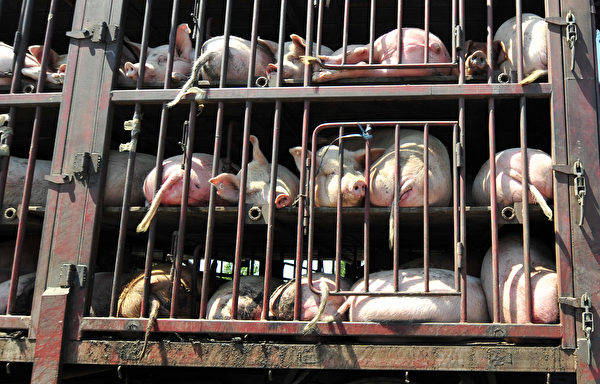
In recent times, the price of live pigs in mainland China has dropped to less than 10 yuan per kilogram (RMB, hereinafter), while at the same time, live pig futures prices have fallen by 23% over the past four months, and when the live pig prices will hit bottom remains unknown.
According to a report by “Huaxia Times” on October 15, on the 15th, the LH2701 contract for live pigs (a variety of live pig futures on the Dalian Commodity Exchange) once fell to 10,395 yuan per ton during the trading session, closing at 10,455 yuan per ton. Market conditions indicate that there is intense speculation between long and short positions.
In response to this, a Dech Futures analyst, Hou Xiaorui, told the media: “The continuous decline in live pig futures in recent times is related to the strong supply and weak demand fundamentals. The October live pig spot prices have fallen instead of rising, with the national average falling below the critical level of 10 yuan/kg. This is mainly due to weakening consumption after the long holiday, an increase in the offloading plans of large scale breeding farms in October compared to the previous month, the continuous backlog of large pigs in the market, the continued increase in offloading weights, and an overall loose supply within the year. As a result, several live pig futures contracts have hit new lows in this phase.”
Data shows that from July 6 to October 15, live pig futures have fallen by 23%. Hou Xiaorui stated that the essence of the decline in live pig futures is the refutation of the optimistic expectation of “capacity reduction driving a future reversal.” Previously, the market had bet that the clearance of breeding sows would drive a reversal in futures prices in the long term, but the performance of the spot market since September has continuously shattered the market’s optimistic expectations.
Industry analysts believe that the imbalance between supply and demand in the mainland live pig market is the reason for the continuous exploration of the bottom in live pig prices.
Senior Director of the NH Futures Research Institute, Bian Shuyang, analyzed with the media, stating that the current speed of live pig offloading has significantly increased, with the national daily offloading volume increasing from 173,700 head on July 7 to 213,000 head on October 13, an increase of about 22.6%. This is the direct driver of the accelerated decline in the spot market since September. In addition, there is no substantial recovery seen in end consumption, as the slaughtering volume of sample enterprises has only increased by 3.3% from 270,800 head to 279,900 head, which is significantly weaker than the 22.6% increase in offloading volumes. Furthermore, the contraction of the live pig market, declining enterprise profits, pressure on the capital chain, enterprises speeding up offloading under cash flow pressure, exchanging quantity for price, and multiple other reasons have led to the live pig market operating at low levels.
The report indicates that the low-level operation of the live pig market has led to a significant decline in piglet prices in recent times. The average price of 7 kilograms piglets has plummeted from 258.57 yuan/head on July 24 to 105.24 yuan/head on October 9, a decrease of about 59%, far below the break-even line of around 260 yuan/head, resulting in an average loss of around 150 yuan per sold piglet.
Regarding the future trend of the live pig market, Bian Shuyang believes that the direction in the fourth quarter is overall bearish, with weak rebounds, and the real bottoming and rebound may have to wait until the actual elimination of breeding sows, with a potential reversal timeframe possibly in the first half of 2027.
Hou Xiaorui also believes that the real bottoming and rebound of live pig futures may have to wait until the second quarter of 2027 when the reduction in sow capacity is transmitted to the fat pig end.