
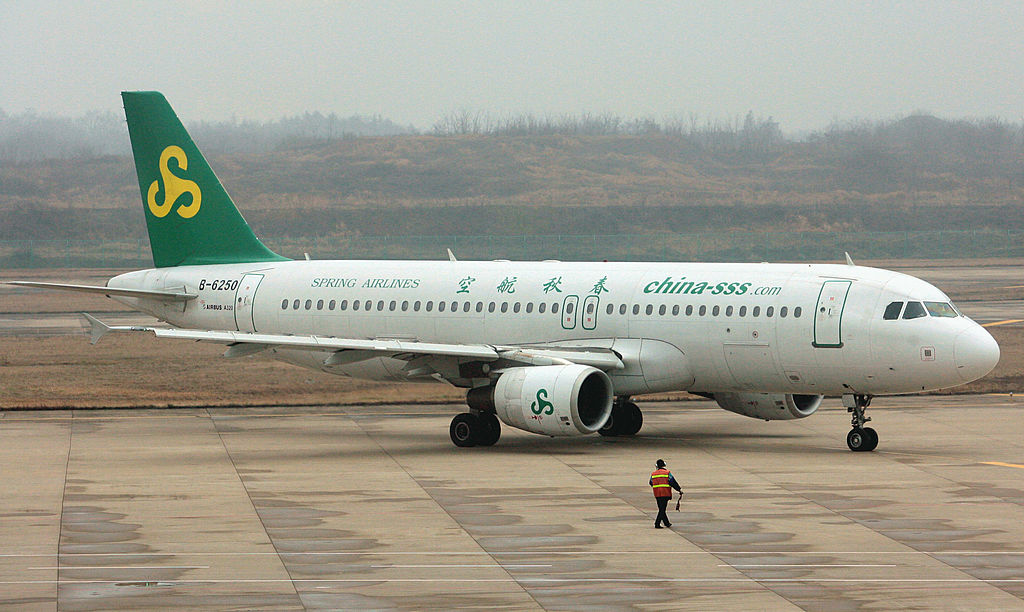
On October 14, the stock price of the mainland low-cost airline Spring Airlines fell to 37.84 yuan during trading hours, approaching its low in 2022. On the 15th, the closing price was about 17% lower than the company’s latest round of repurchase average price, with a sharp year-on-year decline of 87.91% in the net profit attributable to the parent in the second quarter.
According to a report from the “Daily Economic News” on October 15, Spring Airlines hit a low of 37.84 yuan (RMB) during trading on the 14th, close to the 37.33 yuan in May 2022. On the 15th, the stock closed at 39.01 yuan, rising by 1.04% that day.
The company’s repurchase announcement shows that in the latest round of repurchase initiated in April and completed in July this year, approximately 10.6388 million shares were repurchased, costing about 500 million yuan, with an average price of 46.99 yuan per share. The closing price on October 15 was about 17% lower than the average price of this repurchase.
Since 2022, Spring Airlines has spent approximately 1.5 billion yuan on five rounds of repurchases. The first four rounds were used for employee shareholding or equity incentives, while the most recent round, about 500 million yuan, was said by the company to be used for “maintaining the company’s value and shareholder rights.”
The semi-annual report of Spring Airlines shows that the operating income for the first half of this year was 12.336 billion yuan, a year-on-year increase of 19.72%; the net profit attributable to the parent was 1.042 billion yuan, a year-on-year decrease of 10.81%.
In the second quarter, the operating income was 6.266 billion yuan, a year-on-year increase of 25.64%; however, the net profit attributable to the parent was only 59.4439 million yuan, a sharp decline of 87.91% compared to the same period last year.
In the semi-annual report, Spring Airlines mentioned that since March, international oil prices have risen rapidly due to escalating geopolitical conflicts and other factors, with significant fluctuations in aviation kerosene prices. In the first half of the year, the company’s aviation fuel costs reached 4.58 billion yuan, an increase of 53.7% year-on-year; the average domestic aviation fuel purchase price rose by 38.5% year-on-year.
In a research report on September 8, CMB Securities stated that Spring Airlines’ operating costs in the second quarter increased by 40.1% year-on-year, higher than the 25.6% growth rate in operating income for the same period, as rising aviation fuel costs squeezed profit margins.