
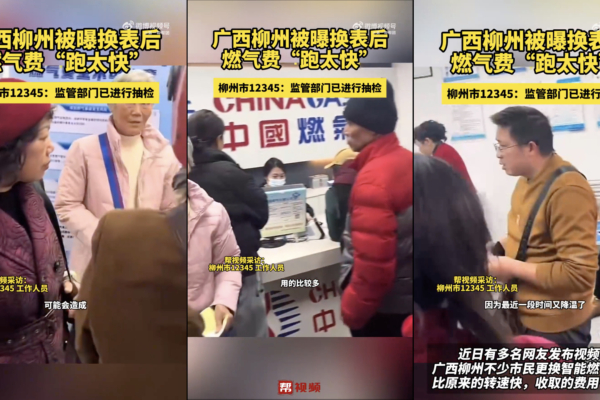
Recently, many residents in Liuzhou, Guangxi, have reported that after their gas meters were replaced with smart meters, the meters “run very quickly” and their gas bills have significantly increased. Some netizens have posted videos claiming that the Liuzhou Gas Company’s service halls are crowded with residents demanding to switch back to mechanical meters. This topic has become a hot discussion online.
Employees of the Liuzhou Gas Company explained that the reason for the “fast-running gas meters” is that after the replacement, users are more sensitive to the instant changes in the numbers. They stated, “The meter was changed during winter, when gas usage is higher than usual, hence the increase in costs.”
According to Southern Metropolis Daily, Liuzhou officials had previously announced that from mid to late October 2024, the Liuzhou Gas Company would gradually carry out a “safety upgrade” of gas facilities for residential users in segmented areas. This includes replacing gas IoT meters, installing gas alarms, valves, self-closing valves, or replacing metal bellows.
The announcement also mentioned the “benefits” brought by the replacement of the gas meters for residents: enabling online gas purchasing, eliminating the need for gas companies to manually read meters at homes, reducing the inconvenience to residents.
During a coordination meeting for the gas smart meter replacement on January 2, Deputy Mayor of Liuzhou Chen Wenmin introduced that the Liuzhou Gas Company had initiated a gas facility replacement program for about 460,000 users citywide, with nearly 400,000 smart meters replaced. By the end of December 2024, 120,000 meters had been successfully replaced.
However, Jimo News expressed that although smart meters bring these benefits, what users are more concerned about is the issue of measurement, as it directly impacts their expenses in a practical way.
The abnormality of gas meters in Liuzhou has sparked discussions among many internet users.
A netizen from Henan expressed concerns about the possibility of remote data manipulation with smart meters, leading to increased fees for water, electricity, and gas across the country after the meter replacement.
A netizen from Guangdong suspected collusion between gas companies and meter manufacturers to intentionally overcharge consumers. They believe that the purpose of replacing meters is to increase charges, which is a typical industry practice.
Users in Liaoning are debating the meter problem, pointing out that extra air and other gases mixed into the gas supply can alter the heat value, leading to increased costs despite the same metering. They emphasize the need for fair billing practices.
A netizen from Chongqing suggested a method to test the accuracy of gas meters by simultaneously connecting an old and new meter to the same gas pipeline, burning gas at the maximum setting for an hour, and comparing their readings.
A user from Jiangsu recounted their interactions with a gas service worker who acknowledged the issue of fast-running smart meters after the user complained about the monthly fee increase. These incidents are indicative of a broader trend of deceptive practices in the current environment.
According to the official website of China Gas, Liuzhou Gas Company is a subsidiary of China Gas Holdings Limited, one of the largest comprehensive energy supply and service companies in China, serving urban populations exceeding 200 million.
Since early 2024, residents in Chongqing, Sichuan, Jiangsu, Anhui, Jiangxi, and other regions have also reported situations where gas meters showed abnormal surges in gas usage and significant fee hikes after replacements.
Reported by mainland media such as Securities Times, on April 17, 2024, well-known screenwriter Li Yaling raised concerns about abnormal gas meter readings at her home in Chengdu.
Li Yaling posted on social media that from January 13 to March 9, while she was in Hainan with her mother, their home in Chengdu showed a gas usage of over 500 cubic meters and a gas bill of nearly a thousand yuan. After raising the issue in a homeowners’ group, many residents found similar problems with their gas meters.
A resident of Tianfu New Area in Chengdu discovered a gas bill of over two thousand yuan after returning from a three-month trip to the United States. Another neighbor compared their gas bills from March and April last year to this year and found a 50% increase in gas costs for the same usage.
Some residents noticed official data indicating that China’s total electricity consumption exceeded the total electricity generated by 294.6 billion kilowatt-hours.
According to data from the National Bureau of Statistics of the Communist Party of China, from January to November 2023, electricity generation reached 80,732 billion kilowatt-hours, a 4.8% year-on-year increase. However, the National Energy Administration of the Communist Party of China reported that during the same period, China’s total electricity consumption accumulated to 83,678 billion kilowatt-hours, a 6.3% year-on-year rise.
The discrepancy between total electricity consumption and generation has stirred discussions on various mainland social media platforms. Many netizens are blaming smart meters for this issue, suggesting that flaws in smart meters have led to the situation where electricity consumption surpasses generation. Meanwhile, officials from the National Development and Reform Commission of the Communist Party explained that the different statistical methods used by the two institutions account for the variance.