
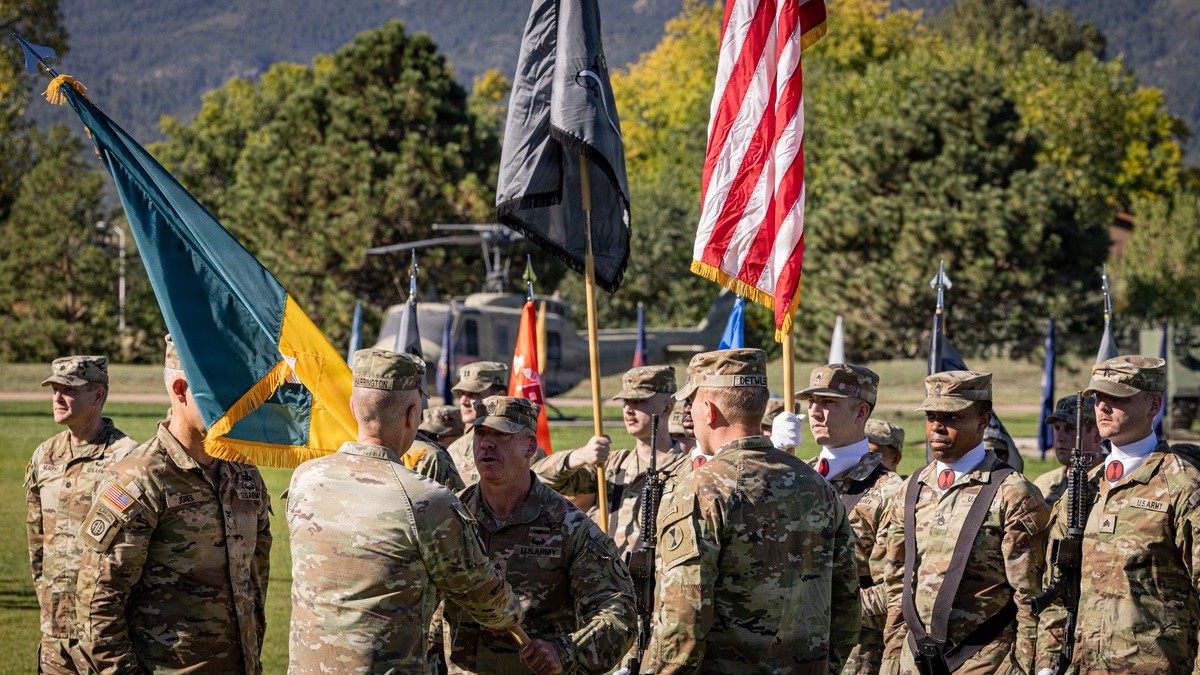
The US Army has recently established the 4th Multi-Domain Task Force to counter China’s “anti-access” strategy, which aims to prevent the US and its allies from entering the Western Pacific region and providing reinforcement to defend Taiwan.
On October 8th, the US Army announced on its official website that the 4th Multi-Domain Task Force was activated at Fort Carson in Colorado.
According to the announcement, this task force is designed to coordinate long-range precision firepower strikes and related operational effects to disrupt and disperse complex enemy Anti-Access/Area Denial (A2/AD) networks.
The 2100-strong new force, under the Pacific Multi-Domain Command (MDC-PAC), will focus on the Indo-Pacific region and provide diversified and robust options covering all domains of operation, including land, sea, air, space, and cyberspace.
The 4th Multi-Domain Task Force Commander, Colonel Hugh Jones, stated during the activation ceremony, “We are building this force to deter aggression and maintain peace. If war breaks out, we must be prepared to fight and win. We have a responsibility to provide every possible advantage to those in harm’s way while leaving the enemy with nowhere to escape or hide.”
USNI News reported on October 13th that the Army describes Multi-Domain Task Forces as forces that counter evenly matched adversaries in an increasingly complex global environment. These forces are equipped with long-range missiles and include electronic warfare, intelligence collection, and air defense units.
Prior to this, similar forces were established in Washington State, Germany, and Hawaii. With the activation of the 4th Multi-Domain Task Force, the US Army now has three units specifically aimed at countering China’s “anti-access/area denial” strategy.
According to the US Army’s 2024 plan, five Multi-Domain Task Forces will be deployed globally, with three units under the US Army’s Pacific Command. The deployment timing of these forces and whether they are equipped with the Typhon medium-range missile system have not been officially disclosed.
China’s “anti-access/area denial” strategy aims to block US forces from coming to Taiwan’s aid, with the goal of controlling the enemy’s access to the operational environment and restricting enemy freedom of action in the region.
Analysts cited by the South China Morning Post on Thursday, October 15th stated that China’s “anti-access” strategy is designed to detect and target approaching US ships and aircraft using a network of long-range missiles, advanced radars, satellites, and communication systems to deter or attack enemy forces and block US military operations.
The US-established Multi-Domain Task Forces will integrate long-range precision strikes with intelligence, network, space, and electronic warfare capabilities, launching operations from dispersed land bases to identify China’s radar, command facilities, and missile launchers, disrupt communications, and target critical infrastructure with land-based missiles.
US Pacific Multi-Domain Command Commander Major General Bernard J. Harrington stated in June that the command plans to utilize unmanned surface vessels, long-range strike drones, and other means to break through the adversary’s blockade network.
He emphasized that every radar emitting a signal and every information-transmitting node belonging to China would always be at risk of being struck.
The General also highlighted the use of artificial intelligence (AI) by the command to shorten the time required for processing commands.
Timothy Heath, a China expert and head of the defense consulting firm Perceptum, mentioned that mobile missile launchers can be hidden in vegetation or buildings, forcing the Chinese military to expend significant resources searching and constantly guarding against ambushes.
In recent years, the US military has been continuously practicing methods to counter China’s “anti-access” strategy.
In 2024, during the Valiant Shield exercise in Palau, the 3rd Multi-Domain Task Force used unmanned launchers to fire missiles at a moving maritime target.
In the same year, the 1st MDTF deployed the Typhon medium-range missile system to the Philippines.
In 2026, the 3rd MDTF brought the Typhon missile launchers and HIMARS rocket artillery to the Japan’s Naha Air Base for exercises.
Chinese Foreign Ministry spokesperson Guo Jiakun criticized the Typhon missile system as a “strategic offensive weapon” in May, warning that its deployment in Japan would increase regional tensions and military competition.
In March, three US Army colonels, including Colonel Ben Blane from the Modern War Institute at West Point, warned that the US military’s Multi-Domain Task Forces must establish forward positions, intelligence networks, and logistics systems before conflicts erupt. Failure to do so could lead to the Army becoming bystanders in the most consequential conflicts in the Indo-Pacific region.