
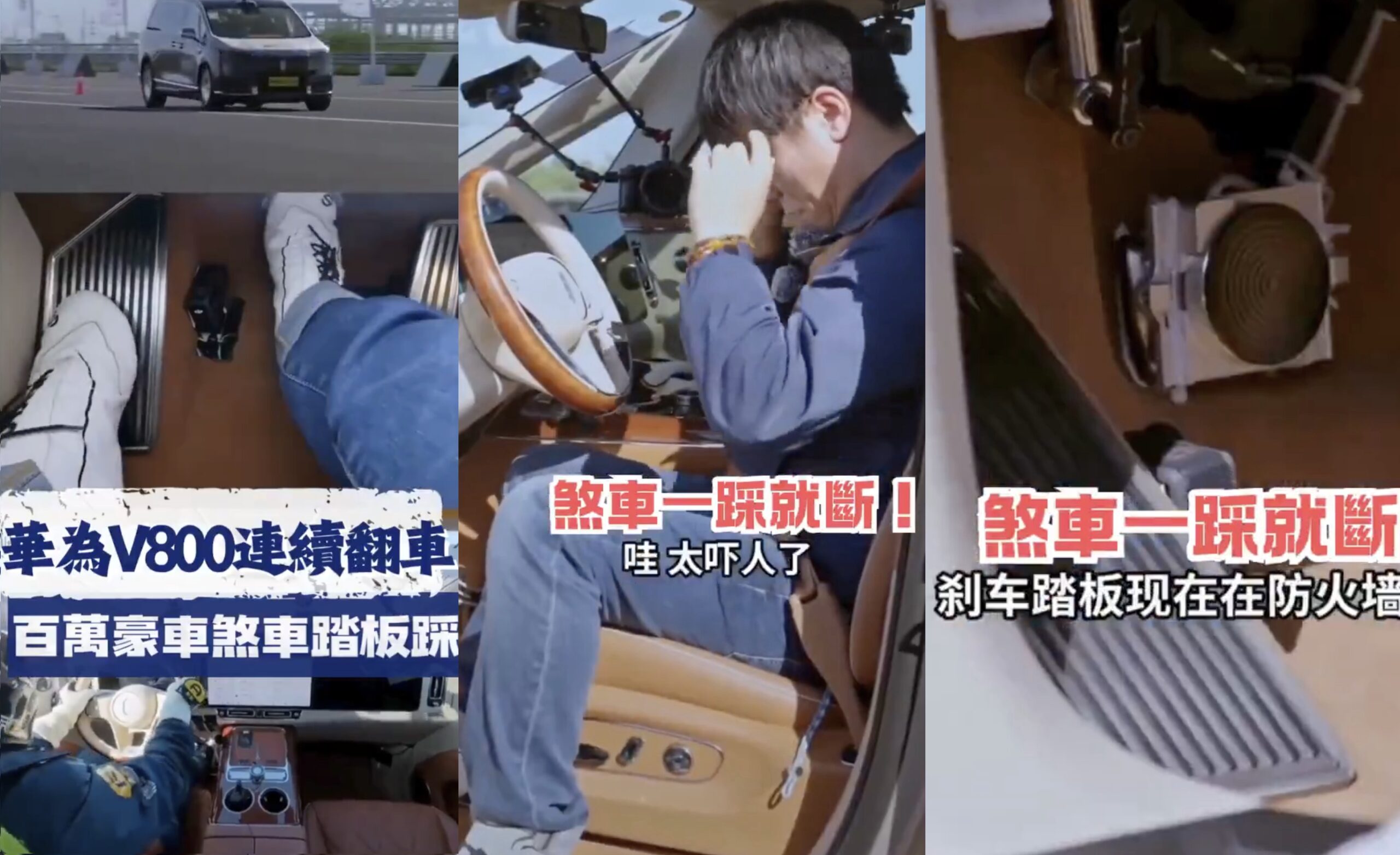
Huawei and JAC Motors jointly launched the luxury car brand Zunjie. The controversy over the brake pedal bracket of the V800 model continues to escalate. On October 13, Zunjie released a third-party static testing report, stating that the V800 brake pedal meets industry standards and no damage was found even under rigorous testing. However, the “Car Expert” who previously released the testing video immediately responded, questioning whether the static bench test can represent the dynamic impact of emergency braking in real driving conditions and requested further testing with mass-produced vehicles.
Zunjie’s “Zunjie V800 Brake Pedal Testing Explanation” released on October 13 stated that on October 11, a nationally accredited third-party inspection agency conducted tests on the V800 brake pedal. The tested samples met the relevant requirements of the automotive industry standard QC/T 788-2018 under a longitudinal force of 1,500 newtons. Further increasing the longitudinal force to 3,000 newtons and visually inspecting 14 sets of brake pedal assemblies, no cracks or damage were found. Nevertheless, they promised to provide free brake pedal upgrades for owners in November.
In response to the test results, the Car Safety Content Manager and participant in the previous test, Dongmen Jiannan, raised doubts on his Weibo account, questioning whether the static loading can reflect the instantaneous dynamic impact of emergency braking in real driving conditions.
He pointed out that the test used a slow loading rate of 20 millimeters per minute, which is different from the force generated during emergency braking at high speeds, especially with Polypropylene with 40% Glass Fiber (PP+GF40) material, which exhibits differences in performance under static and dynamic loads.
Dongmen Jiannan stated that companies have the testing facilities, vehicles, equipment, and personnel to randomly select mass-produced vehicles and conduct continuous emergency braking tests at 100 kilometers per hour to verify real-world performance.
Regarding the test data, he highlighted that sample number 01002 had a permanent deformation of 4.07 millimeters under a force of 1,500 newtons, which was close to the standard limit of 5 millimeters. He questioned the lack of sample photos, videos, before and after comparison of samples, and even doubted if the parts tested were current production components of mass-produced vehicles.
Zunjie has yet to publicly respond to Dongmen’s questioning and has not announced whether they will conduct dynamic retesting on actual vehicles.
The Securities Times learned that the testing was conducted by the China Automotive Engineering Research Institute Testing Center. When asked about the report number, the staff confirmed that the report was issued by the center but mentioned that they could not guarantee the authenticity of reports circulating outside. The commissioning party for the report was Anhui Jianghuai Automobile Group Co., Ltd.
The Testing Center staff also confirmed the existence of the report to China Business News but emphasized that the report is only responsible for the samples or vehicles provided by the companies and does not guarantee the safety of the products produced in bulk by the enterprises.
This indicates that the third-party report confirms the performance of specific tested samples under specified testing conditions and does not guarantee the overall safety of mass-produced vehicle brake pedals.
The focal point of the current controversy lies in the testing methods employed by the third party.
Static testing mainly examines the performance of components under specific loads and test conditions, while real vehicle continuous emergency braking involves various factors like instantaneous forces, component structure, installation methods, and the overall braking system.
In response to this official testing report, Red Star News interviewed automotive industry expert and guest professor at the Yellow River Institute of Technology, Zhang Xiang, to analyze issues about the testing data and the discrepancies with previous real vehicle tests.
Zhang Xiang pointed out, “The third-party laboratory bench retest and the previous ‘Car Expert’ real vehicle dynamic test differ significantly in test objectives, pressure application methods, and equipment conditions, so the different test results are not contradictory.”
He explained that the third-party inspection agencies follow national standards, using static bench vertical uniform loading with fixed and precise equipment to verify the parts’ ultimate static load strength. In contrast, the “Car Expert” test was a high-speed dynamic real vehicle emergency braking test to measure the shortest braking distance, where the tester rapidly and forcefully pressed the pedal, leading to a load increase much faster than in the lab.
“Different conditions result in different component stress forms and impact modes,” Zhang Xiang added, stating that the national standard only specifies vertical positive static load testing, unable to cover all real-world scenarios like lateral twisting, dynamic impacts, real vehicle bumps compounded forces, etc. Therefore, a lab pass does not guarantee absolute safety under extreme real vehicle conditions, he said, likening it to vehicle collision five-star ratings, which cannot ensure 100% protection in all traffic accidents.
On October 13, several related topics surged to the top of Weibo hot searches.
Netizens expressed their concerns, with one saying, “It seems that car companies always have a way to cover up. When others conduct tests, they have everything documented. All evidence is likely fixed. But for the sake of verifying their test report, there isn’t any video, photos, not even a report seal. Now, even the testing agency itself says it’s only responsible for the sent sample.”
Automotive blogger “Mishuai Test Driver” commented, “Zunjie immediately sought a third-party test to prove that the brake pedal is fine and complies with national standards! What about the previously mentioned ‘free upgrade’? It’s a mysterious operation, with a mouth tougher than the pedal!”
Tech blogger “The Poisonous Teacher of Tech” said, “The ‘Car Expert’ test, 1612 newtons, all 3 broke. Third-party testing raised to 3000 newtons, no cracks or breaks. Who should we believe? Or which side is more convincing? Let’s look at the tests from these two sides.
“1. Third-party testing: conducted on a bench in the lab, disassembling the pedal assembly, fixed on the testing machine, slowly applying pressure along the specified direction till 3000N.
“2. ‘Car Expert’ test: done on a track, using real vehicles, not just testing the pedal assembly, closer to real-world use. And at 100km/h full brake, a person actually presses the pedal. Besides the direct pedal pressing, there’s also lateral force during the application, mirroring actual emergency braking situations. So, who do you believe more?”
With the ongoing dispute, it is critical for both consumers and automakers to have a clear understanding of the testing methods, results, and implications for ensuring vehicle safety standards are upheld.