
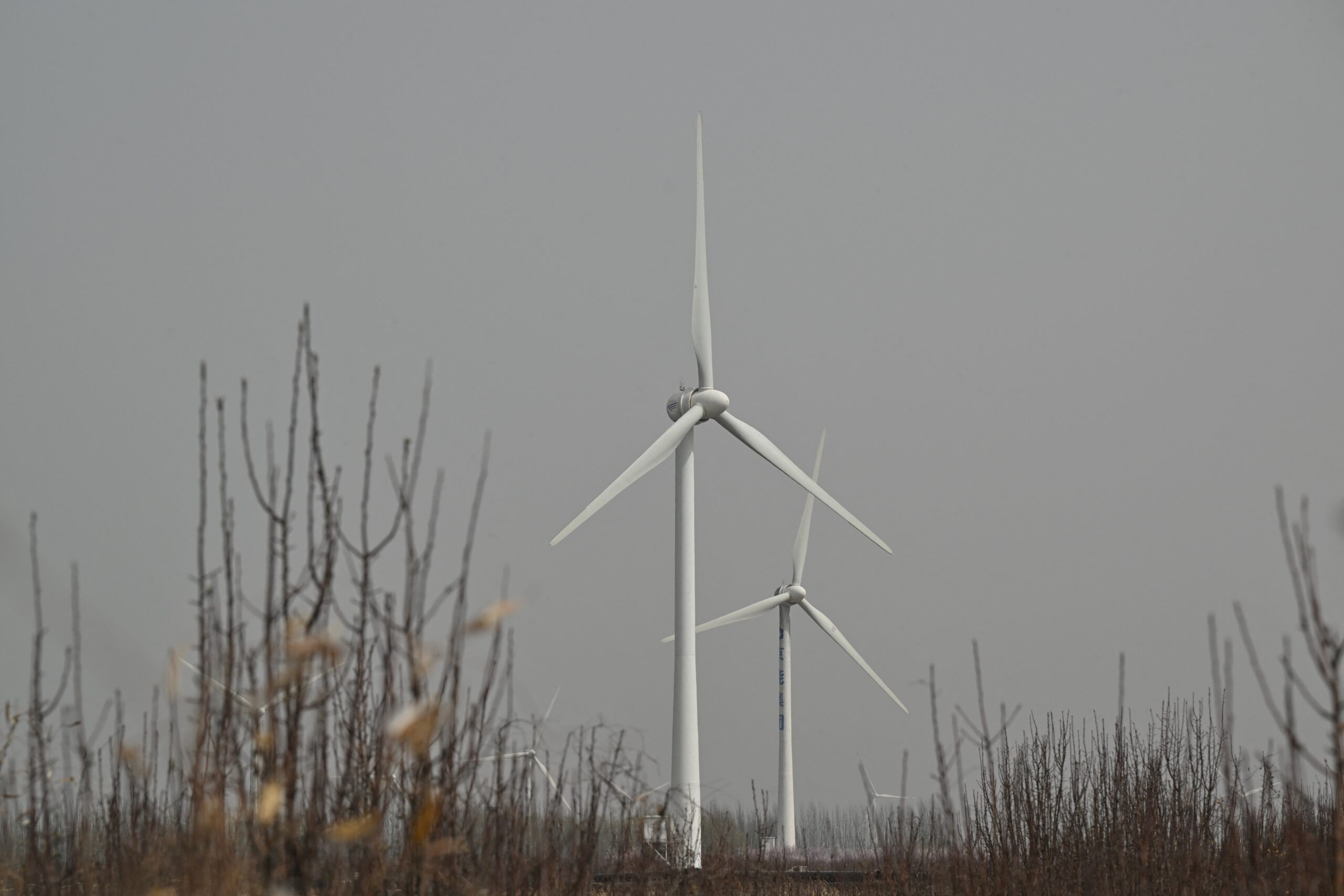
In Inner Mongolia, vast fields of solar panels stretch across the grasslands, and wind turbines stand tall among herds of sheep. Along the roadsides, rows of unused wind turbine blades are stacked, resembling discarded giant fiberglass tusks, while not far away, a large-scale data center is being rapidly constructed.
China is heavily investing in artificial intelligence (AI) infrastructure, aiming to gain an advantage in the technological competition with the United States. However, as the construction of data centers rapidly expands, concerns have been raised about whether some projects can secure an adequate supply of chips and whether there is sufficient market demand.
This situation raises concerns reminiscent of the “ghost cities” left behind after the cooling of China’s real estate boom. Whether the rapid construction of data centers outpaces the supply and actual demand of AI facilities, and whether the massive investment can translate into sustainable economic returns, remains to be seen.
According to a report by CNN on October 13th, Ulanqab in Inner Mongolia is rapidly developing into a major hub for AI data centers in China, with plans to construct nearly 90 data centers. The region boasts vast land, relatively inexpensive electricity, and abundant wind and solar energy resources. Within just two years, large data center parks have quickly taken shape, with companies like Huawei, Kuaishou, and data center service providers setting up operations.
This is part of China’s “East to Compute, West to Store” strategy. Beijing aims to leverage the land and energy advantages in the western regions to cater to the demand for AI computation and cloud services, providing computing power to the eastern regions while absorbing the excess green energy from the west.
However, CNN points out that data centers in some remote areas of China may face issues such as insufficient supply of AI hardware equipment or a lack of users, leading to the emergence of so-called “ghost data centers.” This has also sparked doubts externally about whether China’s massive investment in AI infrastructure can truly translate into economic benefits.
Inner Mongolia has abundant wind energy resources, as well as coal-fired and other power supplies. Some areas have not fully utilized their electricity, and the local cold climate helps reduce the cooling costs of data centers. Moreover, China has the capability to rapidly construct large-scale infrastructure and can expedite data center construction using prefabricated modules.
In comparison, certain regions in the United States are facing bottlenecks in grid access and new power supply. However, even with China’s advantages in land, power, and construction capacity, its data centers may not immediately operate effectively, as the key lies in whether they can obtain a sufficient supply of computing chips.
CNN highlights that the U.S. export controls restrict Chinese companies from accessing certain advanced AI chips, including products from Nvidia and AMD; on the other hand, China also imposes restrictions on the import of lesser-performing chips. While Chinese domestic chip manufacturers are striving to catch up, the performance and supply of advanced chips are still limited.
Nick Corvino, a researcher at the Carnegie Endowment for International Peace, stated, “Chips are one of the most critical factors in the cost of data center construction, and currently, China does not have enough chip supply.”
To enhance computing capabilities, Chinese companies are attempting to use a combination of various chips. However, analysts point out that this approach may consume more power in certain applications, further raising the operational costs of data centers.
Amid the vigorous promotion of AI infrastructure construction, the Chinese Communist Party authorities have also emphasized the need for caution against blind investments and excessive expansion in related industries.
According to a report by Reuters on October 9th, the CPC Central Committee and the State Council issued directives regarding the development of “new quality productivity,” urging caution against blind investments and overexpansion in fostering emerging industries while promoting AI, core technology, and computing infrastructure construction.
The directives call for the establishment of technological monitoring, risk warning, and emergency response mechanisms while strictly holding accountable individuals responsible for significant losses due to blind investments. This reflects China’s challenge in accelerating the development of emerging industries while addressing issues of controlling investment risks and improving the efficiency of fund utilization.
On the other hand, there is still a significant gap in AI infrastructure investment scale between China and the United States.
Beijing recently announced a five-year plan with a budget of $560 billion to expedite the construction of information infrastructure. Research firm Rhodium Group estimates that Chinese listed technology companies’ investment in AI infrastructure will double this year, reaching around $139 billion, but it is still only one-fifth of the expected investment of $800 billion by U.S. tech companies.
China is striving to narrow the gap with the United States in the AI field through massive construction of computing infrastructure. However, the scale of investment alone cannot determine the competition results. Whether the chip supply can keep pace with the construction speed, whether companies have sufficient actual demand, and whether data centers can continually generate economic benefits will all influence the final outcome of this competition.
If infrastructure construction continues to outpace the growth in hardware equipment supply and market demand, China’s massive investments in building data centers may face risks such as equipment idle, lower-than-expected returns on investment, and these data centers might turn into AI versions of “ghost cities.”