
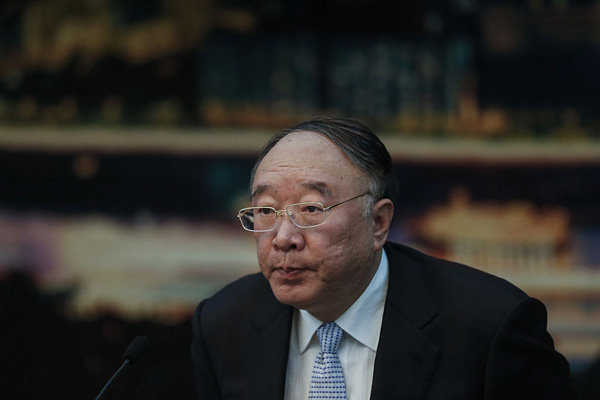
Former Chongqing Mayor Huang Qifan has been retired for nearly 10 years, and rumors about his involvement in a scandal have been circulating ahead of the Fifth Plenary Session. Recently, news emerged that his planned speech was canceled, and there were reports from Hong Kong media vaguely suggesting that he was taken away by relevant authorities.
Hong Kong’s Ming Pao reported on October 13 that the “Forum on Empowering Hangzhou Enterprises with New Quality Productivity for High-quality Development,” organized by the Ningbo Bank’s Hangzhou Branch, was scheduled to take place at a five-star hotel in Hangzhou on the 26th of this month. Former Chongqing Mayor Huang Qifan was invited to be the keynote speaker, but the event was suddenly “canceled for reasons.”
According to Hong Kong media, Huang Qifan, who serves as the vice chairman of the China Center for International Economic Exchanges, was once considered the “super think tank of China.” However, last May, the chairman of the center, Bi Jingquan, fell from power and was sentenced to 14 years in prison for bribery during his tenure at the center. In January of this year, the center’s operational unit was changed from the National Development and Reform Commission to the Chinese Academy of Social Sciences, and an overhaul was initiated.
According to Caixin’s report in February this year, the center was involved in controversial fundraising practices through undertaking local government projects and providing consulting services. It was reported that some retired senior officials working at the center had returned the fees they received, some of which were of substantial amounts.
Another article in Hong Kong’s Sing Tao Daily, on the 13th of the month, mentioned that rumors of high-ranking officials “falling from grace” before the Fifth Plenary Session of the 20th Central Committee of the Communist Party of China, scheduled to be held from October 26 to 29, were circulating. In some chat groups focusing on official personnel news, netizens speculated on the latest “tigers” to be purged based on rumors or “insider information.”
The article stated that several “popular candidates for downfall” yesterday included a deputy party secretary from a western province, a mayor from a northwest province, and a figure related to a mountain city, among others. The most widely circulated rumor pointed to a “former mayor” who had been retired from the National People’s Congress for over 8 years. Chat records indicated that a scholar had revealed that the “former mayor” was supposed to give a lecture at Tsinghua University yesterday, but was taken away the day before, leading the scholar to be called in to substitute as a speaker.
The “former mayor” had worked at the Internet Industry Research Institute at Tsinghua University after retirement, and even attended an expert forum at the institute in June this year. If the rumors are true, it would once again confirm the “curse of the mountain city.”
The Sing Tao Daily article did not explicitly state the identity of the official involved in the incident.
Huang Qifan, the former mayor of Chongqing, currently serves as the vice chairman of the China Center for International Economic Exchanges, chairman of the Industry Transformation Advisory Committee of the Internet Industry Research Institute at Tsinghua University, co-chairman of the Lundy International Think Tank Expert Committee, and academic advisor to the China Finance 40 Forum (CF40).
Now 74 years old, Huang Qifan is a controversial figure who rose to prominence in Shanghai earlier in his career. He was a close associate of former Politburo Standing Committee member Wu Bangguo of the Jiang faction, and held positions such as Deputy Secretary-General of the Municipal Party Committee and Director of the Party Committee Research Office. In October 2001, Huang Qifan was transferred to Chongqing as the Deputy Mayor, and the following year was promoted to the Standing Committee of the Chongqing Municipal Party Committee, overseeing finance, taxation, and other areas of work. In January 2010, he became the Mayor of Chongqing under the leadership of the then Municipal Party Secretary Bo Xilai, who was regarded as the heir apparent of the Jiang faction.
After the Chongqing incident erupted in early 2012, Huang Qifan was implicated in the matter. During the 2012 National People’s Congress, Mayor Huang described his relationship with Bo Xilai to the media by saying, “Our cooperation is seamless, as comfortable as a fish in water, getting along well and enjoying ourselves.” However, Huang Qifan was not affected by the Bo case and continued in his position.
Subsequently, Huang Qifan partnered with Sun Zhengcai. Before Sun Zhengcai was purged in July 2017, Huang Qifan was appointed Vice Chairman of the National People’s Congress Financial and Economic Affairs Committee in February 2017. On January 18, 2018, Huang Qifan was demoted to a member of the Chongqing CPPCC. Following this, he was successively voted out of the National CPPCC and the National People’s Congress.
During Chen Min’er’s tenure as Chongqing’s leader, he publicly criticized Bo Xilai and Sun Zhengcai multiple times, accusing Bo Xilai of establishing an “independent kingdom” and Sun Zhengcai of “lazy governance and deceitful actions.” Bo and Sun were publicly accused of “conspiring to usurp the party.” At the time, commentary from Hong Kong media suggested that Huang Qifan’s downfall was somewhat linked to the “residual poison” left by Bo and Sun.
Chongqing, where Huang Qifan worked for a long time, has undergone a series of purges in official circles over the past decade, leading to descriptions in the media and by netizens of the city being ensnared in a “curse.”
The city has had eight Public Security Bureau directors since it came under direct governance in 1997: Chen Bangguo, Zhu Mingguo, Liu Guanglei, Wang Lijun, He Ting, Deng Huilin, Hu Minglang, and Zhang Anjiang.
On the evening of May 7 this year, the Chongqing authorities suddenly announced the death of Deputy Mayor and Public Security Bureau Director Zhang Anjiang at the age of 55 “due to an unexpected illness that was unable to be treated.” However, online rumors suggest that he died from jumping off a building.
Among the former Public Security Bureau directors, four have been purged, namely Zhu Mingguo, Wang Lijun, He Ting, and Deng Huilin, with Wang Lijun, He Ting, and Deng Huilin falling from power while serving in Chongqing.
In early November 2019, the Chongqing authorities also announced the passing of Deputy Secretary of the Chongqing Municipal Party Committee Ren Xuefeng due to illness, but online rumors claimed that Ren Xuefeng had died from falling off a building at the Jingxi Guesthouse in Beijing during the Fourth Plenary Session of the Nineteenth Central Committee.
In recent years, the “cleansing of the residual poison of Bo Xilai and Sun Zhengcai” in Chongqing has resulted in the investigation of vice-ministerial-level officials, including former Deputy Mayors of Chongqing Xiong Xue and Jiang Duntao, former Deputy Director of the Chongqing People’s Congress Zheng Hong, former Standing Committee Member of the Chongqing Party Committee and Secretary of the Politics and Law Committee Lu Kehua, and former Vice Chairman of the Chongqing CPPCC Duan Chenggang. Former Chairman of the Shanxi Provincial CPPCC Wu Cunrong, who once served as Executive Vice Mayor of Chongqing, was also implicated. Tang Liangzhi, a former Mayor of Chongqing, was reassigned after being demoted as Chairman of the Anhui CPPCC, and later resigned from his post this year to become Deputy Director of the Education, Science, Health and Sports Committee of the National CPPCC.
This year, former Deputy Secretary of the Chongqing Municipal Party Committee and Mayor Hu Henghua was announced to be under investigation on March 20, and the former Standing Committee Member of the Municipal Party Committee and Secretary of the Liangjiang New Area Luo Lin was purged on April 17. Both Hu Henghua and Luo Lin were reportedly involved in a major case related to “China’s LED King,” Lin Xiucheng.