
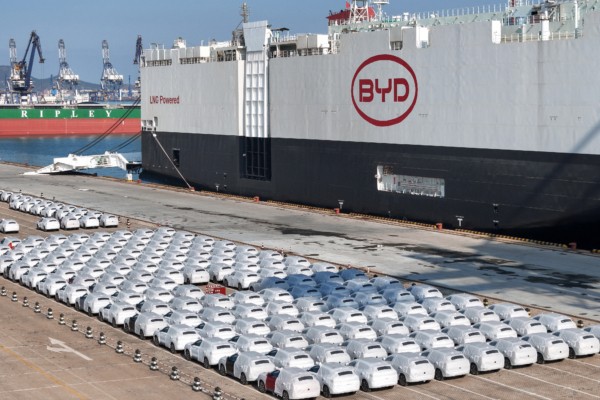
【Epoch Times, September 9, 2026】With the bursting of the real estate bubble and weakened domestic consumption in China, the Beijing authorities have shifted growth momentum in recent years towards the “new three items” industry composed of electric vehicles, lithium batteries, and solar energy components. However, this growth driven by abundant national resources has failed to effectively boost domestic demand and instead triggered a price war due to excess production capacity.
This internal “domestic demand crisis” has transformed into an export flood sweeping across the globe, sparking strong international trade backlash and security concerns. The “new three items” have thus become the eye of a new global trade protection storm.
In recent years, officials and media in China have frequently promoted the “new three items” (electric vehicles, lithium batteries, and solar energy), declaring their comprehensive replacement of the previous export structure focused on clothing, furniture, and home appliances.
The latest statistics from the Chinese National Bureau of Statistics show that in 2025, China’s new energy vehicle production reached 16.52 million vehicles (up 25% annually), solar energy production reached 832.743 million kilowatts (up 7.6% annually), industrial robots reached 770,000 sets (up 28% annually), and integrated circuits amounted to 484.2 billion yuan (up 10.9% annually). The total value of goods exported in 2025 reached 27 trillion yuan, with a trade surplus of 8.5 trillion yuan. The new three items have become the absolute driving force of exports.
Data from international institutions also confirm China’s monopoly position in the new three items field.
A report by the International Energy Agency (IEA) shows that in 2025, the global production of electric vehicles nearly reached 22 million vehicles, of which China accounted for nearly 75% (approximately 16 million vehicles), with exports doubling to over 2.5 million vehicles.
In the battery sector, research firm SNE Research’s statistics show that in 2025, global battery installations reached 1,187 gigawatt-hours (GWh), with CATL holding the top market share at 39.2%, followed by BYD at 16.4%, together accounting for 55.6% of the global market. Among the top ten battery manufacturers, six are Chinese companies.
In the solar and wind sectors, this concentration is even more extreme. Data from the Global Wind Energy Council (GWEC) shows that in 2024, China accounted for nearly 68% of global wind power installations, ranking first globally. The IEA pointed out that China’s cumulative photovoltaic installation capacity is close to half of the global total. Consulting firm Wood Mackenzie further pointed out that China’s production capacity in the four production segments of photovoltaic cells, modules, polysilicon, and silicon wafers accounts for over 80% of global capacity.
Regarding this “number one scale” production capacity myth, commentator Li Jun bluntly stated that it is not based on original technological innovation but relies on the expansion of production capacity driven by state power. He said, “Concentrating all economic elements, manpower, and material resources on one point to do something is not difficult as long as it is not innovative.”
Using electric vehicles as an example, Li Jun pointed out that their prosperity is fundamentally a result of “copying homework” after the introduction of foreign companies, “It is not China’s innovation but Tesla’s innovation. After introducing it, they learned and copied it, and in just over a decade, they got it started.” He warned that in the absence of an exit mechanism, this rampant influx of production, “The inevitable result in the end is everyone turning inward and ending up with nothing.”
American economist David Huang analyzed that Beijing’s bet on the “new three items” is an attempt to transition China from being the “world’s factory” to the “world’s high-value factory.” Cars, as a leading industry that can drive a huge industrial chain, have become the choice to bypass traditional fossil fuel vehicle technology barriers and achieve “overtaking on a curve.” He emphasized that the “new three items” are primarily an industrial upgrade, and secondarily a green revolution.
However, this model has fatal flaws. Huang stated that for the past thirty years, the Chinese economy has heavily relied on real estate development, which, although the bubble has grown, fundamentally created “domestic demand” that could drive interior decoration, home appliances, and generate wealth effects.
But the “new three items” are completely different, Huang pointed out: “China has produced tens of millions of new energy vehicles, the majority of global power batteries, and photovoltaic components, but cannot digest them domestically and must ultimately sell them to foreigners.”
He stressed that the Chinese economy is currently undergoing an extremely high-risk model replacement: “In the past, it relied on the Chinese people continuously buying houses, and now it increasingly relies on foreigners continuously buying Chinese products. This is the biggest weakness of the new growth model.”
When supply expansion far exceeds domestic consumption capacity, the remaining domestic production capacity becomes a brutal price war. In the field of electric vehicles, massive government subsidies play a crucial background role.
In a report released in June 2024, researcher Scott Kennedy from the US think tank Center for Strategic and International Studies (CSIS) estimated that from 2009 to 2023, the Chinese government’s cumulative support for the electric vehicle industry reached a whopping $230.9 billion. These subsidies reshaped the competitive environment, leading to nearly two hundred domestic electric vehicle manufacturers still fiercely competing in the market, normalizing structural overcapacity.
This “bloodshed competition” is even more alarming in the battery and solar energy sectors. Bloomberg New Energy Finance’s research showed that by 2025, the average price of battery packs in China had dropped to $84 per kilowatt-hour, more than 30% lower than in Europe and the US. This significant price difference is primarily due to excess battery cell production capacity, with China’s energy storage battery capacity nearly twice the global actual demand.
In the solar energy sector, an analysis released by Wood Mackenzie in November 2023 showed that the average price of Chinese photovoltaic components had dropped to as low as $0.07 to $0.09 per watt, causing significant losses for manufacturers. According to PV-Tech, in just the first half of 2025, the combined losses of the four major Chinese component manufacturers reached a staggering $1.54 billion.
This production frenzy has led to a tsunami of business closures and layoffs. In August 2025, Reuters revealed that five major photovoltaic leaders in China, including Longi Green Energy, Tongwei Solar, JA Solar, JinkoSolar, and Trina Solar, collectively reduced around 87,000 jobs in 2024, with a 30% layoff rate. Since 2024, over 40 solar energy companies have announced delisting, bankruptcy, or acquisition due to losses.
In the electric vehicle sector, the consequences of overcapacity are directly impacting local governments and consumers. Nezha Auto, which once topped the sales charts among new carmakers, accumulated financing of up to 22.8 billion yuan, including over 8 billion yuan from local state assets. Due to intense price competition, the company filed for bankruptcy in June 2025. According to First Financial, its confirmed debt in the first batch amounted to 5.1 billion yuan, with potential debts exceeding 26 billion yuan, and overdue employee salaries amounting to 460 million yuan, leaving 400,000 owners facing post-sale predicaments.
Another company, Weimar Auto, with accumulated financing of 35 billion yuan, failed in its restructuring efforts. The car’s Internet of Vehicles system was entirely cut off in June this year, rendering the vehicles useless. Its accounts receivable, with a book value of 87.44 million yuan, tragically sold for a mere 106,100 yuan at auction.
Consulting firm AlixPartners estimated that out of the current 129 electric vehicle brands in China, only 10 to 15 will survive by 2030, with 90% of the brands being eliminated.
Why, in the face of massive losses, does China’s production capacity expansion continue unabated? Li Jun attributes this to the “absence of systemic exit mechanisms” and the “dominance of power will over market laws.”
In contrast to Apple’s decision to terminate its car manufacturing project after a decade of investment of billions of dollars due to an inability to turn a profit, Li Jun pointed out, “Apple can stop losses when the outlook is unclear. However, the Chinese system is top-down planning. If they point you in a direction, regardless of profitability, you have to throw money at it, even if you are not making money.”
Under the logic of “strengthening, improving, and expanding” and local governments gambling on the performance of their policies, new capital continues to flow in. Official data shows that in the first seven months of 2026, investment in electronic circuit manufacturing increased by 57.7% year-on-year, lithium battery investment increased by 23%, while overall fixed asset investment in China decreased significantly by 6.7% during the same period.
On August 26, the Chinese Ministry of Industry and Information Technology deployed a new round of “emerging pillar industries” (integrated circuits, new energy storage, etc.) and “future industries” (quantum technology, embodied intelligence, etc.), once again deeply aligning them with national-level funds such as the Phase III of the Big Fund (646.87 billion yuan).
Analysts believe that this mechanism attempting to bypass market regulation and foster emerging industries through administrative measures mirrors the administrative logic that drove the severe overcapacity in the photovoltaic and electric vehicle industries in the past.
With excess production capacity being forced into the global market, the international community is experiencing unprecedented strong repercussions from the “China Impact 2.0.” Customs data from July 2026 shows that Chinese exports surged by 23.9% year-on-year, reaching a staggering trade surplus of $112.5 billion, yet during the same period, total retail sales of social consumer goods increased only slightly by 0.6%, with a 19.2% contraction in real estate investment in the first seven months.
Reuters summarized it as, “Factories are busy, consumers are not buying, and exports are booming,” demonstrating that Beijing is shifting the domestic demand crisis onto the global stage.
In its annual report in November 2025, the US-China Economic and Security Review Commission pointed out that in 2024, China’s production capacity of fossil fuel vehicles had doubled domestic demand, while solar cell production capacity exceeded global demand by more than double. OECD data released in June 2026 also showed severe global steel overcapacity, with the median subsidy received by Chinese steel traders being 15 times higher than in other regions.
This flood of dumping has triggered unprecedented strong backlash from the international community, with Western countries instituting three main retaliatory tracks:
Punitive tariffs by industry: The US raised tariffs on Chinese electric vehicles to as high as 100%, solar panels to 50%, batteries, steel, and aluminum to 25%; the EU imposed up to a 45.3% anti-subsidy tax on Chinese electric vehicles; the US also imposed high punitive tax rates on Chinese solar products rerouted through Southeast Asia.
Special 301 investigations on overcapacity: The US has launched investigations into 21 industries, including automobiles and steel, considering adding “overcapacity tariffs.”
Special investigations on forced labor tariffs: the US has imposed additional tariffs of 10% to 12.5% on Chinese goods on top of existing tariff rates.
David Huang, the scholar, pointed out that in the future, especially for intelligent electric vehicles, they will face political barriers that are even more challenging to overcome than tariffs, such as “control rights review” and “national security barriers.”
Huang analyzed that intelligent electric vehicles are equipped with functions such as positioning, cameras, and remote upgrades. After the Russia-Ukraine war, Europe and the US have elevated their security concerns for intelligent vehicles to a national security level. Vehicle safety now consists of two levels: mechanical vehicle safety and “who ultimately has the ability to control the vehicle.” If vehicles have remote servers and software backdoors, there are inevitably risks of data leakage and misuse of supply chain control.
“In the future, the most severe restrictions by Europe and the US are likely not tariffs but control rights reviews: Where does vehicle data go? Who controls the servers? Can the vehicle functions be remotely shut down in extreme cases?” Huang pointed out that if national security is at stake, price becomes irrelevant.
Additionally, Chinese car companies must also face heavy institutional costs, aftermarket maintenance costs, and environmental costs overseas, which would weaken their role in driving the domestic economy by building factories abroad. The real issue with China’s ongoing model replacement is not the inability to produce but rather “overproduction.”
Huang further explained that the previous real estate model crashed against high leverage debt limits, while the new three items’ production output model is recklessly pushing against the global market capacity, trade protection, and national security bottom lines.
He bluntly stated that this “spiraling inward destiny” is simply repackaging yesterday’s excessive real estate investments into today’s overinvestment in manufacturing, and forcibly exporting and shifting the domestic economic imbalances to the entire world.