
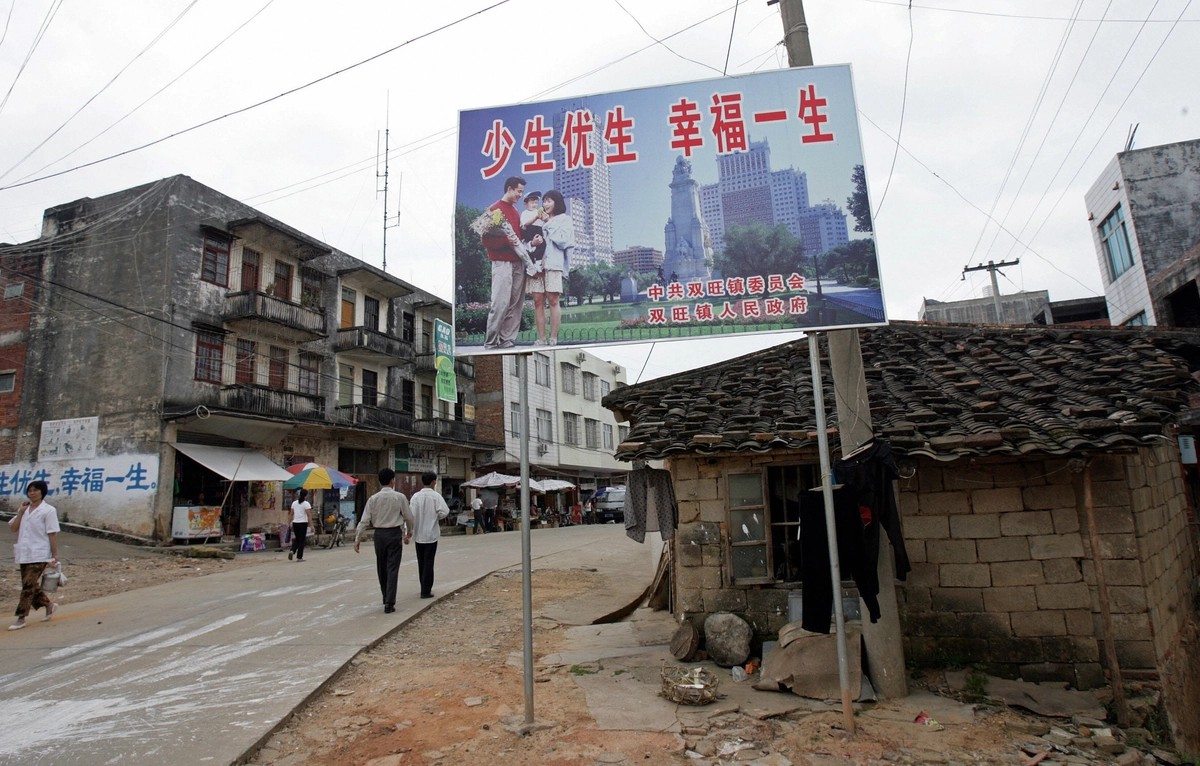
Currently, a quiet revolution against the Chinese Communist Party’s forced birth control policy is underway, and the authorities are powerless in the face of it.
For decades, the CCP has devalued traditional families, treating people as units of the national economy, blaming China’s poverty and backwardness on marriage and childbirth. Since coming into power in 1949, the CCP has attacked traditional values, punishing those who defy its laws, depriving happiness from marriage, family, and women themselves.
Now Beijing is facing the consequences of its own actions.
China’s population is rapidly declining, and the “pro-family” policy recently promoted by CCP leader Xi Jinping to encourage women to marry and have multiple children is facing resistance: women are not buying it. Chinese women are rejecting marriage, choosing to be childfree, prioritizing their careers over the state’s demand, ignoring the three-child policy. Women are quietly initiating a revolution against the CCP’s forced birth control policy.
Two generations of Chinese women have witnessed their mothers sacrifice their careers and autonomy under the one-child policy. Now, educated urban women are reluctant to follow the same path. The soaring housing prices, the brutal youth employment market, and the enormous economic burden of raising children – costing nearly $85,000 on average until the age of 17 and about $96,000 until college graduation – are among the reasons for women’s resistance.
Career development obstacles and workplace gender discrimination have exacerbated this dilemma. As a result, a generation either remains single, delays marriage indefinitely, or chooses what the official media delicately terms as “two-sided marriages” – a modern family cooperation model that divides family responsibilities, discarding the traditional dowry system.
A demographer at Renmin University of China pointed out that in the past decade, the marriageable population in itself has decreased by about 64 million people. But numbers alone cannot explain this phenomenon – people’s attitudes have undergone equally drastic changes.
The magnitude of this shift cannot be overstated.
In just 2024, the number of marriage registrations decreased by 20.5%, from 7.68 million pairs to 6.1 million pairs from the previous year – the largest single-year drop since Beijing began tracking this data in 1986 and the lowest total on record.
This trend has not reversed: despite the government providing cash incentives and continuous promotion, the marriage registration numbers in the first quarter of 2025 still decreased by 8% compared to the same period the previous year. Compared to 2014, the number of marriage registrations has decreased by over 50%.
The proportion of adults unmarried at the age of 30 has more than doubled in a decade, from 14.6% in 2013 to nearly 30% in 2023. Meanwhile, the divorce rate shows an opposite trend, with a 1.1% increase in 2024 despite a significant decrease in marriage registrations.
This phenomenon has a serious impact on the fertility rate.
China’s total fertility rate is currently estimated at 0.93 children per woman, far below the 2.1 children needed to maintain population stability, making it one of the lowest fertility rates on record in the world. Just between 2024 and 2025, the birth rate dropped by about 17%, marking the largest annual decline since 1949, when China had just ended the civil war between the Communists and Nationalists.
The worst part is the one-child policy itself.
For over three decades, the CCP has treated marriage and children as economic levers that can be controlled at will by laws. From 1979 to 2015, the CCP imposed heavy penalties, forced sterilizations, and even forced abortions on families violating national quotas.
The impact of this system extends far beyond shaping population curves – over two generations, it has ingrained the idea that children are burdens to be controlled rather than blessings to be welcomed. Now, to achieve its grand goals, the CCP needs a labor force, but it finds that decades of viewing procreation as a national public affair cannot be reversed through policies. A recent government study warned that China’s labor force could decrease by 200 million between 2020 and 2050.
Can traditional values be easily restored – or can they truly be restored?
Xi Jinping’s response is becoming more direct, telling the National Women’s Federation that women must “actively promote a new culture of marriage and procreation” and establish a “new family trend” serving the “national rejuvenation.” Beijing is also supporting this policy with practical measures – providing 3,600 yuan per year to each child under three and implementing childcare subsidies in over twenty provinces.
This policy has not been effective.
Sociologists studying similar national phenomena are not surprised: as a professor at the University of California remarked, once the declining trend in fertility rates is established, monetary incentives have rarely succeeded in reversing the trend.
The deeper problem lies in what the CCP has wrought.
After decades of devaluing children, childbearing women, and family life, reviving a true reverence for family and life cannot be simply rekindled by a decree. Treating procreation as a policy tool rather than a personal, sacred choice only pushes the value of human life towards relativism.
The continuous suppression of independent religious life by the CCP, especially the underground Christian churches – which teach that every individual has inherent value independent of the state’s utility – has destroyed moral pillars. It is these pillars that once imbued family relationships with meaning, rather than reducing them to transactions. A society cannot easily rebuild its culture of life after two generations have been indoctrinated to see children as burdens to be allocated.
Ironically, it is those faith communities persecuted and threatened by the CCP – with Christianity at the forefront – that have successfully placed marriage and family formation as a priority, achieving what state laws cannot through spiritual transformation.
The Population Crisis Brewed by the CCP
Beijing is now reaping the consequences – the system it built demanded compliance, not trust. The women causing the sharp decline in China’s marriage and birth rates are not abstractly rejecting family – many of them are resisting a state that used their bodies as economic planning tools for 35 years and do not want to accept the same treatment just because of a shift in national interests.
After erasing the intrinsic value of individuals and families traditionally held, the CCP finds that virtues do not readily return at its beck and call. It is paying a long-term price for the overreach of its authoritarianism, and the cradle is truly empty.
Author Biography:
James Gorrie wrote “The China Crisis: How China’s Economic Collapse Will Lead to a Global Depression” in 2013 and regularly publishes commentary articles discussing current affairs and China on his personal blog, TheBananaRepublican.com.
**Original Article**: “Women of China Tell Xi Jinping ‘No'”, published in the English edition of Epoch Times.
This article reflects the author’s personal views and not necessarily the stance of Epoch Times.