
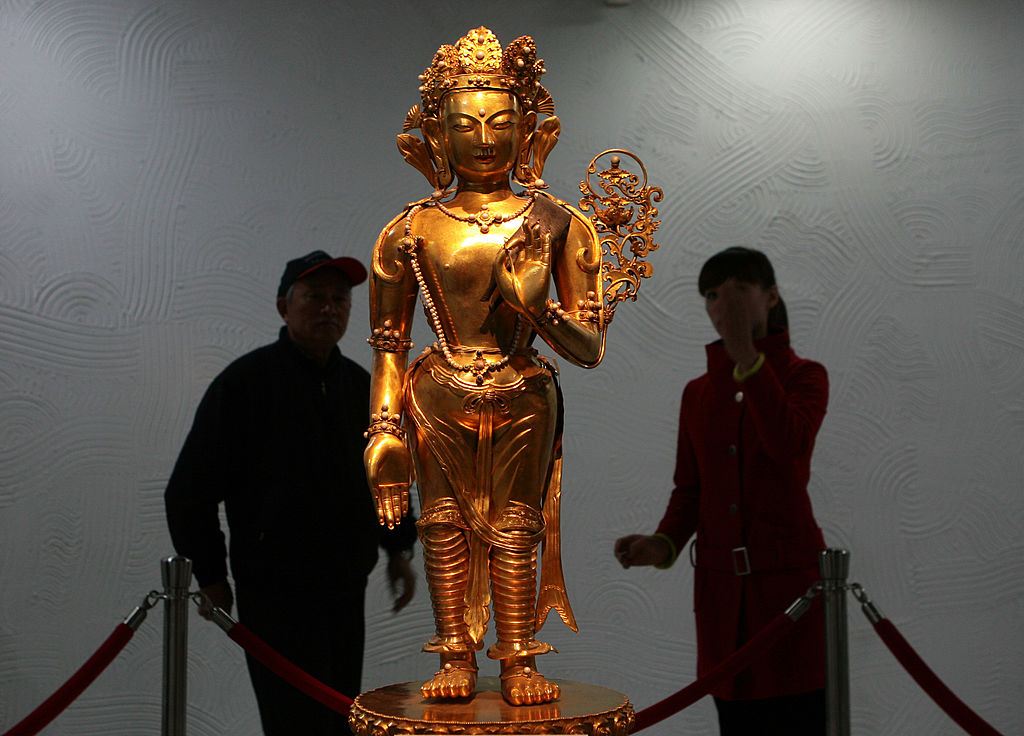
A Chinese jewelry merchant, Mr. Qiu, recently purchased a “Gold Guanyin Statue” for 845,100 RMB in an official auction in Shanxi Province, mainland China. However, upon receiving the item, he discovered that the main component was brass instead of gold. It took him three years to recover the auction payment. The Guanyin statue, which had been kept and transferred by various official departments, was labeled as gold and auctioned, but there is still no clear explanation as to why.
According to a report from “The Paper,” in May 2023, the Shanxi Provincial Department of Finance’s Budget Review Center commissioned the Taiyuan Public Resource Auction Center to auction off a batch of confiscated items. Among them was the Guanyin statue labeled as “Gold,” weighing 2000 grams with an estimated value of 790,400 RMB.
Mr. Qiu won the bid for 845,100 RMB and then went to the Shanxi Provincial Department of Finance’s public warehouse for confiscated items to pick up his purchase. Upon returning home, he noticed the statue had faded in color. By using a spectrometer, it was revealed that the main components were copper and zinc.
Approximately two hours later, Mr. Qiu returned to the public warehouse with the statue, claiming that the description and actual item did not match, and requested a refund, but his request was rejected.
It was reported that a judicial appraisal confirmed that the statue Mr. Qiu returned was the same item that had been deposited in the warehouse in 2021. Through court-commissioned testing, it was found that the statue contained 70.06% copper, 28.5% zinc, and only 0.027% gold, indicating it was a common brass alloy.
In the first-instance court ruling, the Shanxi Provincial Department of Finance’s Budget Review Center was ordered to refund the 845,100 RMB auction payment plus interest and to bear the 50,000 RMB appraisal fee.
The center disagreed with the ruling and filed an appeal, citing the disclaimer clause of “defects not guaranteed” in the auction notice. They also argued that after Mr. Qiu took possession of the statue, he had the time and opportunity to exchange the item.
Recently, the Taiyuan Intermediate People’s Court rejected the appeal, determining that the actual material of the item significantly deviated from the publicized information, and that the relevant clauses could not exempt liability. However, Mr. Qiu’s demand for triple compensation was not supported.
The court documents revealed that the origin of the Guanyin statue was related to a bribery case. In 2012, an individual named Wang spent 880,000 RMB to purchase it from a Chinese bank and gifted it to a state-owned enterprise leader in Taiyuan to expedite settlement of project funds.
Bank sales receipts and related appraisal documents recorded it as a 2000-gram gold product. Subsequently, the Guanyin statue passed through the financial office of the Communist state-owned enterprise, the Discipline Inspection Commission, prosecutors, and the financial public warehouse.
In 2021, the price certification department still verified it as a 880,000 RMB gold Guanyin statue; the 2022 asset appraisal report valued it at 790,400 RMB. At that time, the Shanxi Provincial Department of Finance’s Budget Review Center even issued a statement claiming that the accounts matched the physical item.
Previously reported by Mainland Chinese media, the first-instance court believed that the appraisal company may have provided false certification documents and referred the clues to the Xiaodian Sub-Bureau of the Taiyuan Municipal Public Security Bureau. In April 2024, the sub-bureau decided not to file a case citing “no criminal facts” as the reason.
On September 18, personnel from the Shanxi Provincial Department of Finance’s Budget Review Center stated that they had sent a letter to the unit where the Guanyin statue was handed over, but had not received a response yet.
The related news has sparked doubts among netizens. Some commented that this was a “classic case of switching items after being deposited.” Others expressed that refunding the 845,100 RMB only resolved the buyer-seller dispute, questioning why multiple official departments had handled it for years without discovering that the Guanyin statue was actually made of brass, and where the originally claimed gold had gone.