
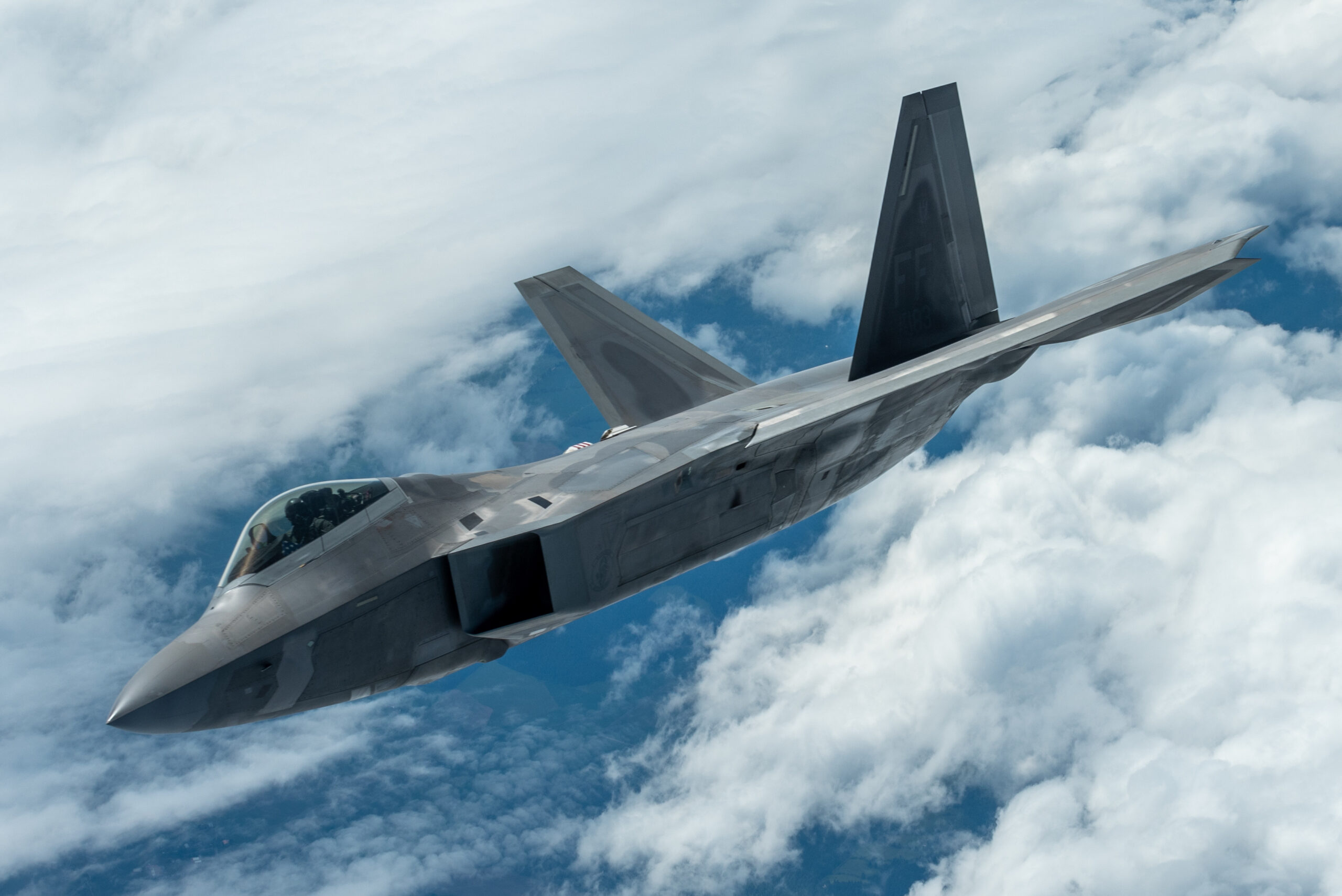
The F-22 “Raptor” fighter jet has been widely regarded as the most powerful pure air-to-air combat aircraft to date, even after more than twenty years of service in the United States Air Force. Excelling in speed, stealth, supersonic cruising, and training, the F-22 is hailed as the king of air superiority.
Since achieving initial operational capability in December 2005, the F-22 has now been in service for over 20 years. For a cutting-edge fighter jet serving in an era of rapid technological advancements, its extended service life is exceptionally rare.
Despite its lengthy service time, the F-22 remains unrivaled in a crucial area: establishing and maintaining air superiority.
One of the reasons this aircraft remains so efficient to this day is due to its highly advanced technological capabilities at the time of its inception. More importantly, it integrates years of combat experience from American pilots and the meticulously designed operational tactics of the aircraft from the outset.
The F-22 fighter jet, a single-seat, twin-engine fifth-generation stealth fighter jointly developed by Lockheed Martin and Boeing, was born at the end of the Cold War as part of the Advanced Tactical Fighter (ATF) program. The program aimed to counter the upcoming introduction of Soviet fighters like the MiG-29 and Su-27, aircraft that could operate within dense ground-to-air missile networks.
In contrast to later fifth-generation fighters, the F-22 had a singular design goal: to defeat the most formidable opponents in air combat. It suppressed enemy aircraft and anti-air networks with supersonic cruising and high stealth capabilities to secure air superiority.
Unbound by aircraft carrier compatibility requirements, export limitations (as it was legislated from the start not to be sold externally to protect classified technologies, thus needing no consideration for “downgraded” or leak-proof generic modifications), or the need to perform routine strike missions for allied air forces (not needing to be a standardized multi-role strike platform among allies), this aircraft was exclusively designed for the U.S. military, with priority given to speed, altitude, maneuverability, and survivability without compromise.
This design philosophy is crucial. Modern multi-role fighter aircraft must balance various conflicting demands, including combat loads, sensors, maintenance versatility, propulsion systems, avionics, and more. When an aircraft is designed for a single purpose, its performance is always superior.
Development of the F-22 began in the 1980s, with its first flight taking place in September 1997 and entering service in 2005.
Since its introduction in 2005, the F-22 has primarily been involved in counterterrorism and airstrikes in the Middle East, as well as carrying out NATO air defense missions. Its combat records include ground attacks against ISIS, intelligence gathering, and armed reconnaissance in Syrian airspace.
The significance of the F-22 to this day stems from its outstanding performance – the perfect combination of speed, altitude, maneuverability, and stealth defining the fighter’s operational methods in combat.
A crucial feature of the “Raptor” is its supersonic cruising ability, allowing it to maintain supersonic flight without using fuel-consuming afterburner chambers. Capable of cruising at speeds exceeding Mach 1.5 while maintaining relatively high fuel efficiency (without engaging the fuel-consuming afterburners) coupled with its harder-to-detect stealth capability, it can swiftly engage or disengage in combat.
Equally important are the Thrust-to-Weight Ratio and aerodynamic design, enabling the F-22 to conduct high-energy (kinetic/speed + potential/altitude) maneuvers at high altitudes. In air combat, maintaining energy, speed, and altitude determines whether a pilot can fully engage in battle or safely disengage.
Stealth capability is also a critical factor, though not a standalone advantage: the low visibility design of the F-22 is specifically optimized for air combat, reducing the enemy radar’s detection range to delay their response.
These features complement each other: stealth capability allows the F-22 to approach targets undetected, speed and altitude give it the initiative, and maneuverability ensures survival in visual combat.
Some aircraft platforms are considered potential successors or competitors to the F-22, each embodying different design philosophies – another reason why the F-22 continues to maintain its competitiveness.
For instance, Lockheed Martin’s F-35 is a high-performance fifth-generation fighter platform optimized for multi-role combat, including strikes, intelligence gathering, and joint operations. Its stealth performance and sensor fusion capabilities are outstanding (unmatched in fifth-generation fighter designs), but its design purpose is not to replace the F-22 in high-end air superiority.
The J-20 as a fifth-generation fighter of the Chinese Communist Party not only is alleged to have stolen American aircraft technology but also faces ongoing limitations related to engine performance (its high-performance domestically designed engine is still in the research and verification stage), pilot training (the operational methods of fifth-generation fighters significantly differ from fourth-generation emphasizing sensor fusion, beyond-visual-range combat, multi-aircraft cooperation, and decision-making in complex electromagnetic environments), and operational system integration (the maturity of integrated avionics systems, sensor fusion, data link, weapon systems, and electronic warfare hardware and software).
Russia’s Su-57 project also encounters continued production delays, limited fleet size, and unresolved issues with sensor performance and engine development.
Given the well-trained and experienced American pilots, the small fleet of F-22 jets, numbering fewer than 200, still possess exceptional combat capabilities and are significantly unmatched.
The F-22 retains operational value to date due to the quality of its pilots, technological maturity, robust performance, and ongoing upgrades. The aircraft’s avionics systems, sensors, electronic warfare systems, and weapon systems receive continuous upgrades, allowing seamless integration with modern combat networks.
Though the “Raptor” fighter jet’s fleet is relatively small, totaling less than 200 aircraft, it remains a cornerstone of American air superiority, operating alongside the much larger F-35, especially when faced with engaging opponents with comparable capabilities. The F-22 has proven its worth.
(Partial references from the article on the military website 19fortyfive)