
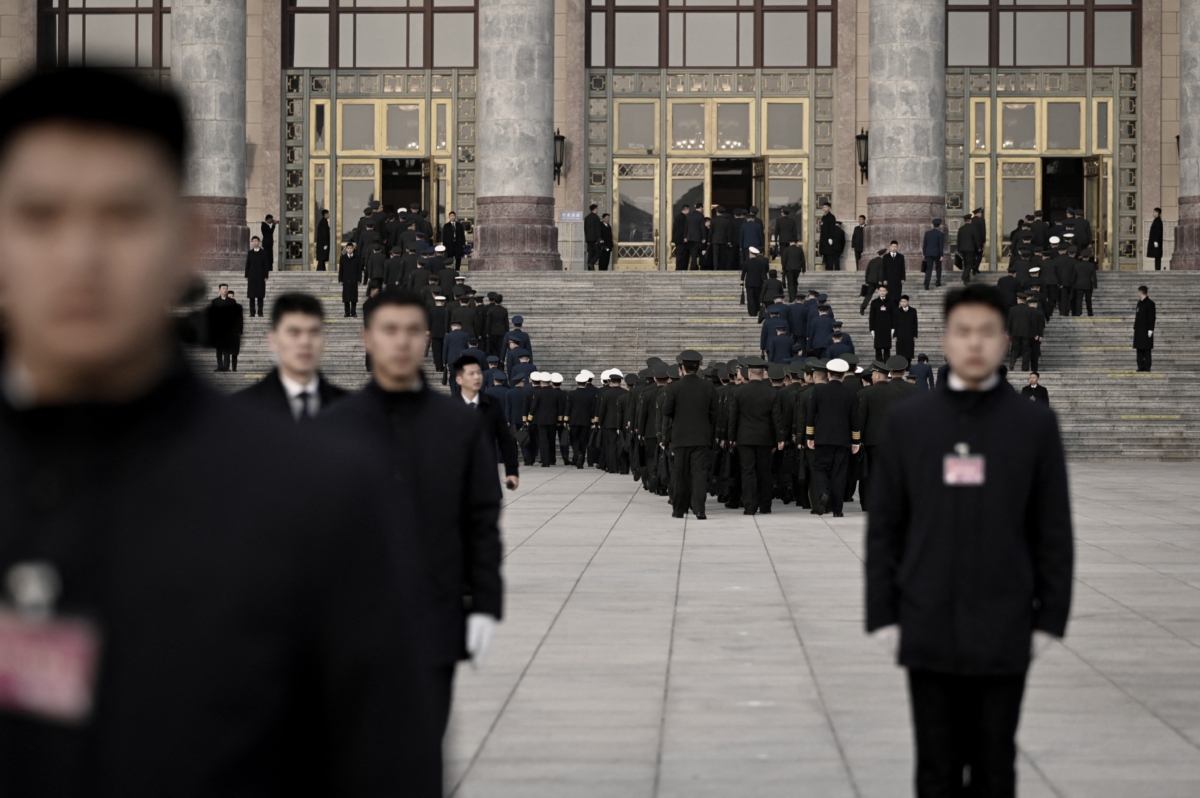
On August 1st, the 99th anniversary of the founding of the Chinese Communist Party’s military, the CCP military newspaper emphasized the importance of ensuring that the “barrels of the guns” always “listen to the Party’s command.” The day before, CCP leader Xi Jinping also stressed the need to ensure that the “barrels of the guns always listen to the Party’s command” and continue the “anti-corruption struggle.” Analysts believe that the military will continue to purge individuals like Zhang Youxia and Liu Zhenli, continuing their clean-up efforts.
Defense Minister of the CCP, Dong Jun, made strong remarks on the Taiwan issue at the celebration on August 1st. Observers believe that while Xi is currently using Dong Jun, it does not necessarily mean he fully trusts him.
The CCP military newspaper published an article on August 1st praising the “achievements” of the CCP’s military development, attributing them to the guidance of Chairman Xi. The article states that the entire military must “ensure that the barrels of the guns always listen to the Party’s command.”
The previous day, the CCP Central Political Bureau held a collective learning session on July 30th with a focus on defense and military-related issues. Xi Jinping emphasized the need to ensure that the “barrels of the guns always listen to the Party’s command” and to further advance the anti-corruption campaign.
During the CCP Political Bureau meeting on the morning of July 30th, it was confirmed that the 5th Plenary Session of the 20th Central Committee would be held in October with the theme of “comprehensively strengthening Party governance.” Many experts suggest that the Plenary Session may involve addressing the issues of Zhang Youxia, who fell from grace in January, and Military Commission member Liu Zhenli.
Taiwanese defense and security researcher, Shen Mingshi, analyzed that Xi Jinping’s call for the military to listen to the Party’s command, with the “Party” here referring to Xi himself. However, observers note that the military reforms initiated in 2016 were not fully realized in practice, leading to the need for a second round of military reforms. This second round, originally launched by Zhang Youxia, resulted in his and Liu Zhenli’s downfall.
Shen Mingshi stated that Xi Jinping’s efforts to cleanse the Party and the military may target senior officers who were closely associated with Zhang Youxia and Liu Zhenli, potentially continuing to purge the remnants of any perceived “poison.” Whether in alignment with the upcoming 5th Plenary Session’s theme of “comprehensive strengthening Party governance” or in the detailed investigation of Zhang Youxia and Liu Zhenli’s cases, these efforts are expected to persist.
In the past two to three years, a significant number of senior CCP military officials have been investigated, particularly among those promoted by Xi Jinping, resulting in a nearly complete turnover, impacting the current shortages in military personnel.
Shen Mingshi indicated that the selection of individuals for positions as commanders or political commissars within the CCP military should be finalized before the 21st Plenary Session. These officers must demonstrate loyalty to Xi Jinping to be considered for frontline leadership roles.
Sun Guoxiang, a veteran political scholar from Taiwan, expressed that Xi Jinping’s renewed emphasis on ensuring that the military “always listens to the Party’s command” indicates that corruption within the military not only involves financial misdeeds but may also affect the quality of weapons, combat readiness, and credibility during wartime. The turmoil at the top could weaken Beijing’s confidence in the PLA’s ability to execute complex battle plans.
On July 31st, the CCP Ministry of National Defense hosted a reception at the Great Hall of the People in Beijing. Defense Minister Dong Jun declared the need to maintain a “solid unified foundation” and “resolutely thwart any form of ‘Taiwan independence’ separatist schemes and external military interference.”
Both former CCP Defense Ministers, Wei Fenghe and Li Shangfu, previously issued similar tough rhetoric towards Taiwan, but they have since been removed from their positions.
Shen Mingshi analyzed that Dong Jun’s speech aligns entirely with Xi’s views. Dong Jun lacks his own standpoint; rather, he follows the Party’s line, opting for more inflammatory statements.
There were rumors circulating about Dong Jun undergoing investigation at one point. Shen Mingshi suggested that Dong Jun’s ability to preside over the August 1st celebration as usual could potentially lead to his inclusion in the Central Military Commission, serving directly as a member of the Central Military Commission in his capacity as Defense Minister. This move could bolster the strength of Xi Jinping’s faction within the Central Military Commission.
Sun Guoxiang stated that Dong Jun’s remarks are standard expressions during the August 1st military founding celebrations. However, highlighting the need to “solidify the foundation” suggests that the military serves as Beijing’s ultimate guarantee in handling unification issues.
He believes that the CCP’s strong stance against Taiwan is partly due to ongoing clean-up efforts within the military. Beijing requires the narrative of “against Taiwan independence, external interference, and obedience to Party command” to reinforce political loyalty.
Sun Guoxiang remarked that Dong Jun can still be utilized by Xi politically, although he no longer holds the same political stature within the Central Military Commission or the State Council as previous Defense Ministers. With the successive downfall of Wei Fenghe and Li Shangfu, the political security of the new Defense Minister has significantly diminished.
A Beijing observer, Yang Shan (pseudonym), mentioned that Dong Jun’s continued tenure as Defense Minister is likely a strategic move by Xi Jinping to maintain outward stability within the military. Should another individual replace Dong Jun, there is no guarantee they would be more competent, albeit Dong Jun possesses slightly stronger professional abilities. However, Dong Jun’s retention does not necessarily indicate Xi Jinping’s complete trust in him.
“Xi Jinping has never fully trusted those he appoints. If he did, we wouldn’t be in the situation we are in now,” he commented.