
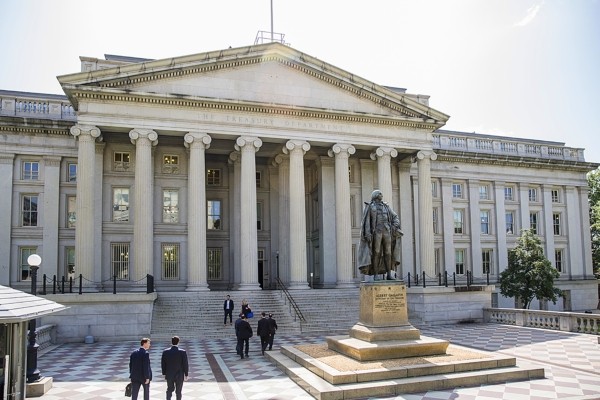
The U.S. Department of the Treasury’s Office of Foreign Assets Control (OFAC) announced on Wednesday a significant sanction action against the illegal extortion network and “shadow fleet” established by the Iranian regime in the Strait of Hormuz. This action aims to further combat Iran’s attempts to extort funds through the strait to support its crumbling economy. Several shipping entities in China and Hong Kong that are suspected of assisting Iran in illegally transporting oil to China are included in these sanctions.
According to the U.S. Treasury Department, in order to compensate for the sharp decline in financial resources due to Operation Epic Fury, the Iranian regime established the Persian Gulf Marine Insurance Company (PGMIC) and the HormuzSafe Marine Services Authority to force commercial vessels passing through the Strait of Hormuz to purchase so-called “marine insurance”.
Despite claims made by these policies to protect vessels from risks such as seizure, the U.S. emphasizes that Iran is essentially responsible for creating most maritime risks. The policies issued by this network must be approved by the Persian Gulf Strait Management Authority (PGSA) supported by the Islamic Revolutionary Guard Corps (IRGC). In reality, these policies are used as a guise for extortion, with funds being funneled into the operating and terrorist activities of the IRGC. HormuzSafe even accepts digital assets like Bitcoin for payment to circumvent Western financial sanctions.
U.S. Treasury Secretary Scott Bessent stated, “In the face of an economy in free-fall and triple-digit inflation, the Iranian regime is desperate for cash. The U.S. will not allow Iran to leverage global trade or use international shipping to fund the terrorism, aggression, and repression of the Islamic Revolutionary Guard Corps.”
In addition to targeting extortion networks in the strait, OFAC is coordinating with the U.S. military interception operations to further strengthen efforts to combat Iranian oil and petrochemical exports. Since the beginning of this year, over 100 vessels associated with Iran’s “shadow fleet” have been sanctioned by the U.S.
In this operation, OFAC designated 8 companies and 8 vessels under sanctions based on Executive Order 13902 and National Security Presidential Memorandum-2. The sanctioned entities include the China-based Qi Hang Ship Management Limited, and several shipping companies in Hong Kong and the Marshall Islands (Marinova Freight Limited, Vast Mighty Limited, Ocean Tranquility Limited, Branch Saying International Trading Co Ltd, Confident Apex Limited, Billion Nexus Int’l Co., Limited, and Nevada Spirit Company Limited).
The 8 chemical and crude oil tankers operated by these companies (WELL SAIL, NATSUMI, CRYSTAL, NIRETA, YEHOPE, LILY, AL SALMI, and BREEZE V) have their assets frozen. U.S. investigations indicate that these vessels have been illicitly transporting millions of barrels of Iranian oil and petroleum products to China and the UAE since 2022.
Sanctioned entities must declare and freeze their assets in the U.S. or held by individuals controlled by Americans. Entities holding a direct or indirect ownership stake of over 50% by sanctioned individuals will also face asset freezing.
The U.S. warns that any American or foreign entity or individual violating sanctions or aiding in their evasion may face severe civil or criminal penalties. Financial institutions engaging in related transactions also face the risk of being subject to secondary sanctions. Additionally, the U.S. Financial Crimes Enforcement Network (FinCEN) offers rewards for reporting, encouraging global informants to provide leads on evading sanctions to comprehensively combat the Iranian regime’s illicit financial networks.