
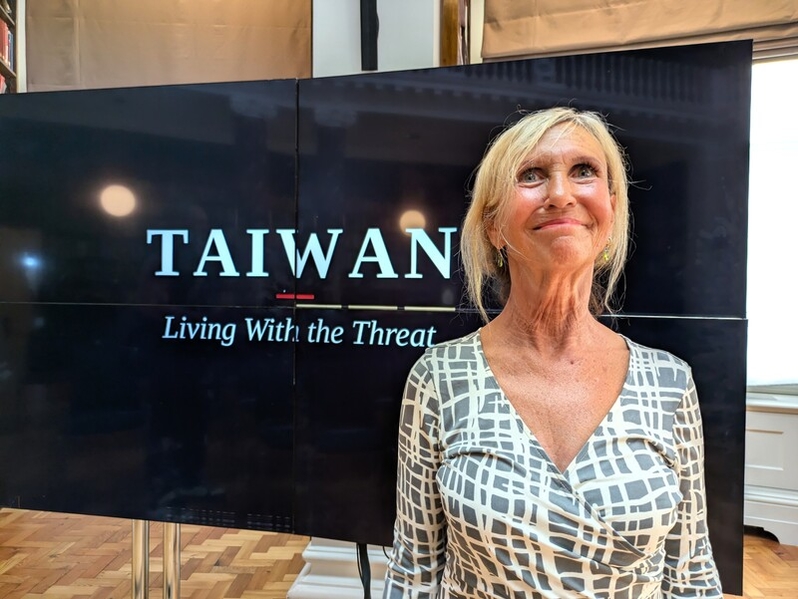
American photojournalist Susan Schulman visited Taiwan for about 10 days in January, documenting how Taiwan coexists with security threats from the Chinese Communist Party. She told Central News Agency that in Taiwan, she deeply felt that invisible and unseen threats are the most challenging to deal with because “you may not even be sure if you should react at all.”
Schulman, originally from New York and residing in London for over 30 years, has covered various continents in her photography work, featured in international media such as the Financial Times. She was commissioned by the Royal United Services Institute (RUSI) in the UK to visit Taiwan in January to shoot a special feature story for the institute’s journal.
During her time in Taiwan, Schulman visited Taipei, Kaohsiung, Taichung, interviewed and documented activities of people participating in airsoft survival games, civil defense training courses, drone clubs, fishermen, elected representatives, and also visited the Taiwan International Shipbuilding Company to observe shipbuilding scenes.
Schulman’s image documentation in Taiwan is planned to focus on how the public perceives, experiences, understands, and responds to security threats from the Chinese Communist Party, rather than the professional military field.
In a recent interview with Central News Agency, Schulman mentioned that if given the chance to return to Taiwan, she hopes to visit outlying islands like Kinmen and Matsu, and engage in deeper conversations with fishermen.
During her visit in January, fishermen seemed “reluctant to talk much” and intentionally avoided extensive contact with her. Considering the increased Chinese Communist activities in Taiwan’s eastern waters, Schulman hopes to conduct research and documentations in relevant waters in the future. She also looks forward to further understanding how Taiwan’s conventional education system guides children in recognizing and practicing responses to various crisis situations.
Although her focus during her time in Taiwan was mostly on “hardcore” issues related to security defense, Schulman pointed out that on her first visit to Taiwan, she was greatly amazed by the natural beauty, the elegant balance of “tradition” and “modernity,” and the gentle friendliness of the Taiwanese people. She mentioned that Taiwanese cuisine did not disappoint her, although Din Tai Fung seemed slightly “overrated.”
Regarding her most profound impressions in Taiwan and the message she hopes to convey through her work, Schulman emphasized the need to not only focus on “visible” threats but also raise awareness of the overall environment, situations, and developments to detect potential threats that are not easily identifiable.
Schulman stressed that it is an ongoing learning process, one of the keys being to face reality and be prepared rather than hiding or masking issues, pretending they don’t exist.
Once becoming like a frog slowly boiled in warm water, one may not even realize the opportunity to be cooked. Threats can manifest subtly, quietly grow, gradually infiltrate, and silently spread. Then, one day, “things eventually happen.”
Schulman noted that in Taiwan, while many people can discuss at length the threats of the Chinese Communist Party to Taiwan and the catastrophic consequences of the mainland taking over Taiwan, the majority may not actively act beyond just talking about it.
Furthermore, the vast majority of the interviewed Taiwanese people were unwilling to disclose their real names. Schulman believed that this not only reflects a fear of the influence of the Chinese Communist Party but also reveals different opinions in Taiwanese society on how to assess and respond to the threats from the Chinese Communist Party.
RUSI held a sharing session at its headquarters in London on the 27th evening, where Schulman showcased her works captured in Taiwan and shared insights with the audience.
During the meeting, Taiwan’s representative to the United Kingdom, Yao Jinxiang, mentioned that facing continuous threats, Taiwan is committed to defending its existing free democratic way of life. The war that erupted in Ukraine in February 2022 has profoundly changed Taiwan’s understanding of security threats and modern warfare. In Taiwan, security defense is no longer just the responsibility of professional soldiers but extends to the entire society, including strengthening infrastructure defense and supply chain resilience.
The Taiwan experience has also sparked interest in the British political arena. Yao Jinxiang mentioned that in April, he was invited to the National Security Strategy Joint Committee of the UK Parliament to share Taiwan’s efforts in constructing a comprehensive societal defense resilience with bipartisan members of the House of Commons and Lords.