
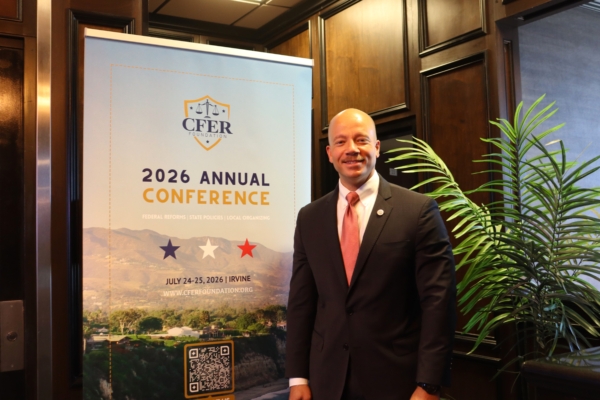
In July 24-25, the California Foundation for Equal Rights (CFER) held its 4th annual meeting in Irvine, Orange County, to celebrate the 30th anniversary of the passage of California’s Proposition 209. The United States Department of Agriculture Assistant Secretary for Civil Rights, Devon Westhill, was invited to speak at the event.
Westhill oversees the civil rights enforcement work of 100,000 employees at the USDA. With an office that has a multi-billion dollar annual budget, serving millions of customers globally, its scale surpasses that of most Fortune 500 companies.
According to Westhill, 30 years ago, California voters passed the constitutional amendment Proposition 209, which explicitly prohibits discrimination or preferential treatment based on race, gender, color, or national origin in public education, government employment, and contracting.
The experience of the past 30 years has proven that diversity and prosperity can be achieved under the principle of “equal dignity for all.” This ensures that students are evaluated based on merit, workers are hired based on performance, and contractors are awarded contracts based on achievements. However, some politicians and legislative bodies still attempt to undermine or bypass this principle.
Westhill pointed out that some people are eager to categorize individuals based on their inherent characteristics and try to replace “equal opportunity” with “equity” through artificial interventions. He particularly highlighted the lack of social and family values:
1. Spirit of self-governance and self-reliance: Similar to the observations made by the early American commentator Alexis de Tocqueville on civic self-governance traditions and Frederick Douglass’s call for “an opportunity for self-reliance,” excessive preferential policies deviate from the core principle of “all men are created equal” in the Constitution.
2. Collapse of family and education: While Chinese and Japanese Americans historically faced severe discrimination, they have thrived today. However, nearly 19 million children in the United States (over a quarter) live in single-parent households. Without loving families and quality education, a “victim mentality” can easily take hold, leading people to seek policy favors. Educator Booker T. Washington once advised, “Never let the bitterness of oppression overshadow the opportunities in front of you.”
Westhill highlighted fundamental policy changes at the federal level, such as halting discriminatory DEI (Diversity, Equity, and Inclusion) initiatives within the government through the signing of executive orders to prevent wastage of public resources:
– Reforming regulations: The Department of Justice has submitted legal opinions to the Equal Employment Opportunity Commission, rectifying past practices where “disparate impact” liability was determined solely based on “unequal outcomes,” preventing employers from making racially motivated decisions to avoid risks.
– Abolishing “disparate impact” clauses: Various departments, including the Department of Agriculture, Commerce, Transportation, Interior, Homeland Security, Housing and Urban Development, Education, and Health and Human Services, have successively canceled or repealed funding programs and regulations based on “disparate impact.”
– Eliminating racial disparities in rights: The Department of Agriculture has eliminated the classification terms of “socially disadvantaged groups”; in April of this year, Congressman Mark Harris introduced the “Equal Treatment for Farmers Act.”
– Setting a precedent on redistricting: In a 6-3 decision in late April (Louisiana v. Calais), the Supreme Court rejected the practice of racial gerrymandering for congressional districts.
Westhill previously submitted a critical legal brief in the Supreme Court’s 2023 case of “Students for Fair Admissions v. Harvard.” He highly praised CFER’s Vice Chair Gail Heriot’s preparation on theoretical foundations, providing strong support to the Department of Justice.
He emphasized that Title VI and Title VII of the 1964 Civil Rights Act and the Fourteenth Amendment explicitly prohibit discrimination based on race, color, or national origin. California’s passage of Proposition 209 puts it at the forefront, with enforceability at the state constitutional level. Federal civil rights laws and California propositions run in parallel and overlap, acting as a last line of defense when California policies attempt to regress.
In conclusion, Westhill stated, “To eliminate the ‘favoritism and resentment’ culture that has existed in the government system for over 50 years, it cannot be achieved solely by an executive order, a court term, or an election. We must stay vigilant and continue to work step by step with our feet firmly planted.”