
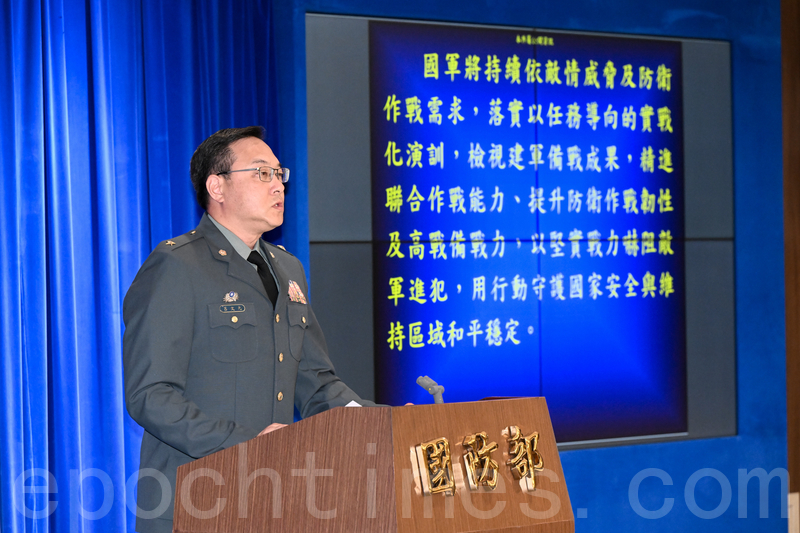
The upcoming Han Guang No. 42 Exercise of the Republic of China Armed Forces is scheduled to take place on August 5th, lasting for 10 days and 9 nights. The exercise will simulate scenarios such as enemy blockades, firepower strikes, and multiple amphibious landings, aiming to validate the joint operational capabilities of the military. This exercise will focus on nine key training objectives including full brigade mobilization, anti-blockade escort, countering enemy intelligence activities, and strengthening multi-domain defense resilience.
The Ministry of National Defense of the Republic of China held a routine press conference today, focusing on the “Han Guang No. 42” live-fire exercise and the 2026 urban resilience (anti-aircraft) exercise. Major General Lu Wen-yuan, Director of the Joint Operations Division of the Defense Department, briefed on the planning of the “Han Guang No. 42” live-fire exercise, which will be conducted throughout the year following a continuous training model. Taking place from August 5th to 14th, the exercise will involve continuous scenario simulations to enhance the troops’ responsiveness in real combat environments.
Lu Wen-yuan emphasized that the exercise will be divided into four phases: preparation and deployment, combat power protection, joint anti-landing operations, depth defense, and sustained combat. It will also integrate with the “Tongxin No. 36 Exercise” of this year, with two brigade-level units executing full brigade mobilization.
In terms of training objectives, Lu Wen-yuan outlined nine key areas of focus, including immediate situation handling and command response, full brigade mobilization and combat recovery efficiency, mobilization production conversion and evacuation, anti-blockade escort, protection of critical facilities against enemy intelligence activities, cross-regional troop movements, continuous logistical support, development of battlefield medical capabilities, and enhancing societal defense resilience.
Furthermore, he stressed the importance of conducting practical training based on mission-oriented combat requirements to improve joint operational capabilities, enhance defense resilience, and maintain a high state of combat readiness to deter enemy aggression and safeguard national security and regional peace and stability.
Following that, Colonel He Yang-zheng, Director of the Human Resource Mobilization Office of the Ministry of National Defense, provided details of the “2026 urban resilience (anti-aircraft) exercise,” highlighting the exercise schedule, regions involved, and control measures to ensure public understanding and cooperation. The exercise is set to verify the evacuation and sheltering procedures outlined in the Ministry of the Interior’s “Air Defense Shelter Guidelines.”
He Yang-zheng explained that the exercise will be carried out on August 7th and from August 10th to 13th in a “pre-warning, simultaneous zoning” manner across different regions, starting from the south and moving to central, outlying islands, east, and north. This year, a total of 368 towns and cities in Taiwan will undergo evacuation drills according to the guidelines, with a focus on indoor venues such as public transportation, daily necessities, and government facilities.
During the exercise, vehicles on the roads will be alerted to air defense warnings through various channels to ensure maximum coverage. Moreover, mobile alerts will be sent to mobile phones through the “Air Threat Warning System,” providing information on air defense shelters. Drivers and passengers are advised to remain calm, pull over to a safe area upon hearing the warning, and seek shelter in the nearest air defense facility while adhering to traffic rules.
In addition, He pointed out that the local governments, armed forces, schools, organizations, companies, and individuals in the exercise areas should cooperate with the control and drills. Failure to comply with the instructions may result in penalties as stipulated by the Civil Defense Act and Regulations on the Implementation of Air Defense Drills. Remember, cooperation is crucial for the success of the exercises and the overall safety and preparedness of the country.