
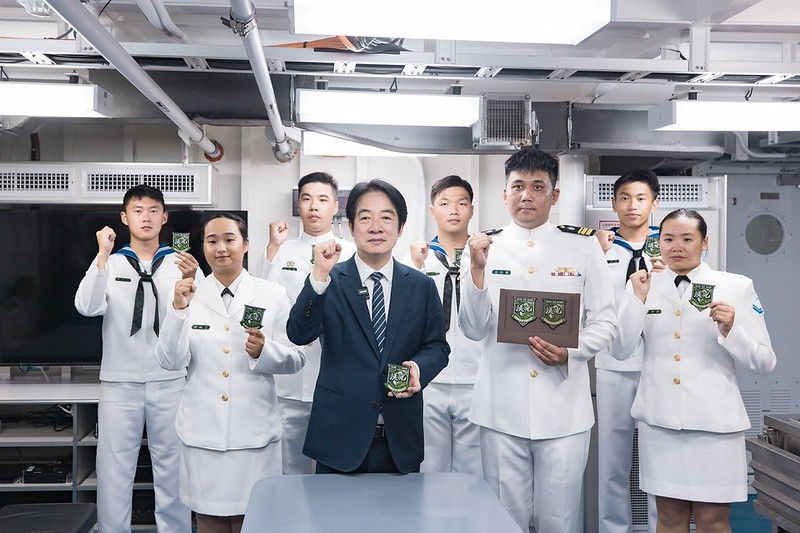
President Tsai Ing-wen of the Republic of China recently attended the commissioning ceremony of the Navy’s Tanshui-class warship in Kaohsiung. He recorded a video titled “Special Education on the Spiritual Combat Capability of the Military” on board the warship, encouraging the military to enhance training together to maintain the peace and stability in the Taiwan Strait. He extended his best wishes for the safe navigation and successful missions of the Tanshui-class warship and the upcoming Han Kuang 42 exercise, which is set to be broadcasted tonight.
President Tsai first arrived at the ship’s mess hall to understand the food preparation and special features on board. He then had a meal and exchanged thoughts with the officers and soldiers. He emphasized the importance of good and sufficient meals for the troops carrying out duties at sea, highlighting the significance of maintaining physical strength and focus. The government has increased the military meal allowances and night snacks since last year to take care of everyone. As the Han Kuang 42 exercise moves into the live-fire phase, the training will become more challenging, reminding everyone to eat well.
President Tsai also expressed gratitude to all personnel involved in the testing and training of the warship. Starting from taking over this new vessel, everyone needs to familiarize themselves with the new weapons and equipment and cultivate teamwork through repeated training to maximize the warship’s combat power. The successful commissioning of the warship is the result of everyone’s collective efforts.
He listened to the challenges faced during the commissioning of the Tanshui-class warship and stressed that commissioning marks the beginning of responsibility. He urged everyone to continue the teamwork established during this time, strive for continuous improvement in training, and cooperate effectively in every mission. The Han Kuang 42 live-fire exercise is about to begin, testing the responsiveness and coordination of each unit amidst simulated scenarios closer to real-life situations.
Regarding the exercise, some personnel mentioned the biggest challenge is the changing circumstances that require swift situational awareness to confirm roles and cooperation methods. President Tsai believed that judgment, cooperation, and mutual trust are the key abilities to be evaluated during this year’s Han Kuang exercise. By incorporating unforeseen situations in the training, the troops have the opportunity to identify and promptly address issues for better performance in the next exercise.
President Tsai emphasized the importance of information sharing and mutual support among units in responding to grey-zone provocations or in training for combat readiness. He highlighted the necessity for the Tanshui-class warship to coordinate with other naval vessels, aerial, and land units during missions. The exercise will repeatedly verify the units’ capability to synchronize information and provide mutual support when needed.
During the discussion on coping with the complex information environment during the exercise, where misinformation can affect decision-making and trust within the unit, officers and soldiers shared strategies for verification and response. President Tsai advised verifying information through official channels, maintaining confidentiality, and fostering trust among the troops to counteract enemy attempts at infiltration and division.
President Tsai stressed that unit cohesion comes from training together and accomplishing missions as a team. The trust built on knowing each other’s roles and mutual reliance enables troops to make decisions and act under pressure. This trust forms the foundation of the spiritual combat capability and the unity of the military. He urged the troops to believe in their training, support each other, and successfully complete missions, knowing that the nation and people stand behind them.
He also asked the ship’s captain to share expectations for the Tanshui-class warship’s future missions. Over the past two years, the government has actively implemented the “Four Pillars of Peace” action plan, reinforcing national defense, enhancing economic resilience, and deepening cooperation with democratic partners to steadfastly maintain the peace and stability in the Taiwan Strait. Every member of the armed forces plays a crucial role in safeguarding national security and maintaining peace. The government will continue to support the military, improving equipment and training environments for a more secure and focused service.
Furthermore, President Tsai reiterated the government’s commitment to enhancing the overall societal defense resilience, uniting the strength of all citizens to increase the nation’s ability to handle diverse risks and threats. This effort ensures the continuous operation of essential systems such as healthcare, transportation, energy, and communication, providing stable support to the troops. He thanked everyone for their dedicated service in safeguarding the nation and people’s safety and wished for the safe navigation and successful missions of the Tanshui-class warship and the completion of the Han Kuang 42 exercise.
Having the responsibilities of both president and commander-in-chief of the armed forces, President Tsai has always been dedicated to caring for the military. He aims to create a favorable environment within the military where every young recruit can pursue their dreams without worries. Starting from the “Xing An Project” initiated by former President Tsai Ing-wen to refurbish old barracks, President Tsai has continued the efforts with the “Zhan Xing Project” to further improve the living conditions for military personnel. His recent visit to a kindergarten reflects his support for childcare facilities to alleviate concerns of military personnel regarding child care.
President Tsai urged the military to strengthen combat training and enhance proficiency in warfare and various specialized disciplines. The primary goal of the national security strategy is to maintain the current peace and stability in the Taiwan Strait. Past battles such as the Battle of Guningtou and the August 23 Artillery War showcase the strength of the military. The government’s development of unmanned aerial systems is essential for national defense independence, aligning with the indigenous naval construction goal demonstrated by the Tanshui-class warship.
Subsequently, President Tsai signed a commemorative plaque of the ship’s naval gun and presented the troops with arm patches designed for this year’s Ministry of National Defense Han Kuang 42 exercise, symbolizing the resolve to defend the homeland and showcasing the military’s relentless improvement with the latest drone imagery. He wished for the success of the Han Kuang 42 exercise’s live-fire drills.