
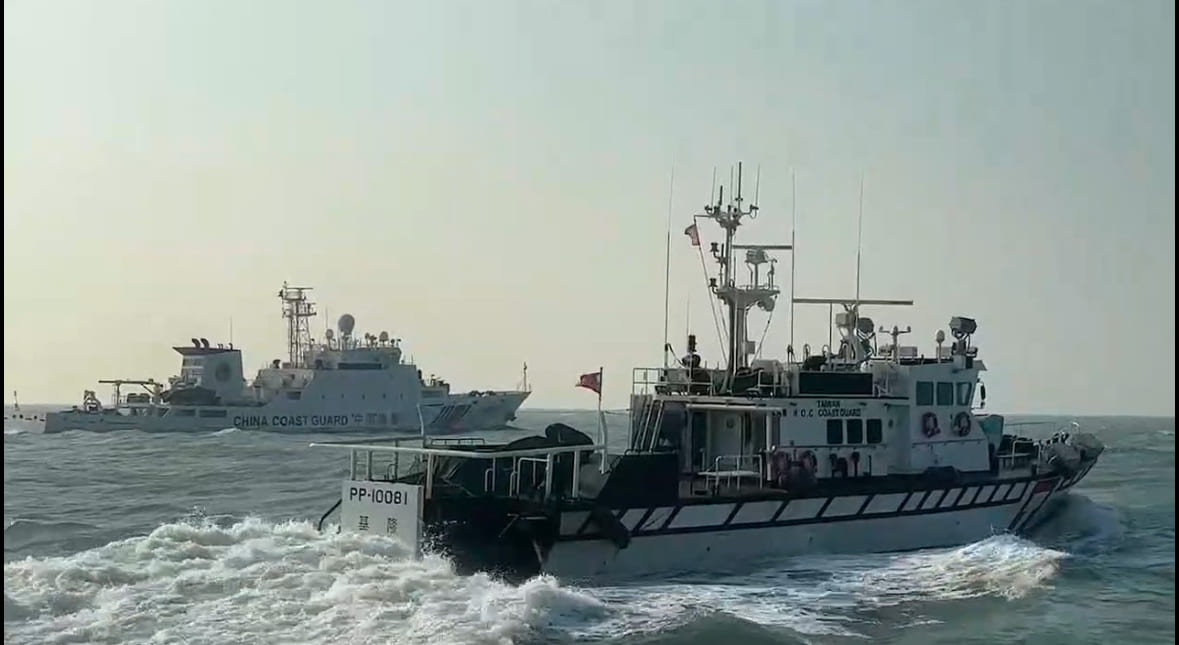
On July 23rd and 24th, the Chinese military conducted live-fire exercises in the waters west of the Taiwan Strait for two consecutive days. Military experts believe that while the shooting range was close to Dongshan Island in Fujian, it did not pose a direct military threat to Taiwan’s main island. However, the decision by China to carry out live-fire exercises in the Taiwan Strait is seen as a move to test Taiwan’s response, establish a military presence, and send political signals to the outside world.
The Zhangzhou Maritime Bureau issued a navigation warning on the 23rd, announcing that live-fire exercises would be conducted in parts of the Taiwan Strait from 6 a.m. to 6 p.m. both days, prohibiting vessels from entering the area. The Chinese officials did not disclose specific participating forces, weapon types, or exercise subjects, but only announced the shooting times and restricted navigation zones.
Since July, China has been conducting live-fire exercises in multiple maritime regions, including the northern Yellow Sea from the 7th to 10th, the southern Yellow Sea from the 16th to 17th, and the Taiwan Strait on the 23rd and 24th.
Regarding China’s consecutive maritime live-fire exercises this month, mainland military expert Hu Zhiying (alias) stated: “The first two exercises were in the Yellow Sea, and the third moved to the Taiwan Strait, showing an increased level of political sensitivity in the shooting area.”
Hu Zhiying analyzed that Beijing’s actions seem to showcase its ability to maintain military activities simultaneously in the Yellow Sea, East China Sea passage, and Taiwan Strait direction. The Yellow Sea is close to the areas where U.S. and South Korean military forces are stationed, while the Taiwan Strait directly impacts the security systems of the US and Japan.
He mentioned, “By repeatedly designating shooting zones within a 20-day period, China is clearly demonstrating its maritime and aerial power. The exercises in the Yellow Sea primarily serve defense tasks for the Beijing-Tianjin-Hebei region, while also exerting pressure on South Korea and the United States.”
Fujian military enthusiast Li Qianshi (alias) disclosed to reporters, “Recently, the Chinese navy has moved its testing and evaluations to the sea. Though it’s considered live-fire exercises externally, it is actually an internal naval evaluation. This information was shared with me by a friend. Every June and July, the Chinese military conducts mid-term evaluations, with each military region, especially the eastern and southern regions, typically evaluating the training and live-fire assessments for the first half of the year at the end of the second quarter.”
Taiwan’s Central News Agency, based on the coordinates of the navigation warnings issued by China, pointed out that the two shooting zones designated on the 23rd and 24th were located near Dongshan Island in Fujian. The relevant waters are approximately 106 kilometers from Kinmen, 103 nautical miles from Penghu, and about 55 nautical miles west of the median line of the Taiwan Strait. Taiwan’s port authorities preliminarily assessed that the shooting operations did not affect the entry and exit of commercial vessels in Taiwanese ports.
Although the shooting zones were near Dongshan Island, the labeling of “live-fire exercises in the Taiwan Strait” holds significant political connotations on its own. Mr. Hu told reporters that China frequently conducts exercises in these waters to lower external guards against a potential military attack, employing a strategy similar to Mao Zedong’s approach of attacking when the enemy is unprepared.
Mr. Hu warned that if this “dulling” strategy succeeds, China may suddenly extend its exercise grounds into true provocative military actions in the future, using this tactical surprise to minimize casualties during critical stages of any engagement.
An informed source within the system analyzed that China’s live-fire exercises on July 23rd and 24th lacked publicly disclosed exercise names, participating branches, and weapon systems, suggesting a temporary escalation and political probing. Currently, despite a post-purge “vacuum of high-ranking officers” in various military regions, training related to Taiwan and the US remains a set policy, unaffected by any senior personnel changes. The source stated, “It’s like a machine, the path is already set, just follow it. Even without competent leaders, they still pretend to have them.”
On the 23rd, Taiwan’s Ministry of Foreign Affairs issued a statement criticizing China for escalating tensions in the Taiwan Strait by not providing advance notice of its naval exercises, establishing restricted navigation zones, and conducting live-fire exercises off the west coast of the Taiwan Strait.