
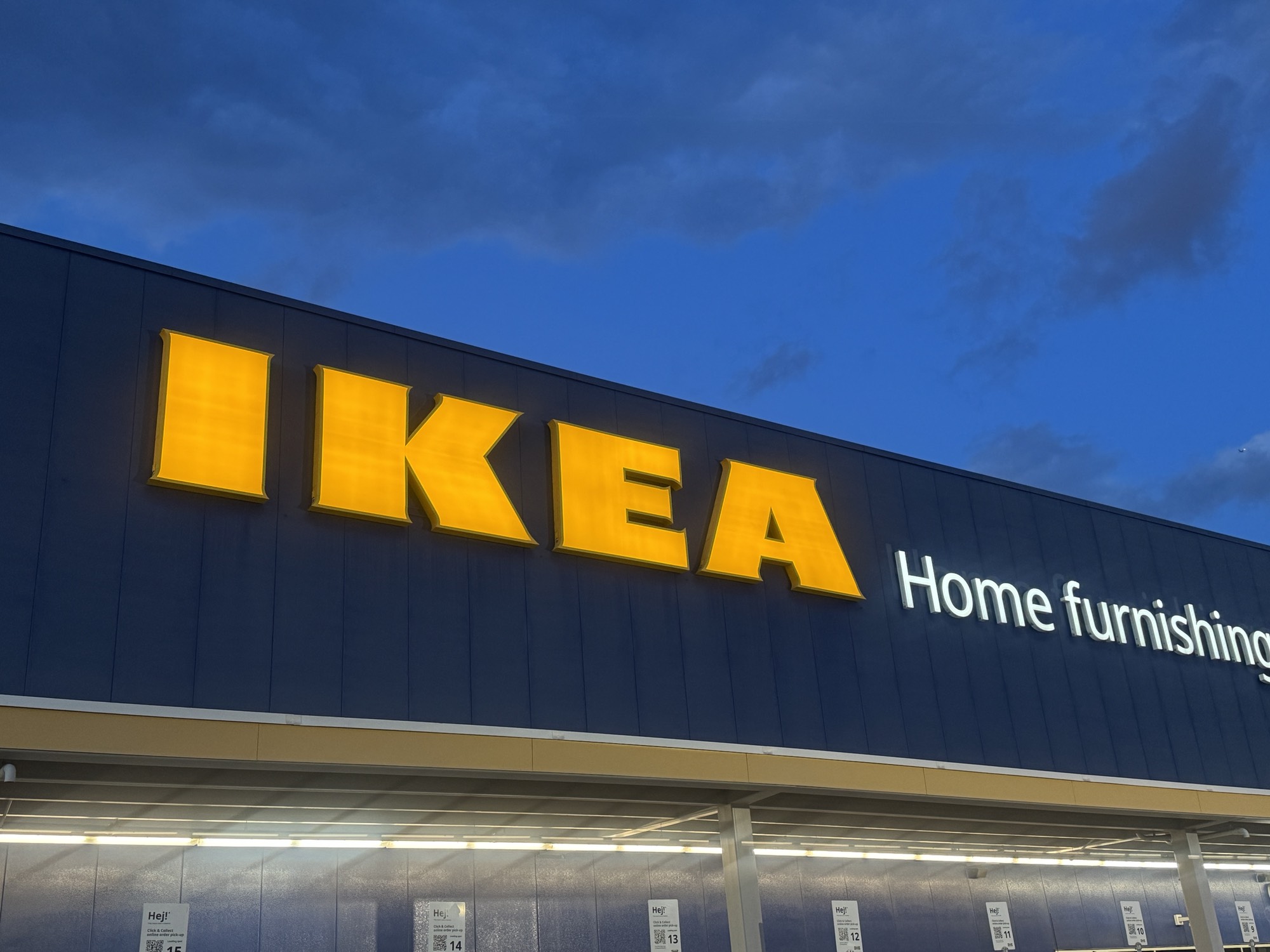
Entering the Chinese market for nearly 30 years, IKEA is embarking on its largest ever centralized asset disposal. IKEA’s 8 commercial properties in Shanghai, Guangzhou, Tianjin, Harbin, Nantong, Xuzhou, Guiyang, and Ningbo have officially been listed for sale.
IKEA, founded in 1943, is one of the world’s largest retailers of furniture and home goods, currently operated globally by the Ingka Group. IKEA entered the Chinese market in 1998, quickly capturing market share with large home furnishing stores, self-service shopping models, and affordable Scandinavian design, at its peak opening dozens of large stores in China.
Recently, Cushman & Wakefield disclosed that it has obtained exclusive sales authorization from IKEA’s parent company, the Ingka Group, for the sale of IKEA’s properties in Shanghai, Guangzhou, Tianjin, Harbin, Nantong, Xuzhou, Guiyang, and Ningbo.
Cushman & Wakefield stated, “The above assets are currently vacant, with no lease restrictions, and can be delivered immediately as is.”
According to the Daily Economic News, details regarding potential buyers and whether REITs (Real Estate Investment Trusts) will be issued in the future could not be answered by Cushman & Wakefield at this time.
On July 20, a reporter from the Daily Economic News visited one of the properties for sale – the original IKEA Baoshan Mall in Shanghai.
The mall used to be the largest IKEA store in Asia. It is located adjacent to the central entrance of Shanghai, providing excellent transportation convenience.
However, currently, there are few pedestrians outside the mall, all ground-level entrances are closed, the once busy lanes and taxi waiting areas are deserted, and the entire IKEA mall sits empty.
This property ceased operations officially on February 2 of this year. A passerby in the mall’s parking lot mentioned, “The mall has been closed for a while.”
Among the aforementioned vacant properties, 7 stores are located in Shanghai Baoshan, Guangzhou Panyu, Tianjin North, Nantong, Xuzhou, Ningbo, and Harbin, corresponding to the 7 large-scale shopping centers of IKEA China that ceased offline operations simultaneously on February 2, 2026; while the Guiyang store had stopped operating as early as 2022 and now included in the asset disposal package.
According to public information, the property area of Shanghai Baoshan is approximately 105,000 square meters, Ningbo and Tianjin properties cover 96,000 and 79,000 square meters respectively, Harbin property spans about 66,000 square meters, Xuzhou property is around 62,000 square meters, Guiyang property covers about 36,000 square meters, Guangzhou Panyu property area is approximately 30,000 square meters, and Nantong property is about 24,000 square meters.
Yan Yuejin, Deputy Director of Shanghai E-House Real Estate Research Institute, mentioned that for any potential buyer, the conversion of such large standalone buildings into long-term rental apartments, community commercial spaces, or corporate headquarters signifies significant construction and time costs. These assets are considered “high-quality stock resources” in the current market environment, but turning them into highly liquid or high-yield formats poses challenges.
From an operational perspective, IKEA China has faced pressure on its performance in recent years. Financial data shows that in the 2024 fiscal year, IKEA China’s sales were 11.15 billion yuan, a 7.6% decrease year-on-year, shrinking over 29% from its peak value in 2019 (15.77 billion yuan); while customer traffic increased, the average transaction value dropped suddenly, prompting the company to downsize through store closures to compress heavy assets, transitioning to smaller stores and real-time online retail for self-rescue.
Yan Yuejin expressed that conducting large-scale functional transformations and self-operation of closed properties carries higher risks than direct sales for realization. This move clearly indicates that in non-core first-tier cities, traditional large-scale home furnishing store formats have little possibility of turning around on the operational front, and strategic contraction is a rational choice.
As for who will take over these large commercial properties, it has become a focal point of market attention. On social platforms, Shanmu and Kaishike have become hotly discussed potential successors after IKEA’s exit.
However, Yan Yuejin believes that from a commercial real estate investment perspective, insurance funds, real estate private equity funds, and local state-owned urban investment and construction companies are the more capable and likely buyers.
He analyzed that insurance funds and real estate funds typically have longer investment cycles and the capability to convert large malls into long-term apartments, community commercial centers, among other asset types; while local state-owned enterprises can improve urban public services and commercial facilities through acquiring existing commercial properties.
Market insiders believe that due to the generally larger size of the properties being sold this time, and the substantial capital investment required for subsequent renovations, there are not many buyers who can immediately take on these assets, and the progress of the final transaction will still need further market observation.