
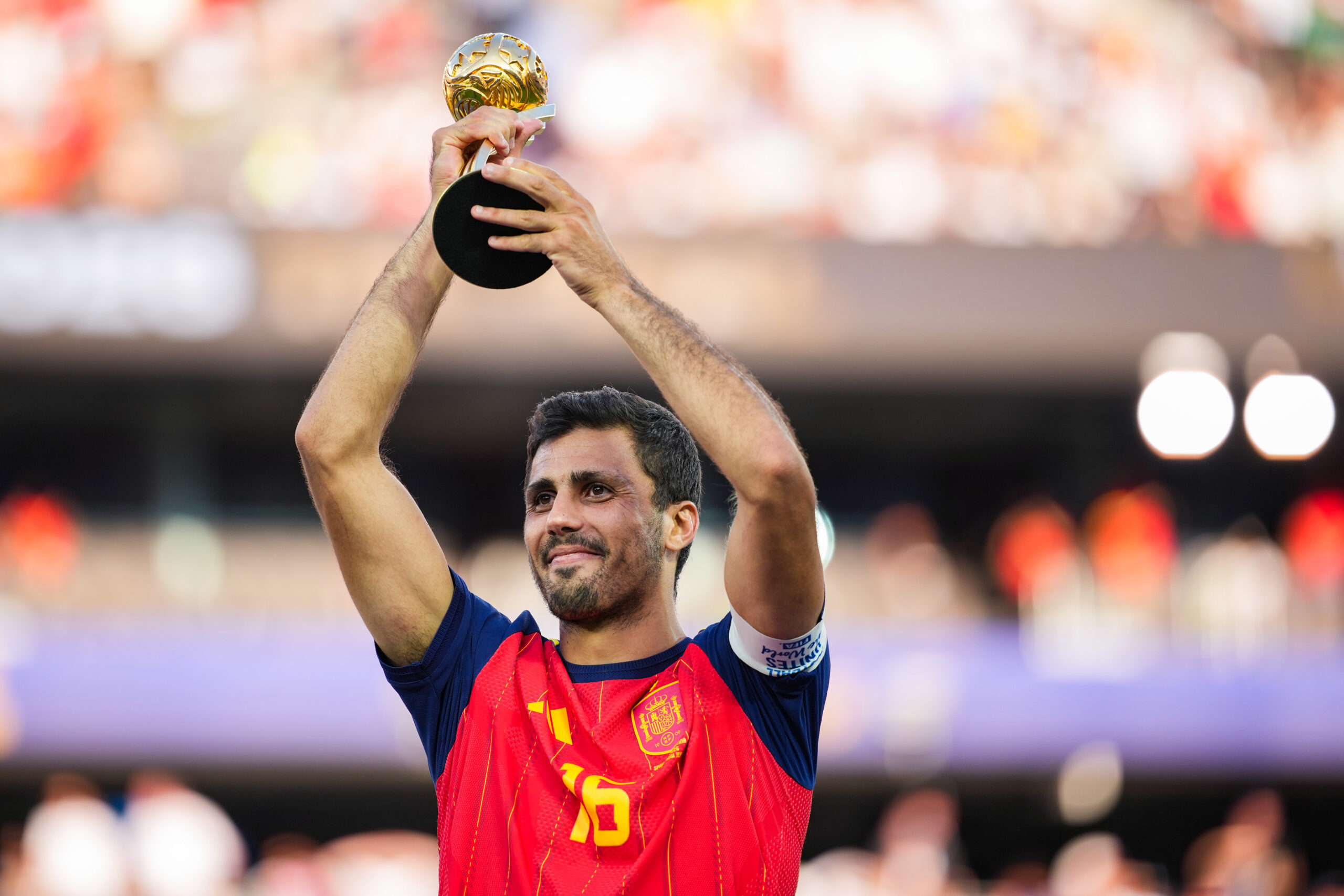
When the name of the Golden Ball Award winner was announced, many were expecting to see a familiar face.
He could be a forward changing the score, or an attacker creating countless goals. Over the years, this trophy seemed to always be closely associated with goals, assists, and decisive moments.
However, as the Golden Glove Award winner Unai Simón stepped down from the award ceremony stage, the host revealed the unexpected name: Rodri.
Countless eyes focused on this Spanish midfielder. He took a deep breath, walked to the center stage, and received his own Golden Ball Award trophy. A player who doesn’t define his value solely by the number of goals, stood on the stage of the highest individual honor in the World Cup.
He is Rodrigo Hernández Cascante, also known as “Rodri” in the football world.
In this tournament, Rodri appeared time and time again in the most crucial positions of the game. When Spain needed to reorganize their attack, the ball often found its way to him; when opponents tried to break through the midfield line, he always appeared at the right moment. He may not be the first one caught by the camera, but he’s often the one dictating the pace of the game.
Every touch, turn, and pass he makes may seem simple, but behind it lies judgment of space, time, and the direction of the game.
And this style of play was not formed overnight. 13 years ago, at 17 years old, Rodri was not even considered to have the qualities to become a top midfielder.
In the summer of 2013, the 17-year-old Rodri left Atletico Madrid’s youth academy.
There was no ceremony, not much attention. At that time, the club evaluated his physical condition and lack of confrontation ability, believing he would find it difficult to meet the team’s requirements for midfielders, and stopped working with him.
For youth academy players, 17 is often a crucial turning point in their professional development. At this age, clubs begin to decide which players are worth investing more resources in and which players need to find another path.
Leaving a prestigious youth system doesn’t just mean changing jerseys; it also means having to fight for another chance to enter professional football.
Fortunately, at that time, though Rodri was not the most eye-catching young player in the market, Villarreal’s scouts noticed him. They saw Rodri’s outstanding technical ability and game reading skills, so Rodri joined Villarreal’s youth team.
At that time, Villarreal had just returned to La Liga from the Segunda Division and was focusing on developing midfielders with ball control and passing skills. After joining Villarreal, Rodri started from the C team, moved up to the B team, and eventually earned opportunities with the senior team.
At the end of 2015, he made his first-team debut in the Copa del Rey.
At Villarreal, Rodri’s role became clearer over time. The team didn’t require him to be a sweeping defensive midfielder covering the entire field; instead, they entrusted him with more organizational tasks.
Receiving the ball from the goalkeeper and center-backs, starting the team’s play, maintaining ball possession when pressured by opponents – these gradually became his main duties, setting the foundation for his playing style at top clubs.
Rodri progressed rapidly. In the 2017-2018 season, at 21 years old, he played 37 matches in La Liga, starting in 36 of them, averaging over 70 successful passes per match with a passing accuracy close to 90%. He was also one of the players with the most interceptions and ball recoveries for the team. In just one season, he officially played 84 matches for Villarreal’s first team. And during that summer, Atletico Madrid began searching for a new midfield core. At that time, Gabi, who had played for Atletico twice and served as captain for six seasons, left, leaving a vacancy in the number 6 position.
Head coach Simeone wanted the team to improve their offensive efficiency while maintaining defensive strength. With Rodri having proven his organizational skills in La Liga, he became Simeone’s top choice. In the summer of 2018, Atletico Madrid brought Rodri back to the Wanda Metropolitano for a fixed transfer fee of 20 million euros plus a maximum of 5 million euros in add-ons.
Five years prior when he left, he was a discarded player in the academy system; five years later upon his return, he had already played 84 official matches with the first team and had become one of the most watched young midfielders in La Liga.
Upon his return to Atletico, Rodri quickly became a regular starter.
In the 2018-2019 season, he played 34 matches in La Liga with a passing accuracy of over 91%, averaging about 65 successful passes per game while maintaining around 2 interceptions and 2 tackles per match.
Atletico only conceded 29 goals throughout the season – the second-lowest in La Liga, with Rodri’s passing numbers ranking among the top midfielders in the league.
However, his second stint at Madrid lasted only a year.
In the summer of 2019, Manchester City paid a release clause of 62.7 million pounds (about 70 million euros) to secure his transfer.
Guardiola was looking for a successor to Fernandinho, and Rodri was deemed the most suitable candidate available in the market at that time.
After joining Manchester City, Rodri’s role in matches further evolved.
He was no longer just a defensive midfielder responsible for defense and tackles but had become a crucial core in the team’s organization of attacks from the back.
His growth over the years allowed him to accumulate the achievements necessary to compete for the highest individual honors.
When Manchester City won their first Champions League, he scored the only goal in the final; when Spain won the European Championship, he was named the best player of the tournament; at the Golden Ball Award ceremony, his name was the last one mentioned. And now, he has reached the stage of the World Cup final.
As time ticked away, the stadium’s sound pressed down from all sides, the opponents pushed their formation forward, trying to change the outcome through repeated attacks. The ball fell to Rodri’s feet. He controlled it, looked up, observed.
In a few short seconds, he saw his teammates’ positions and the space left by the opponents. With one pass, Spain started organizing their play again. There were no passionate rushes or game-changing moments, but the game’s rhythm returned under his control. When the opponents tried to launch a counterattack again, he moved early, cut off passing lanes, making a potential threat disappear before it could materialize.
In eight matches, he completed a total of 790 passes.
This wasn’t the first time he had rewritten World Cup passing records. At the 2022 Qatar World Cup, Rodri broke Xavi’s record of 599 passes in the 2010 South Africa World Cup with 638 passes.
Four years later, he set a new record, pushing the number to 790 passes. The second-place player in this tournament, Pau Cubarsi, had 668 passes, while Aymeric Laporte ranked third with 618 passes, highlighting the significant gap.
These statistics reflect Spain’s control over the game’s rhythm throughout the tournament.
In the final against Argentina, he completed 101 passes in extra time with a remarkable passing accuracy of 96%, winning 80% of his duels, creating 2 chances. Looking at the entire tournament, Spain only conceded 1 goal in 8 matches, and Rodri’s contribution was undeniable.
These numbers wouldn’t be captured in any goal-scoring moments.
Messi led Argentina to the final with 8 goals and 4 assists; Mbappé became the first attacker to score over 10 goals in 56 years with 10 goals.
What Rodri left behind was a different kind of mark: he successfully proved the importance of controlling the game’s rhythm, balancing attack and defense – a contribution more crucial than 8 goals, 4 assists, or participating in 12 goals.
Finally, he stood on the award stage as a defensive midfielder. At the moment of the award presentation, the camera captured him raising the trophy.
But what truly supported that trophy were those moments not caught by the camera, yet appeared time and time again in the right positions.