
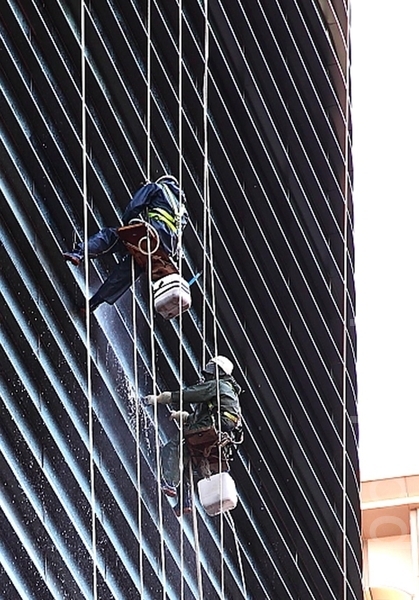
In recent days, in a 60-storey high-rise residential building in Wuhan, Hubei Province, two exterior wall painters were working from the top floor, dangling 200 meters below using double ropes. When they finished work at noon, they checked that the main and auxiliary ropes were intact. However, in the evening when they were working on the 14th floor, one of them discovered that the life-saving auxiliary rope had snapped. The cut was clean with tool marks, and the lower section of the rope was completely missing. Luckily, the primary load-bearing rope was still intact, saving the two workers from a deadly fall.
This incident has sparked a heated discussion online. Many people have come to realize that this seemingly inconspicuous auxiliary rope is the last line of defense for high-altitude workers. Intentionally cutting the rope is equivalent to putting lives in imminent danger.
According to a report by “Xiaoxiang Morning News,” the worker involved, Master Zhou, explained that on July 17th, he and his colleague, Master Xie, were working on the construction of this 60-storey building. Following the mandatory regulations for high-altitude operations, each person was equipped with two independent ropes.
The entire set of ropes extended from the top floor to the ground, totaling nearly 200 meters.
Before taking a break at noon, the two workers specifically checked the ropes, verifying that the main and auxiliary ropes were intact without any damage, and even took simple photos for record-keeping.
When they resumed work at 6 p.m., they descended to the 14th floor using the ropes to paint the exterior walls. Suddenly, Master Xie felt the safety belt loosen as he adjusted his body. Looking down, he saw that the auxiliary rope had completely snapped at the 14th floor, with a large portion of the rope missing from sight. The cut was smooth and clean, clearly indicating that it was deliberately cut with a tool and not due to natural wear and tear.
While the primary rope fixed the suspension platform, bearing the full weight of the workers and tools, the other auxiliary rope was separately anchored to the roof, linked with the full-body safety harness, known in the industry as the “lifeline.” If the primary rope wears out or breaks, the self-locking device on the auxiliary rope instantly locks, preventing a person from falling from a hundred meters above. The dual-rope protection is a mandatory safety requirement.
With only one primary rope supporting them at a hundred meters above ground, both workers were drenched in cold sweat. After carefully completing their tasks, they searched floor by floor for the lost rope segment, but it was nowhere to be found after circling the entire building. They immediately contacted the property management and made a police report.
The report mentioned that the staff of the residential complex had already reported the incident to the police, but there have been no new developments so far.
Many netizens commented that this incident was terrifying. The auxiliary rope serves as a backup, equivalent to providing a second insurance for life; deliberately cutting the auxiliary rope renders the entire dual protection system useless. If the main rope had worn out or slipped at that moment, the consequences would have been unimaginable. The fact that the two workers landed safely can only be described as extremely fortunate.
Some netizens believe that even though there were no casualties in the end, the criminal act has been committed, and the perpetrator should not escape accountability just because nothing tragic happened. The person who cut the rope should be held accountable for “murder.”
Some netizens speculate that the likely motive for the crime was a neighborhood dispute. Many residents in high-rise buildings are unhappy with the noise and paint drips from exterior construction work, or feel that the ropes obstruct their windows and natural light, leading to accumulated grievances that could manifest in actions taken while workers are on break.
An article by “Zhongke Anqi Network Technology” also pointed out that this incident exposed management loopholes in high-altitude operations in high-rise buildings. During construction, rooftop anchor points and mid-levels of the building lack dedicated personnel on watch, and there are blind spots in floor monitoring, providing an opportunity for those harboring grievances. It emphasizes the importance of communication with homeowners before construction, scheduling breaks at different times, and conducting nighttime work to reduce neighborhood conflicts.