
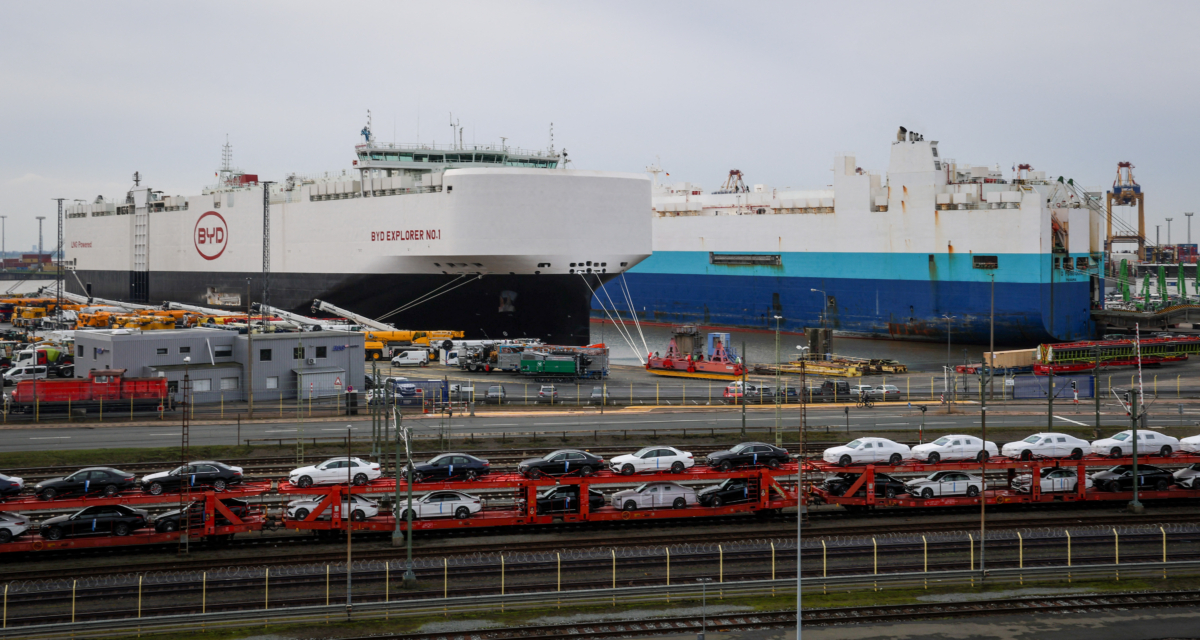
In September, China’s domestic retail sales of passenger cars fell by 28% year-on-year, with a nearly 50% drop in traditional fuel vehicles and a historic high penetration rate of new energy vehicles. At the same time, exports saw a significant increase. Meanwhile, the European Union is considering restrictions on the import of Chinese hybrid vehicles, and China plans to lower the export tax rebate rate for new energy vehicles. Analysts believe that the export dividends of Chinese automakers are narrowing, and trade tensions between China and Europe are escalating.
The China Automobile Dealers Association Passenger Car Market Information Joint Conference (Joint Conference) released data on October 12 showing that in September 2026, national passenger car retail sales totaled 1.618 million vehicles, a 28.0% year-on-year decrease but a 5.0% increase from the previous month. From January to September, cumulative retail sales reached 13.334 million vehicles, a 21.7% year-on-year decrease.
According to Chinese media reports, the Chinese passenger car market in September exhibited five distinct characteristics: overall pressure on sales volume; contraction of traditional fuel vehicles; increasing penetration rate of new energy vehicles in September; exports surpassing domestic demand; and dealers facing significant survival pressure as the traditional peak season of car sales from September to October was notably weaker than in previous years.
The Joint Conference data revealed that in September, retail sales of traditional fuel vehicles decreased by 43%, with a 49% drop in pure fuel vehicles and a 25% increase in conventional hybrid vehicles year-on-year. Among traditional fuel vehicles, domestic brands saw a 47% year-on-year decrease, mainstream joint venture brands a 42% decrease, and luxury brands a 41% decrease.
Retail sales of new energy vehicles declined by 16.7% in September, with domestic brands down by 19%, mainstream joint venture brands up by 36%, and luxury brands down by 8%. The impact of unfavorable subsidy policies on domestic retail sales of self-owned A00-class electric vehicles was more significant.
Sales of domestic brands totaled 1.13 million vehicles, a 25% year-on-year decrease but a 5% increase from the previous month. Domestic brands accounted for a 69.8% market share in September, up by 2.8 percentage points year-on-year.
Mainstream joint venture brands sold 310,000 vehicles in September, a 36% year-on-year increase and a 2% increase from the previous month. In September, German brands accounted for a 12.2% market share, down by 2.0 percentage points year-on-year, Japanese brands accounted for 10.7%, down by 0.9 percentage points, and American brands had a market share of 6.3%, up by 0.5 percentage points year-on-year.
Luxury vehicle retail sales totaled 170,000 vehicles, a 29% year-on-year decrease but a 12% increase from the previous month. With luxury car prices returning to a reasonable level, luxury brands held an 11% market share in September, a decrease of only 0.2 percentage points year-on-year.
The Daily Economic News reported that since April this year, domestic sales of traditional fuel vehicles have been consistently declining, approaching a “half” reduction for four consecutive months since June.
From April to September 2026, year-on-year declines in domestic sales of traditional fuel vehicles were 32.2%, 37.5%, 45%, 45.7%, 45.7%, and 45.3%, respectively.
Overall, from January to September, Chinese automobile production and sales totaled 23.246 million and 23.271 million vehicles, respectively, both down by 4.5% year-on-year. In September, automobile production and sales totaled 2.99 million and 2.956 million vehicles, respectively, down by 8.7% and 8.4% year-on-year.
Regarding the overall performance of the automotive market in the first three quarters of this year, the China Association of Automobile Manufacturers believes that the slight decline in Chinese automobile production and sales reflects a market trend of “cool internal, hot external” dynamics.
Data shows that in September, the export of passenger cars (including complete vehicles and CKD) reached 917,000 vehicles, a 73.7% year-on-year increase, accounting for 36% of the sales volume of passenger car manufacturers (compared to 19% in 2025). New energy vehicles accounted for 60.8% of the total vehicle exports in September.
The Joint Conference believes that export surpassing domestic demand has become a key focus for some car manufacturers, as exporting effectively stabilizes wholesale and profits, with export sales becoming a core driving force for the growth of car manufacturers.
Exports have become a pillar of the Chinese car market, but the policy environment supporting exports is also changing.
The export tax rebate rate for new energy vehicles is facing a reduction. The Chinese Ministry of Finance and the State Administration of Taxation announced on October 12 that starting from April 1, 2027, the export tax rebate rate for new energy vehicles will be reduced from 13% to 9%.
Cui Dongshu, head of the Joint Conference at the China Automobile Dealers Association, told Chinese media that this adjustment will help pressure car companies to abandon low-cost internal competition.
Yang Weibin, an expert in new energy vehicles and power batteries, believes that this adjustment aims to curb new energy vehicle companies from aggressively entering overseas markets by selling at low prices, even at a loss, to prevent fierce competition from spreading abroad.
However, the path of Chinese passenger car exports is not without challenges. The European Union is considering new import restriction measures. The European market is a core region for Chinese electric vehicle exports.
According to a Bloomberg report on October 11, the EU is considering a new car import restriction plan to address the rapid growth in sales of Chinese hybrid vehicles in the European market.
Documents obtained by Bloomberg show that the EU plans to adopt an import quota system to limit the number of relevant vehicles entering the European market.
Under the current plan, the quota for the first year is 350,000 vehicles, increasing by 6% each year from the second year. By this calculation, the second year’s quota is expected to be around 371,000 vehicles, the third year around 393,260 vehicles, and the fourth year around 416,856 vehicles. The plan still needs internal discussions and approval within the EU.
Cui Dongshu, head of the Joint Conference at the China Automobile Dealers Association, estimates that China’s exports of plug-in hybrid models to the EU will approach close to 800,000 vehicles this year. With the impact of the new trade arrangements, export volumes may decline next year.
The Second China-EU Trade and Investment Dialogue (TIC) was held in Beijing on October 8 and 9. Just a day before, the European Parliament passed a resolution overwhelmingly, stating that China’s industrial policies have become a “threat to survival” for the EU and urging swift countermeasures.
Wang He, a China expert, previously told Epoch Times that the imbalance in China-EU trade is a key backdrop for escalating tensions between the two sides. The EU has long suffered from a trade deficit with China, with a significant reason being the high tariffs, corporate subsidies, and numerous non-tariff barriers maintained by the Chinese Communist regime.
Davy J. Wong, an American economist, believes that Europe no longer simply views China as a trade partner, but is increasingly emphasizing industrial security, supply chain security, and technological sovereignty. The underlying logic of China-EU relations is being reshaped.
Wong warns that trade frictions between China and the EU could further escalate. “The possibility of a trade war breaking out is approaching a critical point. It is predicted that there may be a high-intensity localized trade war involving multiple sectors between China and the EU in the future.”