
On Monday, October 12, 2026, the Chinese Communist Party announced sanctions against the Communication Minister of Paraguay and the Foreign Minister of Belize. The reason cited was the continuous official diplomatic relations that these two countries maintain with Taiwan. The Ministry of Foreign Affairs of Taiwan strongly condemned this action, viewing it as a blatant interference in its sovereignty and diplomatic policies. The Paraguayan Minister stated that they will continue to advance cooperation with Taiwan.
Paraguay and Belize are two out of the twelve formal diplomatic allies of Taiwan. Beijing has long been pressuring Taiwan’s diplomatic partners, attempting to force these countries to sever ties with Taiwan, further restricting Taiwan’s international diplomatic space.
In two separate announcements, the Chinese Ministry of Foreign Affairs accused individual politicians in Belize and Paraguay of displaying a “anti-China (anti-Communist)” inclination in promoting and maintaining diplomatic ties with Taiwan. The CCP announced freezing the assets of the two officials within China, prohibiting any organizations or individuals within China from engaging in transactions, cooperation, or other activities with them, as well as refusing to issue them visas or allowing them entry into China, Hong Kong, and Macau.
A spokesperson for the Chinese Ministry of Foreign Affairs, Mao Ning, in Beijing stated that these politicians are “willing to act as pawns” for Taiwan’s pursuit of independence.
These sanctions are largely symbolic since ministers from Taiwan’s diplomatic allies usually do not travel to China. Beijing has previously imposed similar sanctions on Western political figures who support Taiwan.
According to Reuters, Gustavo Villate (also known as Biyade in Taiwan), the Minister of Information and Communication Technology of Paraguay, mentioned in an interview with local media that given the ongoing cooperation projects with Taiwan, including an Artificial Intelligence (AI) Data Center initiative, China’s action was “expected.”
“We are very calm. We will continue to advance all existing projects and will work even more forcefully to promote these efforts,” Villate said.
The department overseen by Villate, along with the US Embassy in Paraguay, issued a statement in July indicating that a joint cybersecurity review found multiple “threat actors” linked to the Chinese government infiltrated Paraguay’s national systems. Beijing denied these allegations at that time.
Paraguay and Taiwan signed a cooperation agreement on Artificial Intelligence infrastructure in May, planning to construct an Artificial Intelligence Computing Center in Paraguay. Previous reports estimated that the investment for this data center project is around 200 million US dollars, with Paraguay aiming for the center to be operational by the end of 2027. The project aims to combine Taiwan’s semiconductor technology with Paraguay’s energy advantages to enhance local technological development.
Shortly before the Chinese issued the statement on sanctions, the Belizean Embassy in Taiwan posted on its Facebook page celebrating the 37th anniversary of diplomatic ties between the two countries (anniversary on October 11). The embassy wrote, “We look forward to a future full of growth, opportunities, and lasting friendship.”
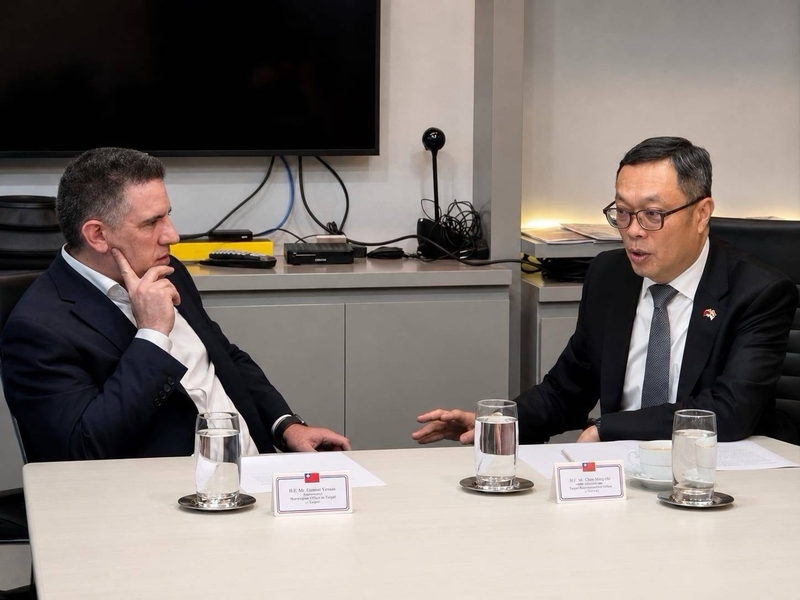
Last month, Belize’s Foreign Minister, Francis Fonseca, met with Taiwan’s Foreign Minister, Joseph Wu, in Belize. In June of this year, Villate also met with Taiwan’s Deputy Minister of Foreign Affairs, Chen Ming-chi, in Paraguay.
At the time of this report, Belize had not responded to the Chinese sanctions.
The Ministry of Foreign Affairs of Taiwan strongly condemned China’s actions, stating that China has no authority to interfere with Taiwan’s diplomatic relations. In a statement, the ministry expressed that these sanctions constitute “a blatant interference in the sovereignty and diplomatic policies of another country.”
The Ministry of Foreign Affairs of Taiwan reiterated that the Republic of China (Taiwan) and the People’s Republic of China (Communist China) are not subordinate to each other. This is an internationally recognized fact and the objective reality in the Taiwan Strait. China (the CCP) has no authority to dictate Taiwan’s diplomatic relations.
President of the Republic of China, Lai Ching-te, stated in his National Day speech on Saturday that Taiwan cherishes peace but will never give up freedom. He noted that the increase in Taiwan’s defense budget is to deter war, maintain peace, and not to provoke conflicts.