
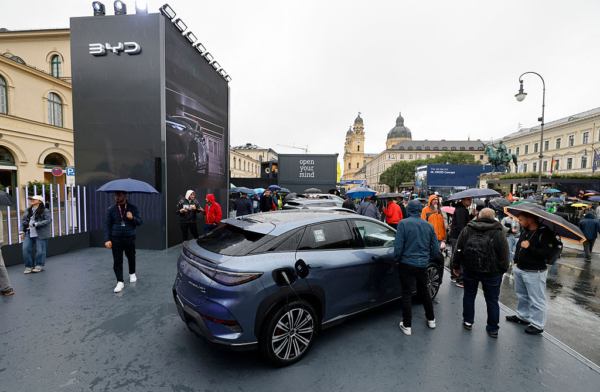
Due to a slowdown in domestic car sales in China and the EU imposing tariffs on Chinese electric cars, Chinese car manufacturers have increased their efforts to export hybrid vehicles to avoid the EU tariffs. However, a deal agreed upon last week between China and the EU to restrict the export of hybrid vehicles will pose new challenges for these Chinese car companies. Analysts believe that if Chinese car companies set up factories in Europe, the EU will still face challenges from Chinese automakers.
According to Reuters, Felipe Munoz from Car Industry Analysis mentioned, “This will make life a bit tougher for Chinese carmakers, but… this won’t stop them, just like previous measures taken by the EU against electric cars didn’t stop them.”
“Europe is gradually coming to a crossroads where a choice has to be made: to follow the American way, or to allow the entire automobile industry to be taken over by Chinese companies,” Munoz added.
Chinese customs data shows that in the first half of this year, the total export value of hybrid vehicles from China to 27 EU countries reached $7.5 billion, triple the $2.5 billion in the same period last year. This figure is nearly nine times the total export value in 2021 ($845 million).
Since the EU imposed tariffs on Chinese electric cars in 2024, more and more automakers have shifted towards exporting plug-in hybrid vehicles, as this type of vehicle is not subject to EU tariffs. Additionally, the weak charging infrastructure in parts of Europe has also supported the demand for plug-in hybrid vehicles, which are favored in the market for their long range and excellent fuel economy.
Data from Jefferies shows that SAIC Group, BYD, and Chery, three Chinese car companies, account for over 90% of the sales of Chinese brand hybrid vehicles in the EU, with hybrid vehicles representing over half of these three companies’ sales in the European market.
Investors generally see the agreement reached last week between China and the EU to limit the export of hybrid vehicles as a signal of easing trade tensions, and believe that plans to impose tariffs on Chinese hybrid vehicles may have been temporarily shelved.
Li Yanwei, an analyst at the China Automobile Dealers Association, pointed out that the rapid growth in sales of Chinese hybrid vehicles is increasingly challenging European manufacturers, including Volkswagen, which has long dominated the sales of plug-in hybrid vehicles in Europe.
Analysts suggest that this agreement may ultimately accelerate the pace of Chinese car companies setting up factories in Europe to produce vehicles, although some manufacturers may try to export ahead of the quota system taking effect.
Bill Russo, founder of the Shanghai-based consultancy firm Automobility, was cited by Reuters as saying, “I think this will strengthen the momentum for Chinese car companies to manufacture in Europe.”
However, export quota measures will still pose challenges for the overseas development of Chinese car companies.
Xiao Feng, Director of Hong Kong and China Industrial Research at CITIC CLSA, recently told reporters, “You can’t expect BYD or other automakers to export cars on a large scale without facing tariffs or other forms of resistance from foreign governments.”
With weakening consumer confidence and reduced government subsidies in China, passenger car sales in the country have continued to decline for most of this year. According to data released by the China Association of Automobile Manufacturers on Monday, September sales dropped by 27% year-on-year to just over 1.6 million vehicles.
China is the world’s largest car exporter but faces increasing scrutiny from trading partners, who are concerned that China’s cheap exports are impacting their domestic industries and affecting trade balance.
According to S&P Global Ratings analyst Stephen Chan, as Chinese car companies seek to offset the impact of a sluggish domestic market, the industry is increasingly relying on overseas markets for sales and profit growth.
As the EU faces mounting pressure and is being called upon to rebalance trade relations with China, European Trade Commissioner Maros Sefcovic stated last Friday, following two days of negotiations with Chinese officials, that the EU and China have agreed to halve the quantity of hybrid and plug-in hybrid vehicles exported from China to the EU.
Two EU senior officials revealed to the Associated Press on Monday that under the agreement, the EU’s annual import quota for hybrid vehicles from China will be set at 350,000 vehicles, including plug-in hybrid vehicles.
Michael Dunne, an expert closely monitoring the Chinese automotive industry, was quoted by Reuters saying, “The next step is to see whether Beijing will comply with the agreement or seek alternative ways, or strive for temporary tariff exemptions.”