
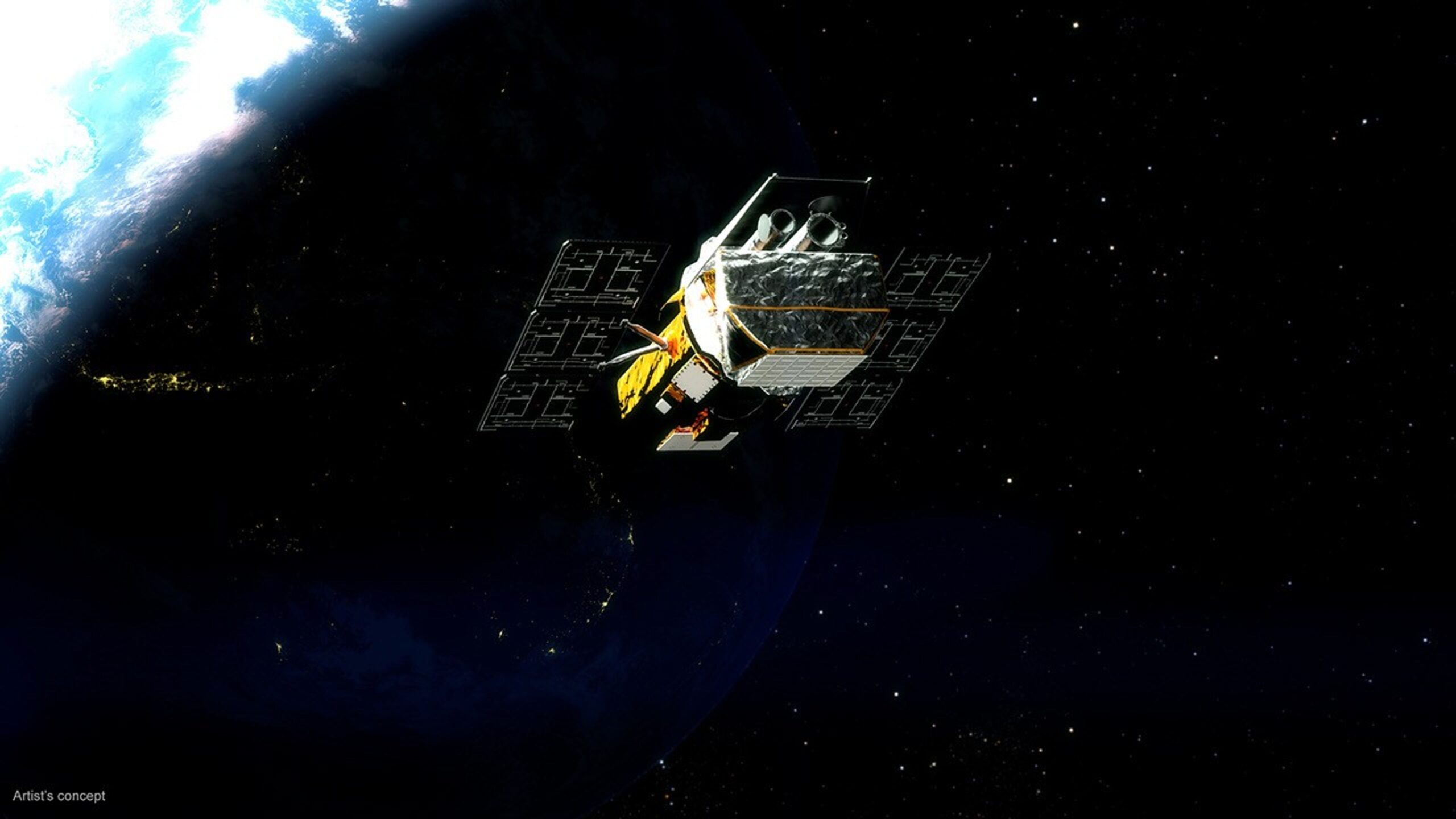
The National Aeronautics and Space Administration (NASA) and Katalyst Space Company jointly announced on Wednesday (August 19) that a commercial rescue mission to save NASA’s aging space telescope, the Neil Gehrels Swift Observatory (Swift), has failed. The main reason for the failure was an irrecoverable attitude control technology issue encountered by the LINK spacecraft responsible for executing the dragging mission in space.
In a joint statement, both parties stated: “After continuous monitoring and evaluation of the LINK spacecraft, we have jointly confirmed that the spacecraft cannot capture the Neil Gehrels Swift Observatory mission, nor can it lift it to a higher orbit.”
However, NASA has not completely terminated the operation. The LINK spacecraft will still attempt to rendezvous with the Swift for a close-range operational demonstration. This will not only showcase the spacecraft’s capabilities beyond capturing, but also collect important data for NASA and Katalyst Space Company and provide guidance for future satellite servicing missions.
The failure of this mission signifies the imminent end for this valuable astronomical telescope, which has been operational for over 20 years. The nominal on-orbit lifespan of the Swift Observatory was originally designed to be two years, but since 2004, it has been studying cosmic phenomena such as gamma-ray bursts, X-rays, ultraviolet, and visible light, making scientific contributions far beyond expectations.
In recent years, increased solar activity has led to an increase in Earth’s atmospheric drag, causing the Swift to rapidly decay in orbit. Without external rescue, it continues to be influenced by Earth’s gravity and is expected to naturally re-enter Earth’s atmosphere and burn up later in 2026.
NASA stated that it will prioritize seeking new solutions in the future to be able to respond quickly to cosmic events, while utilizing existing missions to fill observational gaps.
The LINK spacecraft developed by Katalyst Space Company was successfully launched into space on July 3 via Northrop Grumman’s Pegasus XL rocket.
The original plan was for the LINK to approach the Swift and raise it from its orbit about 347 kilometers from Earth to a higher orbit of about 600 kilometers, thereby extending its operational life.
However, upon reaching space, the LINK spacecraft began to spin out of control. Engineers at Katalyst Space Company spent weeks trying to regain control and uploaded new attitude control software last week, but were still unable to fully stop the abnormal rotation of the spacecraft.
An analysis by the Space.com website noted that the LINK mission itself was filled with challenges. In recent years, increased solar activity accelerated the orbital decay of the Swift, and when NASA awarded Katalyst Space with a contract of around $30 million in September 2025, the company had only about nine months to design, manufacture, and test the LINK spacecraft.
Despite the failure to save the space telescope, the participants have given positive feedback on this bold attempt.
Ghonhee Lee, CEO of Katalyst, stated that after accepting the high-risk, high-reward mission from NASA, the company gained valuable experience and achieved several milestones, planning to apply these experiences to future flight missions.
NASA Administrator Jared Isaacman also emphasized that although this was not the expected outcome, it would not change the significance of the mission. “We will draw many lessons and experiences from the LINK mission and apply them to future missions.”
Shawn Domagal-Goldman, Director of Astrophysics at NASA Headquarters, added that the construction, testing, and operation of this space mission have enhanced the talent pool of the U.S. aerospace industry, “and accelerated the technological development of space-based services in new ways.”