
The US Navy announced a crucial adjustment to its future submarine fleet this week, as analysts believe that China’s increasing military strength in the Pacific region has prompted the US military to prepare for any potential conflicts in the Pacific region.
According to CNN, the Pentagon announced that the planned construction of 19 Virginia-class nuclear-powered attack submarines (SSNs) will be reclassified as cruise missile nuclear submarines (SSGNs), with the addition of Virginia Payload Modules (VPM), which will add 28 missile launch tubes on top of the existing 12 on Virginia-class submarines.
These launch tubes can carry Tomahawk land-attack missiles and hypersonic gliders. Analysts believe that combined with the stealth capabilities of submarines, the new submarines possess a crucial ability to penetrate China’s missile defense systems.
Senior Research Fellow at the Royal United Services Institute (RUSI) in London, Sidharth Kaushal, stated that submarines are one of the few platforms that can conduct patrols near or inside the First Island Chain (a series of islands consisting of Japan, Taiwan, and the Philippines, where China can deploy significant firepower) relatively safely.
Kaushal pointed out that with hypersonic missiles, even adversaries with strong air defense systems would struggle to counter. Deploying these high-speed, highly maneuverable missiles closer to the target would significantly reduce the adversary’s reaction time.
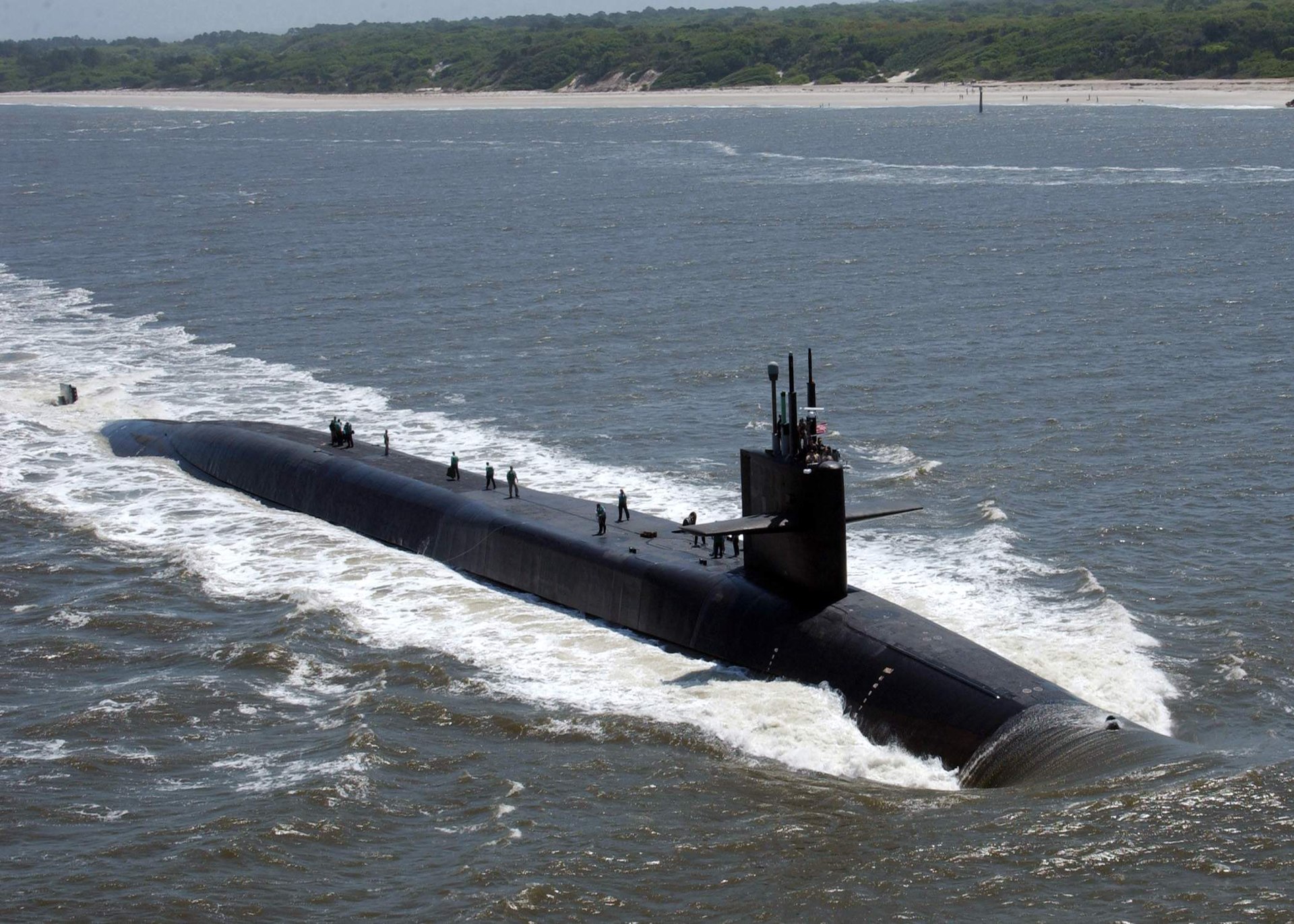
The US Navy began the gradual decommissioning of four Ohio-class missile submarines this year. After the signing of the Strategic Arms Reduction Treaty II (START II) between the US and Russia in 1993, these submarines were converted from ballistic missile submarines to cruise missile nuclear submarines (SSGNs). The four Ohio-class submarines were equipped with Trident ballistic missiles with nuclear warheads, each capable of carrying up to 154 Tomahawk cruise missiles, playing a significant role in global deterrence and operational missions.
During the “Operation Midnight Hammer” against Iranian nuclear facilities by the US military, one Ohio-class submarine was dispatched to support B-2 bombers in strikes, with one having been retired last month and the remaining three planned to be retired in the coming years.
The Submarine Industrial Base Council of the United States stated that after the decommissioning of the four submarines, the US Navy’s underwater strike capability would decrease by up to 60%.
The first Virginia-class SSGN submarine is expected to enter service in 2029, with the final one slated to join the fleet by 2038. This means that during this period, the Navy’s missile strike capability may diminish.
Currently, the Navy has at least 24 small Virginia-class submarines, approximately 20 aging Los Angeles-class submarines, and 3 dedicated Seawolf-class submarines, ensuring the Navy does not lose its conventional submarine-launched missile capability entirely.
Senior US military officials are confident that the addition of 19 new submarines can perfectly replace the Ohio-class submarines. Vice Admiral Rob Gaucher, the head of the submarine program, stated in a release that these new SSGN submarines can ensure the US Navy continues to dominate the underwater domain for decades to come. With the new submarines, the US Navy can significantly enhance its strike capability, safeguard allies, deter aggression, and overcome any adversaries.
Admiral Daryl Caudle, the Chief of Naval Operations, highlighted that the older submarines possess both stealth and unparalleled covert strike capabilities, while the next-generation Virginia-class SSGN submarines are built upon the foundation of these older submarines, with enhanced survivability, adaptability, and sustained operational capability.
Experts caution that the replacement of old submarines with new ones is not a one-to-one swap, as the new submarines can only carry approximately 26% of the missiles carried by the older submarines, with firepower only a quarter of the older submarines. Additionally, the older submarines have two sets of crew rotations, compared to only one for the new submarines, potentially doubling the patrol time compared to the new submarines.
Alessio Patalano, a professor of War Studies and Strategic Studies at King’s College, London, believes that although the new submarines are smaller, distributing missiles to more platforms allows for increased operational depth within enemy territory, forcing adversaries to be constantly on edge.
This aspect is vital in the context of a Taiwan Strait conflict. In preparation for potential military actions against Taiwan, China has been actively increasing its submarine construction efforts. A report by the International Institute for Strategic Studies in February of this year showed that from 2021 to 2025, China’s submarine construction quantity and tonnage have exceeded that of the US (10 vessels compared to 7 vessels, 79,000 tons compared to 55,500 tons).
Simultaneously, China has been rapidly expanding its missile capabilities. In December 2024, the Pentagon estimated that China’s rocket forces had increased missile reserves by 50% over the past four years.
Decker Eveleth, Deputy Research Analyst at the CNA Corporation and an expert on Chinese missile capabilities, warned last year that the Chinese military was preparing for an invasion of Taiwan by targeting ports, helicopter bases, supply facilities, and any infrastructure theoretically supporting Taiwan. Meanwhile, the US military’s ammunition reserves have significantly decreased since the US-Iran collaboration to strike.
Experts argue that the new Virginia-class submarines can significantly offset China’s missile advantages, especially in the early stages of a conflict. US submarines can enter the First Island Chain, gaining strategic positions to rapidly neutralize China’s missile defense radars and command centers, greatly weakening China’s anti-surface capabilities, providing low-risk entry routes for surface vessels, and creating conditions for carrier-based follow-up strikes.
Experts suggest that equipping the new submarines with hypersonic launch capabilities, and as hypersonic gliders’ performance improves, will truly enhance the submarines’ strike capabilities, forming a deterrent against China.
However, experts also caution that China will not passively sit by and will look for ways to flex its muscles through military parades, with many even briefly believing that the Chinese military technology had surpassed the US.
Nonetheless, the US Navy remains confident in outmatching China and continuing to dominate at sea. The Navy’s statement mentioned that the new Cruise Missile Nuclear Submarines (SSGNs) are equipped with advanced sensors, unparalleled stealth, and advanced automation systems, allowing them to operate freely in contested waters, ensuring the US Navy maintains absolute underwater superiority.