
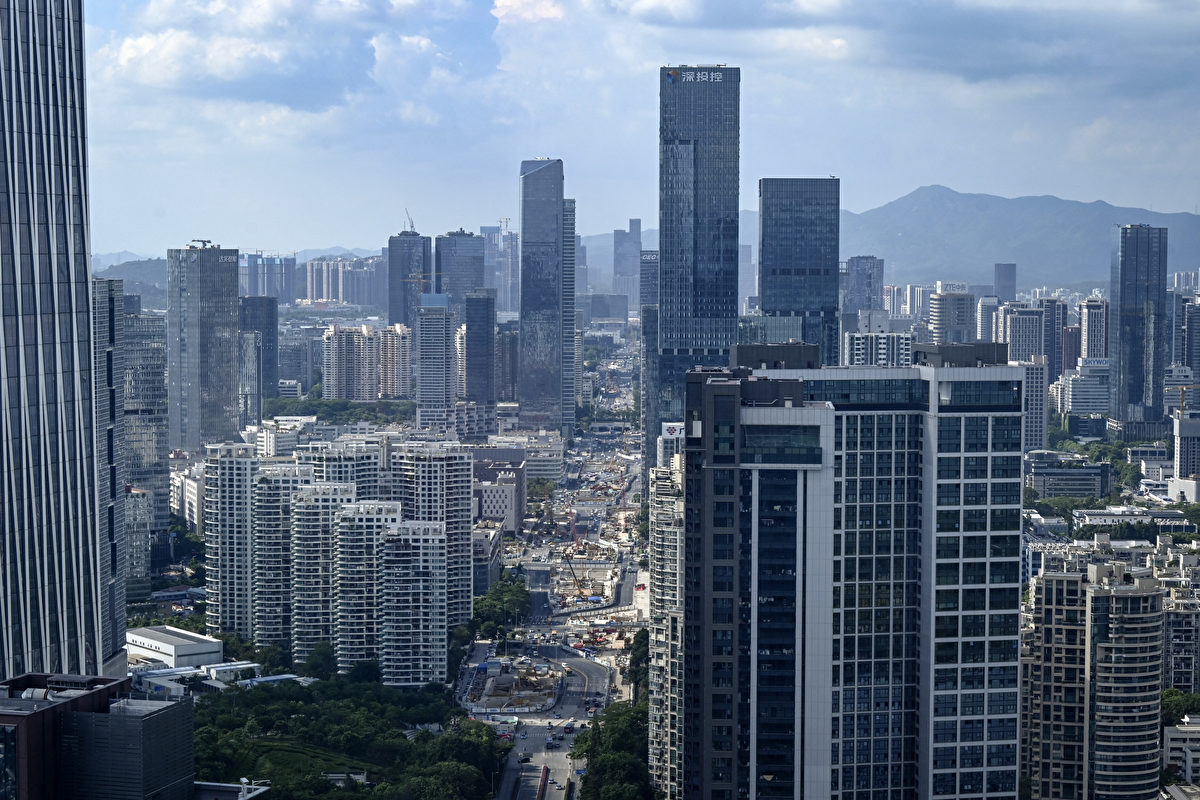
The real estate market in mainland China has been in a long-term slump, with foreign investors seeking significant discounts to sell their commercial real estate and office buildings in the country. At the same time, the supply area and vacancy rate of office buildings in China continue to increase, adding further pressure to the real estate market.
According to reports on August 5th from mainland Chinese media, global private equity giant KKR (Kohlberg Kravis Roberts & Co.) is currently offering substantial discounts to sell its 9 commercial real estate assets in China. KKR, known as the “king of leveraged buyouts,” operates in fields such as private equity, infrastructure, real estate, and private credit.
The long-term rental apartments and Bund hotels being sold by KKR cover nine projects in cities including Beijing, Shanghai, Guangzhou, and Chengdu. Two of the properties, Da Xing Fangyu Apartment in Beijing and Yu Garden JUSt Crystal Hotel on the Shanghai Bund, are already on the sale list with prices around 900 million yuan each.
Reportedly, KKR expects to sell these assets at only around 50% of their initial acquisition cost. For instance, the Fangyu Apartment purchased for 1.87 billion yuan in 2022 is now being sold for approximately 900 million yuan.
Around the same time, international asset management firm AEW Capital Management is also simultaneously offloading its core office building portfolio in Beijing and Shanghai, which includes properties like the Hongsheng International Center in Beijing, the Jingyin International Center, and the Shanghai Pufa Building.
AEW is said to be facing asset depreciation of 40-50%. The Hongsheng International Center, acquired for 4.5 billion yuan, and the Pufa Building, acquired for 2.752 billion yuan, are now being sold at nearly a 50% discount.
In July, there were also reports in the market about FountainVest Partners planning to sell the four grade A standalone office buildings of the Wanda Plaza in Minhang, Shanghai. Acquired for a total of 2.8 billion yuan from Wanda Group in January 2019, the current estimated value for the four buildings is only 1.5 to 1.8 billion yuan, indicating a substantial decrease from the purchase price.
Foreign investors primarily focus on commercial real estate in Beijing and Shanghai, with office investments constituting a significant portion of their real estate portfolio. Since 2019, the commercial real estate market in Beijing and Shanghai has seen a drastic devaluation by over 40%.
Since the end of 2024, investment management companies, including BlackRock and The Carlyle Group, have been actively selling their commercial real estate assets in China at prices significantly lower than their purchase prices.
As a result of the mass exodus of foreign capital from mainland China, the supply area and vacancy rates of office buildings continue to rise, particularly in first-tier cities.
In a recent report on China’s grade A office market for the first half of 2026 released by Cushman & Wakefield, the total new market entry area of grade A office buildings in first-tier cities during the first half of the year reached 802,000 square meters. It is projected that the second half of 2026 will see a concentrated entry of 3.036 million square meters in first-tier cities.
By the end of the second quarter, the vacancy rates for grade A office buildings were 24.9% in Shenzhen, 23.5% in Shanghai, and 22.6% in Guangzhou. Beijing’s grade A office vacancy rate stood at 14.7%, with an estimated addition of around 700,000 square meters of new space entering the market in the second half of 2026, which will directly impact the vacancy levels in surrounding areas.
Xie Jinhe, Chairman of Taiwan’s Wealth Media Group, mentioned on Facebook that the attention drawn to KKR’s actions is due to their selling of properties at 50-60% of market value, which may not be enough to repay bank loans if all properties are completely sold off. This move can be seen as a strategic exit from the subdued Chinese real estate market, implying further challenges in the economy.
Xie emphasized that the withdrawal of foreign investors from Chinese commercial properties indirectly reflects a pessimistic view on the Chinese economy. Particularly noteworthy is KKR’s and PAG’s investment of 470 billion yen in Japanese commercial real estate and the beverage industry. This latest move by KKR signifies a notable shift in direction.
An article by Bloomberg suggests that an increasing number of foreign investors are opting to endure significant losses by selling their Chinese properties as they believe they are trapped in the Chinese property market and finding it challenging to attain returns. This trend may further exacerbate the pressure on the Chinese economy.