
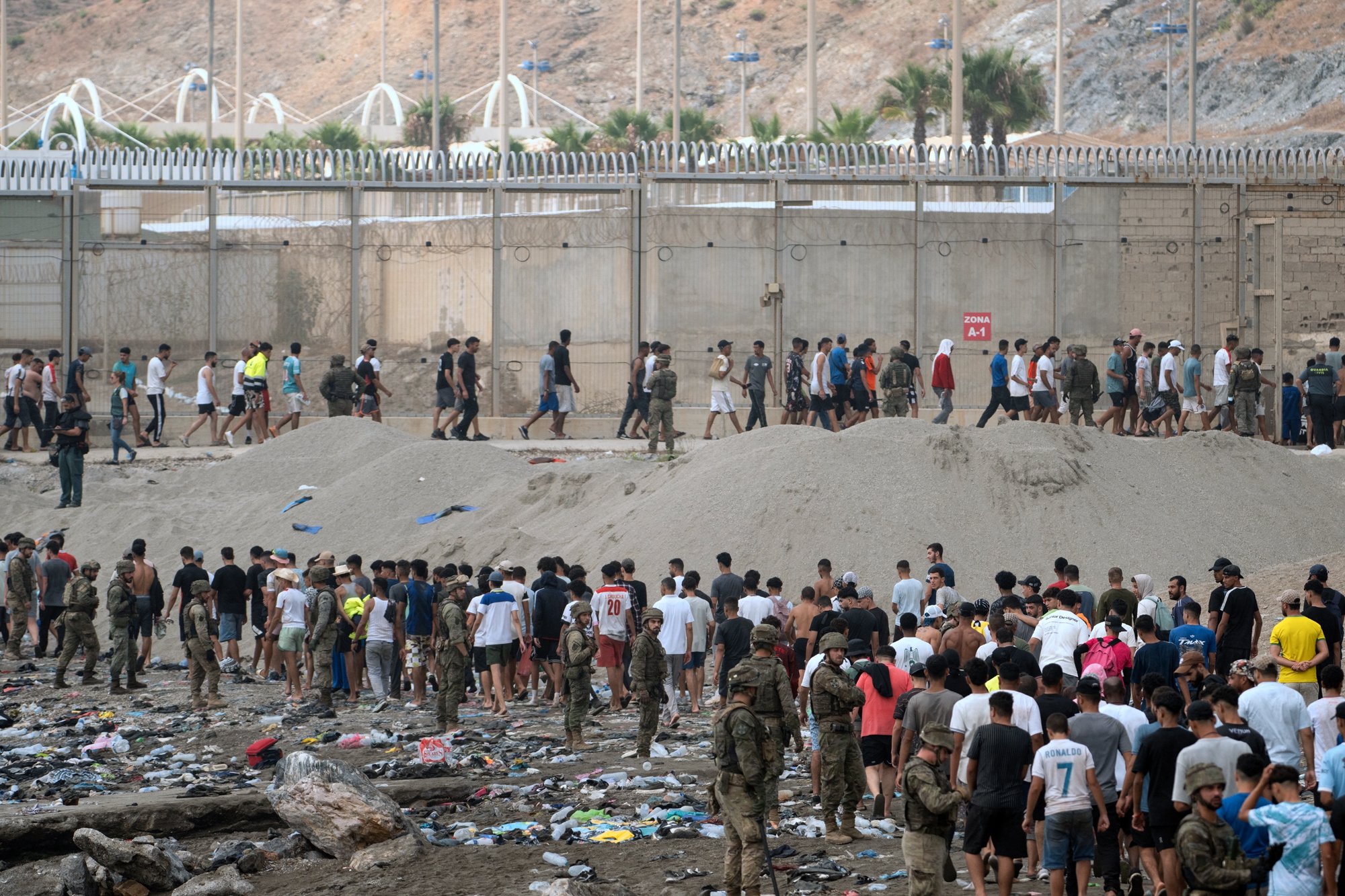
Recently, there has been a large-scale illegal immigrant crossing incident in the Spanish enclave of Ceuta, resulting in at least 88 deaths, sparking heated debates within the European Union regarding border security and immigration policies. Ursula von der Leyen, President of the European Commission, has called for strengthening external border controls of the EU and setting up physical border barriers at necessary locations.
In a report by a European news channel on Monday, von der Leyen wrote a letter to the Spanish Prime Minister Pedro Sánchez, emphasizing the need for the EU to “further strengthen the defense of critical border areas, including rigorous monitoring, and setting up physical barriers when necessary.”
Prior to this, Sánchez had faced criticism from other European governments for his handling of the crisis, with accusations of mishandling the situation. Sánchez, on the other hand, has accused multiple EU leaders of using the immigration crisis in Ceuta to attack his government, with von der Leyen’s actions seen as an attempt to ease tensions with Spain.
She stated that the EU should learn from this crisis and will work in five areas in the future: enhancing cooperation with non-EU countries to prevent illegal immigration, strengthening external border management, establishing early warning systems, combating human trafficking networks, and expediting the repatriation of those without valid residence permits.
Juan Jesús Vivas, the Mayor of Ceuta, had informed the Spanish newspaper El País that the local morgues received 88 bodies, including those of individuals who died in smaller-scale border crossing attempts in the past two weeks. Most of the deceased drowned, while some were crushed to death while climbing breakwaters or border fences.
Morocco has reported a lower death toll, stating that at least 11 people died, with 10 drowning and one falling off a cliff.
The incident occurred around July 29th to July 31st, with an estimated 50,000 to 60,000 people entering Ceuta from Morocco by land and sea (with many swimming around the border).
Following the incident, Spanish police and military continue patrolling Ceuta, and a 500-meter-long floating barrier has been set up in the maritime area bordering Morocco. Local authorities state that the majority of border crossers voluntarily returned to Morocco within 48 hours, with order gradually being restored.
EU member states will hold an emergency video conference of interior ministers on Tuesday to discuss coordinated response measures, including the possibility of reinstating some Schengen internal border controls. Italy announced the temporary suspension of certain Schengen border control arrangements with Spain, reinstating border checks.
However, the incident has also exacerbated divisions within the EU regarding immigration policies. Leaders of 22 countries, including Italy and Denmark, sent a joint letter to the EU attributing the crisis to Sánchez’s recent policy of legalizing around 500,000 undocumented immigrants. They argue that policies that could serve as an “attractive factor” to illegal immigrants must be addressed.
Despite external doubts about Morocco’s tacit approval of migrant border crossings in this incident, von der Leyen still considers Morocco as an important strategic partner of the EU in combating illegal immigration.
She mentioned that the EU is in discussions with Morocco to establish a more institutionalized cooperation relationship, which could strengthen border early warning systems in Ceuta and Melilla, while enhancing technical and financial support to Morocco. Ceuta and Melilla are two Spanish enclaves in North Africa, serving as the only land borders connecting the EU to Africa.