
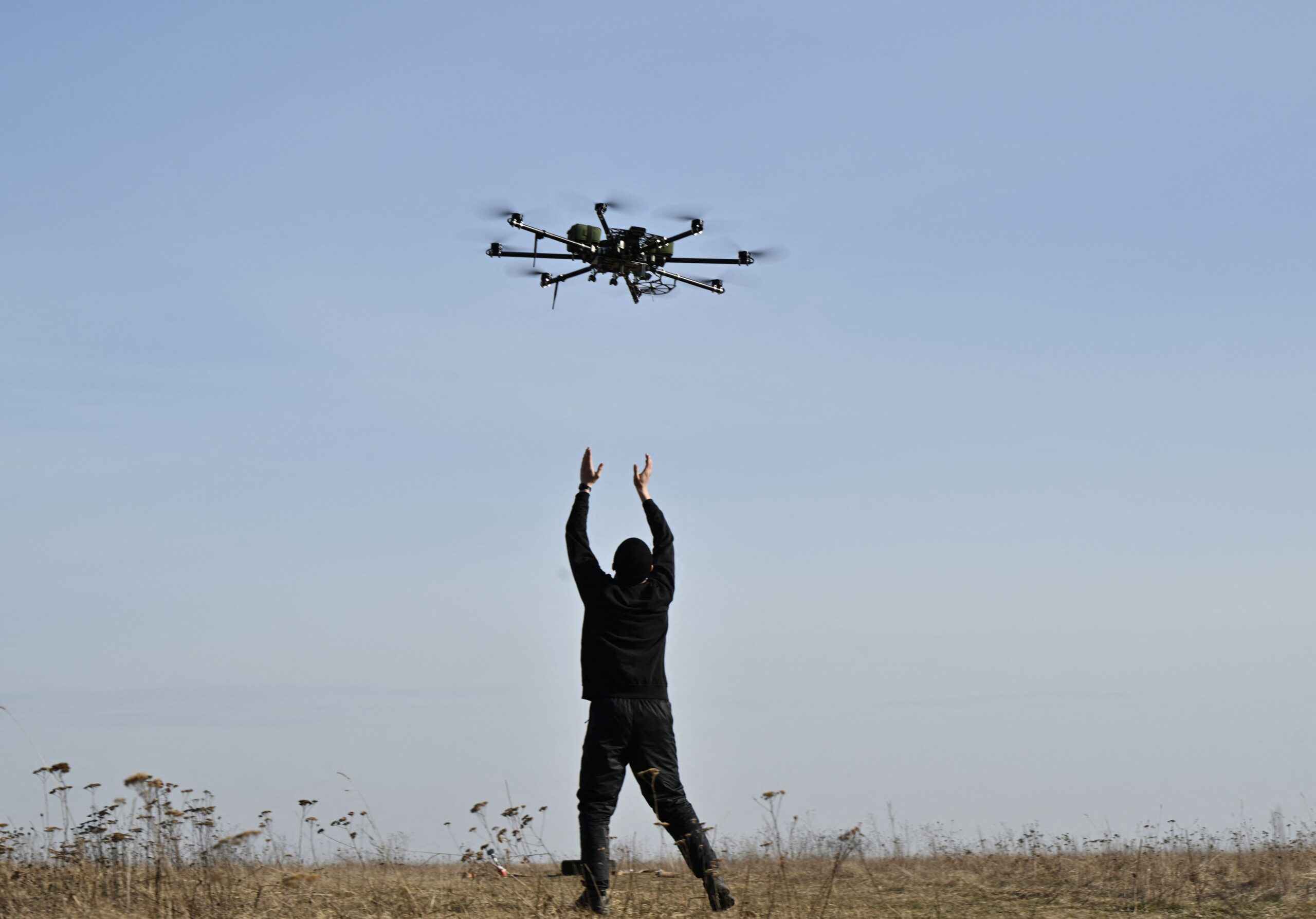
Japan is seeking to reduce its reliance on China and expand its domestic manufacturing industry, as a group of Japanese startups are venturing into the field of defense drones production.
According to a report by Nikkei Asian Review, companies entering this field include Terra Drone, Prodrone, ACSL, and Eams Robotics. Currently, Chinese suppliers, including DJI, dominate 91% of Japan’s industrial drone market. With the loss of market share by local manufacturers, Japan’s production capacity in key components such as batteries, motors, sensors, and flight controllers is also shrinking.
For example, Prodrone announced a partnership with Toshiba on Friday to jointly produce interception drones, funded by the Japan Policy Investment Bank (a government-supported lending institution). This collaboration allows Prodrone to rapidly develop and manufacture various types of drones, combining its expertise with Toshiba in defense radar and command control systems, aiming to establish a domestic supply chain to support large-scale production.
This move aligns with the government’s efforts to rebuild the domestic drone production capacity. Last December, the government set a goal to increase the domestic production share of industrial drones from the current 3% to over 50% in the coming years. The market size is expected to grow from 56,000 units in 2024 to 140,000 units in 2030. The government aims to achieve a domestic supply volume of 80,000 units.
The government aims to develop a type of low-cost interception drone under the label “Made in Japan,” designed to counter various types of attack drones targeting countries in the Persian Gulf, as seen in conflicts in Ukraine and the Middle East.
Defense Minister Shinjiro Koizumi, during his visit to Prodrone in Aichi Prefecture on May 20, stated, “We need a new defense model.” He highlighted the proliferation of millions of cheap drones manufactured and deployed in conflicts from Ukraine to the Middle East.
One such example is Iran’s “Shahed-136,” a piston engine-driven propeller drone with a low cost of $20,000, capable of carrying about 50 kilograms and traveling 2,000 kilometers. Russia has improved this drone and used it to attack Ukrainian cities, launching thousands of units monthly.
Eams Robotics has developed a prototype interception drone for the Japanese Ministry of Defense, with a diameter of about 50 centimeters and an effective payload of 2 kilograms.
Interception drones require target information and navigation support. Eams Robotics aims to use the “Lattice” system, a mission coordination system developed by Anduril Industries based in California, currently undergoing testing by the Japan Maritime Self-Defense Force. Eams Robotics President Eiji Sotani mentioned that his company is in discussions with Anduril for potential cooperation.
Eams Robotics stated that they are also in talks with developers of similar systems like Toshiba and Fujitsu for their drones to achieve interoperability with the Japan Ground Self-Defense Force. The company is also considering partnerships with Ukrainian drone and software developers to obtain permission to produce their products in Japan.
Eams Robotics produces civilian drones, including transport quadcopters with a payload of up to 20 kilograms. The company is also developing a hybrid vertical take-off and landing (VTOL) aircraft equipped with four lift rotors and a fifth rotor for forward propulsion, with a payload capacity of 5 kilograms and a range of 50 kilometers. President Eiji Sotani mentioned the need to find manufacturing partners to expand production.
Based in Tokyo, Terra Drone is dedicated to building a domestic supply chain for interception drones. Terra Drone has a subsidiary called Unifly in Belgium, specializing in drone traffic management services. On Monday, Terra Drone announced that Unifly won a contract to provide defense drone management systems for the Belgian Ministry of Defense.
The company is currently developing an AI-guided interception drone called Terra A1. This rocket-shaped drone is about 50 centimeters high, powered by four electric motors, capable of reaching speeds up to 300 kilometers per hour and flying a distance of 32 kilometers. The drone uses external radar data to approach target drones; once the target is in sight, the onboard AI calculates its flight trajectory and guides the drone to intercept and destroy the target.
On July 15, Terra Drone, along with three other companies, made it to the candidate list for the Japanese Ministry of Defense’s interception drone supply. Tests scheduled for August will determine if these design proposals are viable for mass production.
Prominent traditional manufacturers are also seizing opportunities in the drone production field. Toyota’s tooling and steering system manufacturer JTEKT produces flight controllers and battery components for drones, and has invested in Prodrone.
Automotive powertrain component manufacturer Exedy produces drone propellers and is also an investor in Eams Robotics.
Koizumi, during his visit to Aichi Prefecture on May 20, shared a dynamic of development on the X platform, indicating that Mitsubishi Heavy Industries (MHI) is developing multirotor drones and portable fixed-wing models. This may signal the expansion of the company’s business beyond its traditional focus on large defense platforms, such as the sixth-generation fighter developed in collaboration with the UK and Italy, as well as projects involving Australia’s escort vessels.