
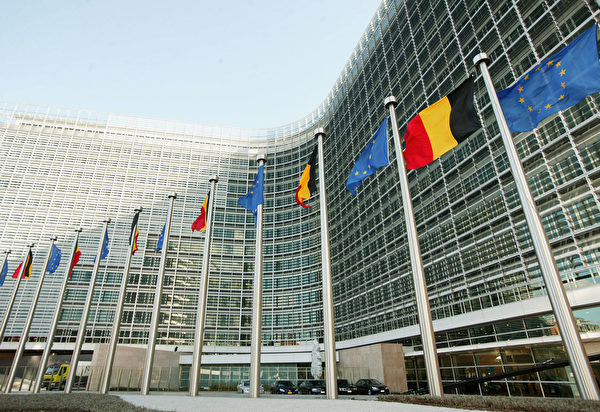
Facing the dual pressure of a surge in low-cost goods from China and a domestic political and economic crisis in Europe, EU leaders will gather in Brussels on Thursday, October 15, to attend a summit aimed at reevaluating the future direction of EU-China trade relations. In this critical game to reshape the EU’s strategy towards China, Germany, as the largest economy in Europe, is breaking away from its cautious stance and taking the lead in pushing for more stringent import restrictions.
The urgency of convening this summit stems from a sharp increase in Chinese exports of automobiles and various industrial products, which has seriously threatened European domestic industries and sparked widespread fears of large-scale layoffs across Europe.
Ahead of the summit, German Chancellor Friedrich Merz issued a warning during a speech in Parliament on Wednesday, October 14, stating that Europe will no longer turn a blind eye to distortions in competition such as high subsidies, currency manipulation, and overcapacity, emphasizing that “anyone seeking a trade conflict with us will find that we are now fighting back”.
Germany, which used to oppose protectionist measures, has seen a drastic shift in its stance. According to Bloomberg, Germany is actively pressuring the European Commission to swiftly expand import quotas originally targeted at Chinese hybrid cars to include more key industrial sectors such as chemicals, mechanical engineering, and pharmaceuticals.
Reuters reported that the policy focus of the European Commission has fundamentally shifted from the past emphasis on “securing access for European businesses in the Chinese market” to “forcing a reduction in China’s exports to the European single market”. Enormous trade deficits in various industries including automobiles, machinery, basic metals, textiles, and chemicals have come under the EU’s restriction radar.
Meanwhile, Germany has formed a strong alliance with France. Last week, Chancellor Merz and President Macron jointly wrote to the European Commission, calling for the establishment of a new trade defense tool – the EU would have the authority to exclude trading partners from the single market when they engage in persistent unfair trade practices (known as a “kill switch” mechanism).
If the Chinese authorities impose export restrictions on rare earths crucial to European automobile and green energy industries in the future, this mechanism will serve as the EU’s “second strike weapon”. According to the Financial Times, this “kill switch” mechanism and the previously agreed upon restrictions on hybrid cars have been packaged in a form of “Global Safeguards” that comply with the non-discrimination principles of the World Trade Organization (WTO), theoretically treating all trading partners equally, but essentially targeting China’s exports by selectively exempting the European Economic Area (EEA) and other regions.
This series of radical restrictions follows the recent agreement reached in early October between China and the EU on the “hybrid car quota case”. According to details disclosed by the Financial Times and The Guardian, starting from December 1, the EU will implement strict quotas of 350,000 hybrids, including oil-electric and plug-in hybrid cars, imported from China annually, significantly cutting over half of the anticipated 800,000 vehicles.
However, the mechanism also exempts vehicles assembled within the EU, with the core intention of compelling the entire Chinese automobile supply chain to relocate to Europe to protect the manufacturing base of Europe.
The hardening positions of Germany and France are driven by the existential crisis facing domestic industries. For instance, in the automotive industry, German car sales in the Chinese market have plummeted drastically, with a 66% decline in German automobile exports to China from 2022 to 2025; meanwhile, new car imports from China to Germany surged by 121% in the first seven months of this year alone. The pressure from domestic competition has triggered a storm of layoffs, with only the Volkswagen Group facing the potential loss of up to 100,000 jobs and plant closures, forcing German politicians and industrialists to abandon their previous cautious stance completely.
The EU is gradually signaling an expansion of trade restrictions. Ursula von der Leyen, President of the European Commission, previously stated that the massive trade deficit with China has reached an “unsustainable” threshold, and the EU will use all possible means to reduce it. Valdis Dombrovskis, EU Economic Commissioner, also emphasized in an interview on Tuesday, October 13, that the trade imbalance between China and the EU is not limited to the automotive industry, and the EU must work on rebalancing multiple industrial sectors simultaneously.
The flood of low-cost goods from China is impacting all of Europe. According to data from the Chinese General Administration of Customs and Eurostat, China’s trade surplus has soared to $938 billion in the first nine months of this year, with the possibility of breaking the historical record of $1.2 trillion set in 2025. Additionally, last year, the EU’s trade deficit with China reached a staggering €360 billion (approximately $402 billion), resulting in a daily deficit of €1 billion, a trend that has continued to expand in the first half of 2026.
In response to this, the Chinese authorities have recently raised substantive objections in their negotiations overseas. According to Reuters, the Chinese side has pointed out that the EU’s colossal surplus figures are “untenable” as nearly half of the trade between China and the EU involves “intermediate goods”, where European companies purchase cost-effective semi-finished products from China, process and upgrade them in Europe, and then sell them globally. China believes that while the trade surplus is credited to China, the actual profits are earned by Europe, in addition to Europe maintaining a long-term service trade surplus with China.
Meanwhile, European leaders are facing severe domestic political pressures. Macron is grappling with a budget standoff, Merz is striving to consolidate his ruling coalition after a setback in local elections, and Spanish Prime Minister Sánchez is lagging in polls. Faced with the growing influence of right-wing and nationalist parties capitalizing on stagnant economic sentiment, mainstream politicians urgently need to demonstrate their determination to protect domestic employment through a tough external trade policy.
Despite warnings from the Chinese Ministry of Commerce that any “across-the-board” plan adopted by Europe would backfire, analysis from think tanks indicates that China’s exports to Europe in the first half of this year ($254 billion) far exceeded its exports to the US ($172 billion), making the EU a more critical market for China.
This gives EU negotiators leverage as they strive to avoid a full-blown trade war. With the push of the Franco-German proposals and the impending first batch of defense measures in December, EU-China trade relations are entering an unprecedented period of tension.