
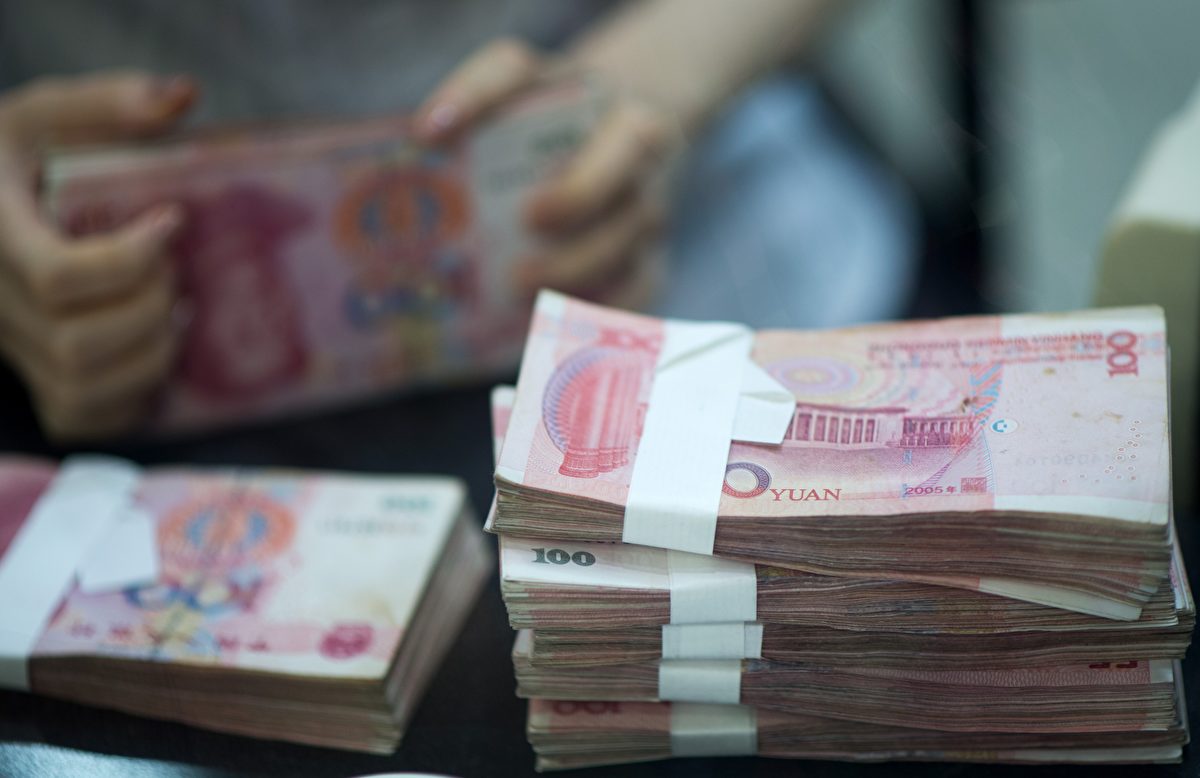
The latest research shows that the debt of the Chinese Communist government continues to increase, especially with government debt interest payments accounting for 19.2% of the fiscal budget. In 2026, it is estimated that the debt interest will reach 1.4 trillion, leaving a difficult fiscal gap to fill.
The latest study by the Conference Board indicates that China’s growing debt burden has become a constraint on implementing new economic stimulus policies. Due to the past reliance on investment-driven growth models, debt interest expenditure has risen rapidly, severely limiting fiscal flexibility.
Research reveals that debt repayment and interest alone are expected to account for 19.2% of this year’s central government general public budget, meaning nearly 20 yuan out of every 100 yuan of fiscal expenditure is used for interest payments. This issue is particularly severe at the local government level, with local government debt interest expenditures increasing by 16% annually during the same period. Overall, it is estimated that the central and local government’s debt interest expenditure in 2026 will reach 1.4 trillion yuan, surpassing the 348 billion yuan in 2014.
A report by the Center for Strategic and International Studies (CSIS) further points out that from 2013 to 2025, the communist regime’s debt interest expenditures surged by 341%, exceeding any other major budget category, such as a 141% increase in defense spending.
Data from the National Finance and Development Laboratory of the China Academy of Social Sciences also shows that from 2021 to 2025, the government sector’s leverage ratio increased by 0.8, 3.6, 5.3, 6.1, and 7.6 percentage points each year, escalating the accumulating burden of interest obligations from ongoing fiscal expansion.
An article in The Wall Street Journal on October 13th suggests that China is caught in a dangerous cycle of debt expansion, with a significant amount of funds wasted on the construction of factories and residential buildings with low demand, leading to a vicious price war. Not only are profits affected, but the situation also impacts wage incomes, stifling domestic economic growth.
Camille Boullenois, the Deputy Director of the Rhodium Group, stated, “The most likely scenario is that the situation continues to deteriorate slowly, the financial system gradually declines, and the efficiency driving growth diminishes.”
Jacob Gunter, the Head of the Economic and Industrial Project at the Mercator Institute for China Studies in Berlin, remarked, “We see that this system (Communist Party) is reaching certain limits of its own.”
Political analyst Xia Yan pointed out that according to annual data, by the end of 2025, China’s macro-financial leverage ratio had risen to 302.4%, an increase of 11.7 percentage points over the year. However, household debt increased by only 0.5% for the whole year, while corporate debt rose by 7.8%. The main contributor to the leverage is the Communist government itself, with government debt balances growing by 17.0% year over year. As the leverage ratio soars and nominal economic growth continues to decline, with nominal GDP growth in 2025 at only 4.0%, economic growth is slower than debt growth, resulting in a continuous increase in leverage ratio, intensifying the pressure to pay interest. This growing interest payment burden further constitutes new fiscal expenses, squeezing resources available for economic growth.
Due to public financial emptiness, the Communist authorities are relentlessly seeking sources of revenue. An article in the Swiss newspaper NZZ recently published under the title “The Wealthy Have Become Targets of Government Tax Hunt,” noted that many local government officials in China are currently unable to pay salaries on time. In the face of financial difficulties, “making money” has become a top priority for local governments, targeting wealthy individuals with overseas investments for retrieval of overdue property taxes.
The biggest problem lies in determining the amount of tax to be paid. Some Chinese citizens received tax reminders listing specific amounts, while others only received vague estimates. Tax authorities claim that estimated taxes can serve as a basis for negotiation between both parties. The tax department’s operational methods do not seem to have formed a fixed pattern yet, but their determination to collect unpaid taxes is undoubtedly firm.
However, Barclays Bank believes that even if wealthy individuals’ overseas investments in other regions of the world can generate tax revenue for the Communist Party’s finances, it may still be difficult to fill the huge fiscal gap, as China’s total macro-debt has exceeded 300% of GDP.