
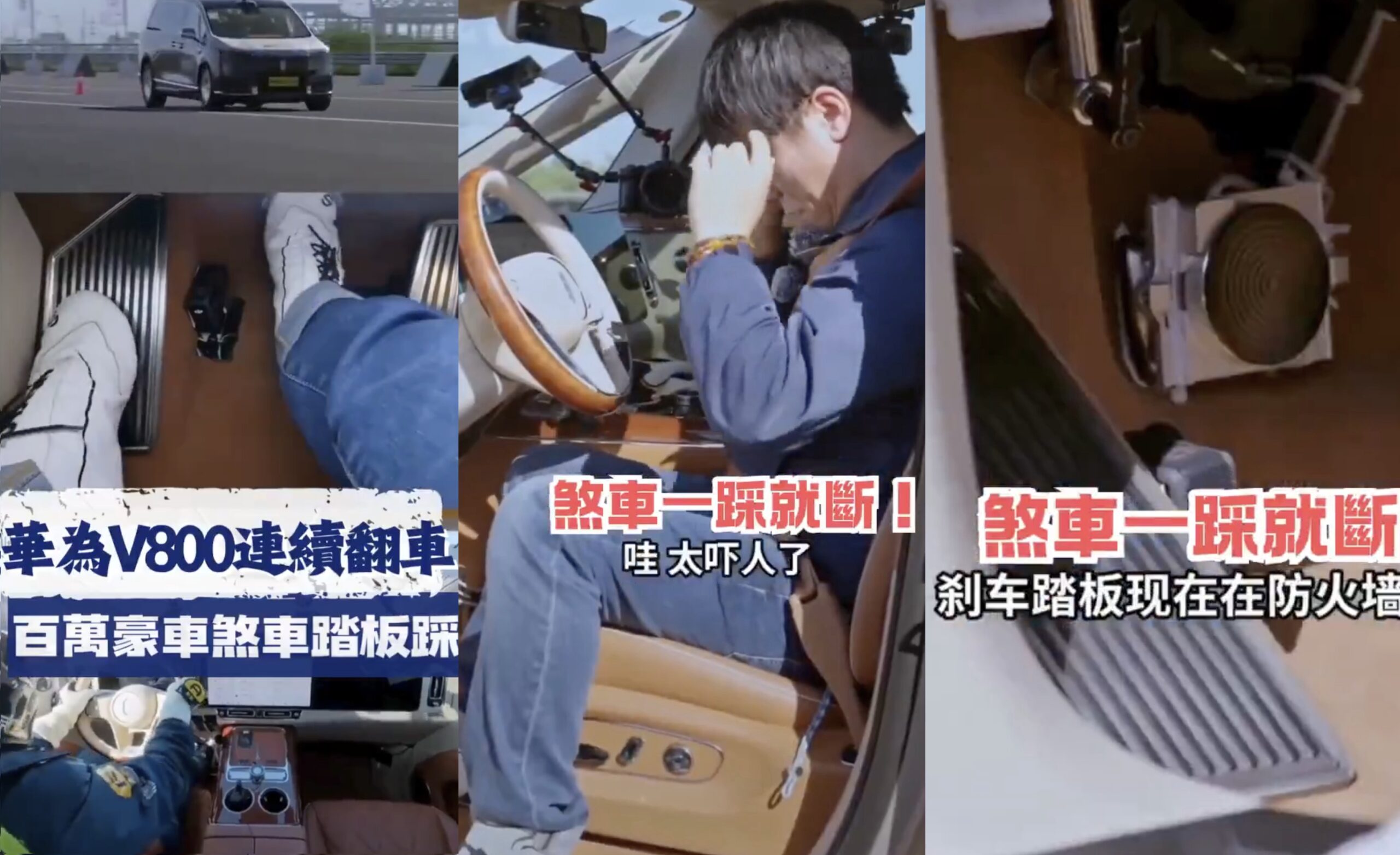
Huawei’s high-end new energy vehicle brand, Zunjie, created in collaboration with Jianghuai Automobile, has recently been embroiled in a controversy regarding brake safety. The vehicle testing platform “Understand Car Emperor” conducted emergency brake tests on three Zunjie V800 vehicles traveling at a speed of 100 kilometers per hour, during which the brake pedal brackets of all three vehicles fractured, raising concerns about the safety of the vehicles’ braking systems and engineering design.
On October 8th, the car information platform “Understand Car Emperor” under ByteDance released a video of closed track testing: 3 new Zunjie V800 vehicles in the “100km/h-0 basic braking performance test” experienced brake pedal bracket failures consecutively while braking at full force at 100 kilometers per hour, with consistent fracture locations and failure modes.
In contrast, the other 8 vehicles tested under the same conditions successfully completed 6 full-force braking tests each without any bracket failures. Following the release of the testing video by “Understand Car Emperor,” discussions surrounding the cause of the fractures quickly emerged.
A vice chief engineer of a Chinese automaker analyzed in a video posted on Tencent and other media outlets that the brake pedal bracket failure on the Zunjie V800 not only involves issues of component strength but also exposes shortcomings in the manufacturer’s engineering design, manufacturing processes, functional safety design, and software strategies.
The engineer pointed out that the longer the lever arm, the greater the bending moment the pivot point must bear under the same pedal force. He emphasized discrepancies between the structural design and load requirements, suggesting that the Zunjie V800’s pedal structure lacked sufficient reinforcement measures given its design features.
Regarding manufacturing issues, the engineer highlighted that the support for the pedal axis of the Zunjie V800 comprised only a single standing plate, while other similar models typically have two to three reinforced standing plates of the same material and type.
Furthermore, he raised concerns about the software control strategies in emergency situations, questioning whether the vehicle’s actual deceleration ability in the conducted test was mainly due to electronic intervention rather than proper function of the conventional braking system.
The engineer concluded that the Zunjie V800 controversy encompasses not just the strength of a plastic bracket but also the connection between structural design, manufacturing processes, functional safety architecture, and fault response strategies.
He emphasized the necessity of complete safety assurance in automobiles, stressing the importance of fundamental component strength design, manufacturing quality control, and system responses to faults.
The Zunjie V800, a large luxury extended-range electric multi-functional recreational vehicle (MPV) jointly developed by Huawei and Jianghuai Automobile, was launched in August 2026 with prices ranging from 766,000 to 1,016,000 yuan. The controversy surrounding the Zunjie V800 has led some owners to reconsider their purchases, with some opting to sell their vehicles despite non-refundable deposits.
In response to the situation, Zunjie Automobile expressed plans to optimize relevant component designs and offer free upgrades to already delivered vehicles. The decision on whether to conduct a recall ultimately rests on the conclusions of defect investigations by regulatory authorities.
On October 11th, the Chinese Ministry of Industry and Information Technology, among other departments, issued a notification prohibiting car companies from engaging in false advertising or neglecting safety responsibilities. This move was interpreted as a response to the Huawei Zunjie “brake pedal fracture” incident. Critics suggest that official announcements are merely cosmetic, and concerns have been raised regarding potential repercussions faced by those who reported the issue, given Huawei’s ties to the Chinese government.