
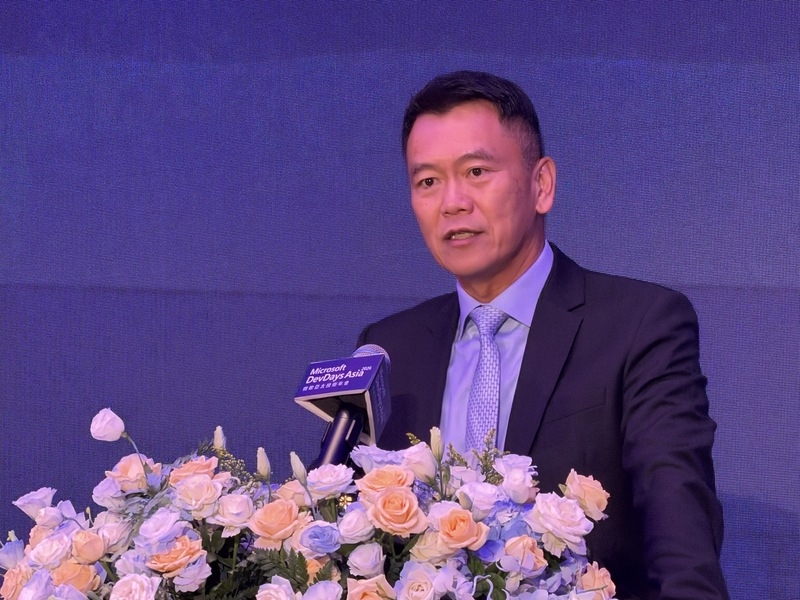
Microsoft Taiwan hosted the DevDays Asia 2026 Asia-Pacific Technology Conference in Taipei today (21st). Chia-Shiang Bian, General Manager of Microsoft Taiwan, stated that the demand for artificial intelligence (AI) computing power will continue to exceed supply in the next 2 to 3 years. Microsoft is actively expanding its data center in Taiwan, with the overall infrastructure expanding from the original 2 sites to 4 sites. In this wave of computing power competition, Taiwan’s role in the supply chain is “undoubtedly crucial”.
When asked by the Central News Agency about the shortage of AI computing power and the expansion plan of data centers, Chia-Shiang Bian responded that the shortage of computing power is not just about shortages of graphics processing units (GPUs) or central processing units (CPUs), but also includes issues like power supply and space allocation for new server racks. It is necessary to not only build new data centers but also reconfigure the existing facilities.
He emphasized that the trend over the next 2 to 3 years will still show a demand for AI computing power greater than supply. While Microsoft is pursuing revenue and profit growth, its core goal is to meet customer demands.
Chia-Shiang Bian stressed that in this global competition for computing power, Taiwan’s supply chain will benefit significantly and play a crucial role. From AI servers, computing, storage to networking, Taiwan is a key player driving overall computing power worldwide. In the short term, no major changes can be seen, nor is there any leakage or loss of market share to other regions.
To address the bottleneck of computing power and meet local regulatory requirements, Microsoft is accelerating the construction of data centers in Taiwan. Chia-Shiang Bian revealed that the services provided by Taiwan’s data center have expanded from over 70 items to more than 200 items, with the overall infrastructure expanding from the initial 2 sites to the soon-to-be-opened 4 sites.
He mentioned that the Taiwan data center is classified as a Hero Site within Microsoft’s global infrastructure, adopting a 3+1 configuration, which can connect to data centers in other regions of the Asia-Pacific and around the world through networking. Many corporate clients who connect to the Taiwan data center are able to reach global customers immediately. Currently, the Taiwan data center has a large number of clients, mainly including highly regulated industries related to data sovereignty, such as government agencies, healthcare, and finance.
Regarding the progress of Microsoft’s self-developed chips that the public is concerned about, Chia-Shiang Bian pointed out that the design, production capacity, and future applications are progressing very smoothly. As a driver of AI applications such as Copilot and Microsoft 365, Microsoft’s services require massive front-end inference capabilities, with highly predictable and controllable behaviors, making them extremely suitable for improving efficiency and reducing computing power costs through application-specific integrated circuits (ASICs).
He mentioned that AI has transitioned from virtual conversations to practical applications this year, expanding deployment from the cloud to directly reaching consumers through end devices. The core goal of the Asia-Pacific Technology Conference of Microsoft is to assist enterprises in establishing AI development models that embody both “intelligence” and “trust”, accumulating their own intellectual assets to create unique value.
Regarding the ecosystem of AI basic models and partner competition, Wan-Yu Chen, Chief Operating Officer of Microsoft Taiwan, stated that Microsoft Azure is the only platform in the world that embraces all aspects in the realm of cloud and AI. Whether it’s OpenAI or the latest models from Anthropic, they are first released on Microsoft’s cloud platform. Microsoft focuses on providing rigorous cybersecurity control and human-responsible AI architecture, allowing enterprises to autonomously determine the most suitable AI tools in a secure and controllable environment.