
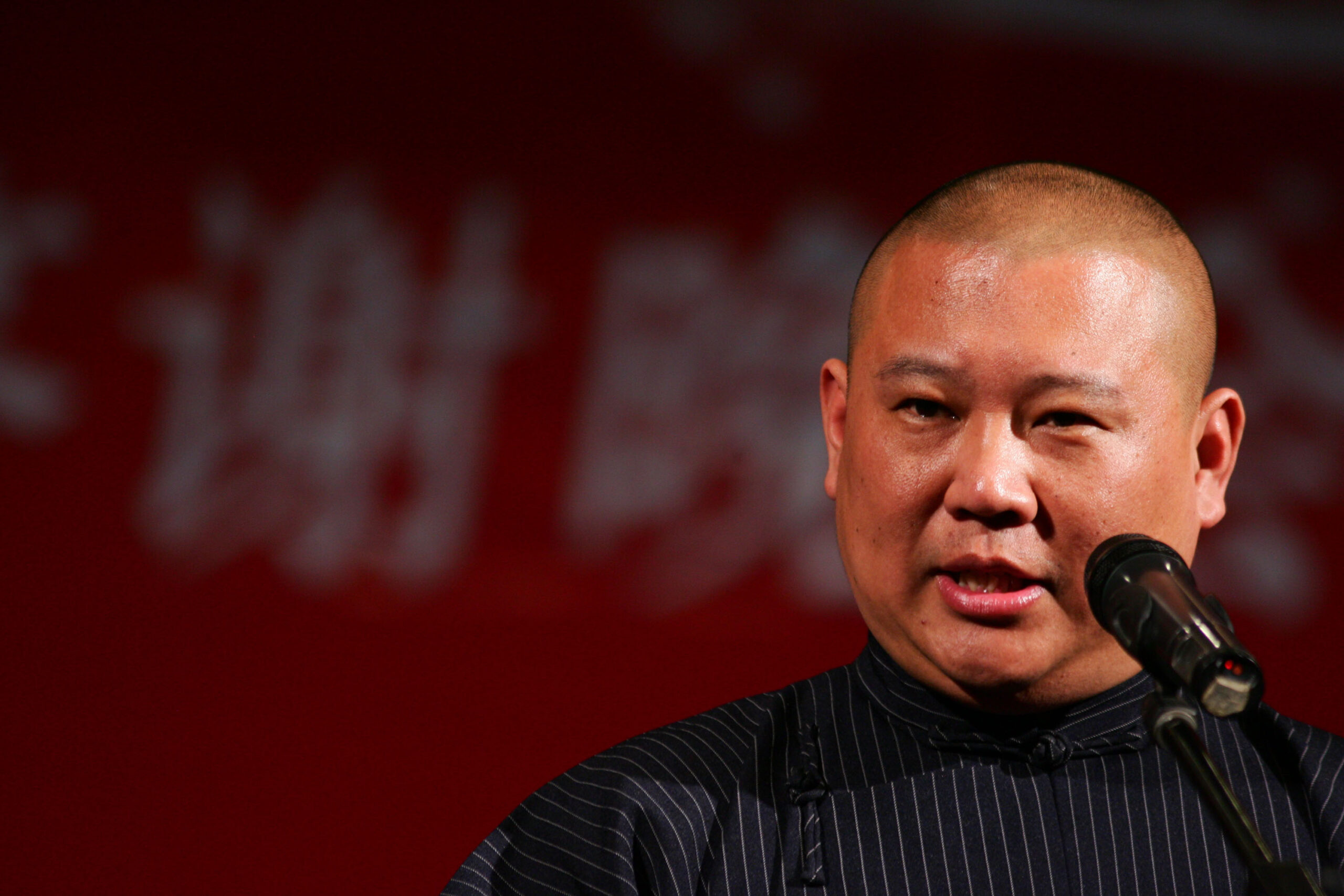
On August 16, 2026, Chinese renowned crosstalk performer and founder of De Yun Society, Guo Degang, had his scheduled performance in Xi’an canceled due to an improvised altered lyric performance in Wuhan that led to an investigation. Analysts have labeled this event as the “Communist Party’s beginning of the Cultural Revolution movement,” and it’s anticipated that the entire Chinese artistic community will face systematic scrutiny.
Guo Degang’s performance on August 15 at the Xi’an Greenland Poly Theatre for the 10th-anniversary tour of Kirin Drama Society was officially canceled. According to news reports citing the Xi’an Greenland Poly Theatre, the venue received a cancellation notice, and ticket refunds are currently being processed.
The controversy stemmed from Guo Degang’s impromptu lyric change during a performance in Wuhan. On July 24, during a performance of “Jigong Living Buddha” at the Kirin Drama Society in Wuhan, Guo Degang humorously altered lyrics of the Red movie “Railway Guerrilla” insert song, “Strumming My Beloved Pipa,” to include playful lines like “The sun in the west is about to set, the Forbidden City is quiet.”
The Wuhan Cultural and Tourism Bureau subsequently responded to the incident. On August 11, the government agency issued a statement saying that although the performance had legal approval, Guo Degang’s altered singing segment was not reflected in the submitted materials and was suspected of violating the “Regulations on Commercial Performance Management,” prompting a formal investigation.
These rapid developments have attracted significant attention from the public. In an interview video, a man from Beijing shared his personal viewpoint on the matter. He remarked, “Not only was Guo Degang reported for his crosstalk, but any segment by any crosstalk performer could be reported. Every crosstalk piece contains satire.”
He pointed out that crosstalk performances encompass both celebratory and satirical expressions, with audience interpretation being key. If someone feels targeted or uncomfortable with a particular line, “then it’s aimed at you, and if it makes you uncomfortable and unhappy, do you want to censor it?”
Referring to the issue of whether Guo Degang’s crosstalk reflects societal criticism, the man cited traditional crosstalk performers and their works as examples.
He mentioned how previous crosstalk pieces also featured significant social critiques, such as ” Buying Monkeys” by Ma Sanli and the “Thief Company” by Niu Qun and Feng Gong. These works, he argued, utilized exaggeration and irony to create humor, serving as essential expressions in crosstalk.
He opined that while other performers are affiliated with official institutions, Guo Degang operates independently as an individual.
Contrary to the grassroots perspective of the Beijing man, independent critic Zhen Fei delved into a more systematic analysis of the same event from the perspectives of artistic tradition and censorship.
Zhen Fei mentioned that in terms of artistic form alone, Guo Degang’s altered lyrics are a common spontaneous display in traditional performing arts. She emphasized that the controversial aspect was not the “alteration” itself but the context change that ensued.
The song “Strumming My Beloved Pipa” is an insert from the movie “Railway Guerrilla” and was later selected as part of the official celebrating the 70th anniversary of the Communist Party of China. Zhen Fei pointed out that this song holds unique political and cultural attributes due to its historical context.
She argued that the original lyrics’ geographic reference to “Weishan Lake being quiet” was laden with clear historical narration, and by changing the location to the “Forbidden City,” Guo Degang evoked entirely different associations within the traditional cultural context.
Zhen Fei revisited several controversies involving Guo Degang over the past year.
She mentioned a November performance of “A Timid Hero” by De Yun Society in Beijing’s Beizhan Theatre, where Guo Degang and Yu Qian mocked the chaotic management of cultural units, touching on themes like “non-experts leading experts.” Following this, relevant authorities in Beijing’s Xicheng District called for rectification.
Subsequent Kirin Drama Society Beijing opera performances and segments from Guo Degang’s April performance in Sydney, Australia, also sparked reports and controversies.
Zhen Fei observed that from the initial talks and advice to the current investigation, the regulatory pressure on Guo Degang has been gradually escalating.
During a recent episode of a self-media program, former Shanghai entrepreneur Hu Liren discussed the latest developments in the case. He stated, “The latest news domestically indicates that Guo Degang has been controlled, and all De Yun Society activities have been suspended; furthermore, the authorities are investigating his finances.”
Hu Liren believed that the nature of these actions isn’t as straightforward as discussed by the public. He recounted a segment that he believed “directly hit the Chinese Communist Party,” noting that this segment was subsequently taken down.
He recounted, “Guo Degang narrated a story about a bandit who first robbed with a sickle and got caught, then tried robbing with a hammer and got caught again, and when he put the sickle and hammer together, implying joining the Communist Party, the previous bandit incidents became his party years.”
According to Hu Liren, such expressions openly criticizing the Communist Party by implying that “you are just a bandit” could have led to severe consequences during the Mao era.
He emphasized that Guo Degang’s influence in China is a critical factor in this incident. He asserted that the larger Guo Degang’s impact, the more sensitive the authorities become.
Hu Liren declared, “The actions against Guo Degang are not isolated but mark the beginning of a movement,” referring to it as the “Communist Party’s initiation of the Cultural Revolution movement.” He predicted that the entire Chinese artistic community will undergo systematic scrutiny. Hu Liren highlighted that some previously online works have been dug up for political review.
Regarding specific measures, Hu Liren explained that if the Communist Party intends to take action against someone, they can easily investigate their finances. This scrutiny could lead to seizing assets following arbitrary excuses and then serving hefty tax bills, potentially leading to the ruin of families and personal wealth.