
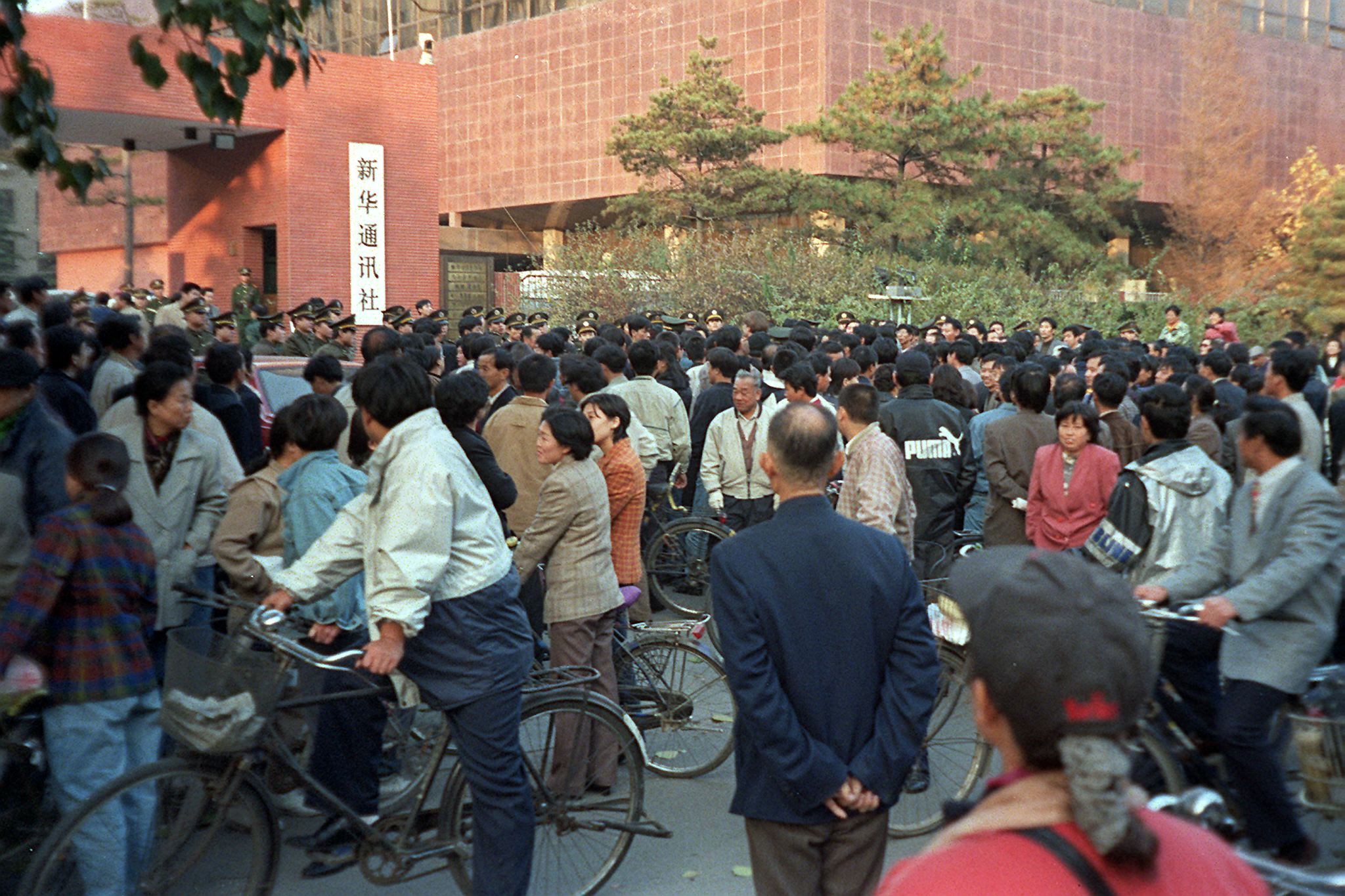
With the passing of former Chinese Premier Zhu Rongji, the series of systemic reforms he advocated during his lifetime have once again become a hot topic of discussion. The reform of state-owned enterprises initiated by Zhu facilitated a leap in economic growth by removing systemic barriers, but it also brought about tremendous pain for a large number of grassroots workers.
Many witnesses of the “wave of unemployment” expressed their sentiments, acknowledging that while the reforms indeed created economic growth miracles, the massive cost behind the transition was quietly borne by tens of millions of ordinary workers, while interest groups formed by the combination of power and capital acquired more resources.
According to official media reports, former Chinese State Council Premier Zhu Rongji passed away on Wednesday (August 12) in Beijing at the age of 97. From 1991 to 2003, Zhu served as Vice Premier and then Premier of the State Council of China for over a decade. Under Zhu’s leadership, the Chinese State Council launched a series of systemic reforms in state-owned enterprises, housing, healthcare, education, and food.
With Zhu Rongji’s passing, the “grasping the large and letting go of the small” policy in state-owned enterprise reform that he spearheaded has once again stirred up public discourse.
Recently, Li Chuanliang, former Deputy Mayor of Jixi City, Heilongjiang Province, reflected on the state-owned enterprise reform during Zhu Rongji’s era and its impact on laid-off workers in an interview with a media outlet.
He believed that considering the economic environment in China at that time, the overall direction of state-owned enterprise reform was correct and in line with the tide of history. Many state-owned enterprises were already trapped in difficulties like “triangular debt,” and some companies found it challenging to continue developing. Li Chuanliang cited an example of a northern steel company that brought in market mechanisms and strategic investors after the reform, significantly improving operational efficiency but leading to many workers being laid off.
He mentioned that the song “Starting from Scratch,” which became widely known, depicted the plight of the laid-off workers. The background of the song was the massive unemployment caused by state-owned enterprise reform in China in the 1990s.
However, Li Chuanliang emphasized that the actual difficulties faced by the laid-off workers should not be overlooked just because the reform was deemed necessary.
He noted that he had come into contact with many laid-off workers and witnessed their life experiences, where some struggled with low income after losing their jobs and had to resort to setting up stalls or engaging in other work to sustain their families.
Li Chuanliang pointed out that a significant portion of the re-employment training funds at that time were misappropriated and squandered by official institutions and not used properly for re-employment training. Issues with medical security also plagued many laid-off workers, as their medical insurance was inadequately addressed, resulting in difficulties in seeking medical treatment becoming a widespread problem.
In the absence of proper solutions to these challenges, some laid-off workers were plunged into long-term difficulties and further resorted to large-scale petitioning. Li pointed out the inherent flaws in the system created by the bureaucratic regime of the Chinese Communist Party.
These issues ultimately became the long-term “sequelae” left by the state-owned enterprise reform.
Several individuals who experienced the wave of unemployment firsthand shared their real-life experiences with the media.
Liu Jianguo (pseudonym), a laid-off worker from Yuzhou City, Henan Province, reminisced with the media, stating that he began working at a collectively-owned enterprise that produced ceramic machinery, cast iron pipes, small lathes, and planers in 1981. The factory employed over 500 formal workers at that time, who resided in large dormitories with a canteen on-site. The monthly salary was 21 yuan, supplemented with a 5 yuan meal allowance, but the meal fee of 16 yuan was directly deducted from the salary, resulting in a net pay of 10 yuan per month.
Liu Jianguo, originally from a rural area, chose to stay in the city instead of returning to the countryside per his parents’ arrangement. He later married a woman from the city, obtained land to build his own single-story house, and completed construction when he was 35.
In his view, the factory in that era was not just a job, but a cornerstone of many people’s lives. Workers relied on the housing, canteen, and relatively stable work environment provided by the institution. Few expected that one day these amenities would suddenly disappear.
In the 1990s, he experienced layoffs, buyouts of work years, and restructuring, which led him out of the original work system. He then traveled to Guangzhou, Zhengzhou, and engaged in various businesses, selling small goods, dealing with overstocked goods, and operating in the food and antiques industries. Currently, he does not receive a pension and works as a security guard in his neighborhood.
Reflecting on his former colleagues who entered the factory with him, Liu Jianguo noted that many of their life paths diverged from his own. He remarked that many rural youths who joined the factory with him were even worse off than him, with numerous individuals becoming disconnected from society.
In his opinion, while the downsizing itself caught many people off guard, the larger issue was that individuals who had long been in stable work environments often did not know what steps to take next once they suddenly lost their identity and source of income.
He also mentioned that some of the young people who entered the factory with him experienced broken marriages later on.
From entering the factory to seeking self-employment after being laid off, Liu Jianguo’s journey spanned several decades of dramatic changes in the Chinese economy. He is just a microcosm among the millions of unemployed workers.
Zhou Xiaomei (pseudonym), a laid-off worker from Yining City, Xinjiang, shared her story with reporters, revealing that she was laid off from a paper manufacturing company in 2003 when she was 30 years old, and her husband was 36 years old at the time, both leaving their respective positions simultaneously.
Zhou Xiaomei worked at the former paper mill for 13 years. Recalling the past, she remembered that there were around three to four hundred workers at the factory, and after the layoffs, most workers at the plant were sent home. Zhou Xiaomei shared that she received 13,000 yuan (buyout of work years) and her husband received 15,000 yuan. She revealed that her biggest fear at the time was the lack of future security.
She expressed, “I was most afraid at that time that when I got old, I would not have a pension, no food to eat, and would have to collect junk during the winters.” This constant worry haunted her for over twenty years, leaving a lasting psychological impact on her life.
This fear served as the driving force for Zhou Xiaomei to work tirelessly after being laid off. She mentioned, “We used to leave home early and return late; our neighbors thought my husband and I had divorced and moved away.”
With only one child and retired in-laws who could help care for the child, Zhou Xiaomei went on to work in food processing and private enterprises, changing jobs several times and eventually working until retirement. While her monthly wage gradually increased from a few hundred yuan initially, the years of laboring were not easy.
Even after retirement, Zhou Xiaomei did not fully stop working. Currently, she works as an accountant at a state-owned enterprise cafeteria (as a contracted worker or outsourced worker), responsible for daily accounting and monthly reports.
Looking back on the more than twenty years since being laid off in 2003, Zhou Xiaomei admitted that her initial fears had not completely vanished. Nonetheless, her life had moved forward step by step. She said, “There’s no choice. Although life has mistreated us countless times, we still have to live well.”
Zhong Jianping (pseudonym), who worked at a state-owned petrochemical enterprise in Henan for 15 years before transitioning to entrepreneurship, recounted his experiences with state-owned enterprise reform, worker layoffs, and the changes post-enterprise marketization during an interview.
Zhong Jianping joined the workforce in 1999 when state-owned enterprise reform was already underway, with some assets being transferred to tertiary sector units. Since he did not belong to the original state-owned enterprise structure, he did not undergo the process of buying out years of service like the older workers. However, many long-term employees already within the state-owned enterprise system were “reformed out” during the process.
He mentioned that in the petrochemical enterprise he worked at, various sums were frequently distributed to employees to facilitate the smooth progress of the reform. He remarked, “To advance the reform smoothly, our unit frequently gave small sums of money to employees.”
While not entirely dismissing the necessity of the reform at the time, he acknowledged that several old state-owned enterprises faced severe issues such as systemic rigidity, personnel burdens, and favoritism. However, he also believed that the reallocation of personnel, equipment, and assets during the reform process resulted in the loss of state-owned assets and other problems.
He noted that after the enterprises transitioned from state-owned to privately-owned, the proportion of shares held by the leadership was often higher. While workers obtained a portion of shares based on their tenure, the leadership’s shares were particularly high due to their designated allocation of shares, tenure-based incentives, and so forth, leading to high incomes for the leaders.
Regarding asset disposal, Zhong Jianping saw room for reflection in the process. He commented, “There are many high-quality assets that were separated from state-owned enterprises and sold to private enterprises. The decisions rested solely with the leadership.”
He believed that the changes brought about by state-owned enterprise reform transcended just the enterprises and workers. Certain social welfare functions such as schools, hospitals, and kindergartens previously operated by state-owned enterprises were seen as burdens and gradually detached from the enterprise system.
He specifically mentioned a medical experience post-marketization that he underwent, emphasizing the potential conflicts of interest that could arise after the transition of welfare-driven healthcare to a market-oriented model.
He highlighted that during a common cold and cough episode, he received hospitalization due to having medical insurance. The seven-day sick leave completely depleted his annual holidays, costing approximately 1,700 yuan. However, he experienced a recurrence of the cough within three days after discharge. When he sought treatment from a local clinic, a few medications effectively resolved his ailment for less than 100 yuan.
In his opinion, such experiences showcased the conflicts of interest that could emerge after the shift from welfare-driven healthcare to commercialized medical services. He remarked, “When doctors prioritize their profits, we become a means for them to gain benefits.”
He believed that similar changes could occur in the education sector as well. He referenced cases where some teachers withheld crucial teaching content from classrooms and later held separate paid sessions.
Based on these observations, he concluded that the marketization of healthcare and education, while enhancing operational efficiency, could potentially foster profit-driven issues, resulting in “unethical medical treatment and teaching practices.”
Apart from examining state-owned enterprise reform, Zhong Jianping delved into China’s food policies. He recounted his firsthand observations of policy implementation at the grassroots level.
He mentioned that when Zhu Rongji visited grain depots, local officials would expedite the transportation of grain from surrounding counties to ensure that the depots appeared full when filming for CCTV news.
Zhong Jianping also shared an incident from his tenure in the land management department while working in a senior role. He narrated that during Zhu Rongji’s inspection trips to Guangdong and Shenzhen, frontline departments would address safety hazards months in advance upon receiving notifications. And as the leadership’s entourage approached, personnel would be stationed along the railway sides.
He stressed that these were personal experiences during his time working at the grassroots level, not events observed through news reports.
Regarding the historical evaluation of Zhu Rongji, Zhong Jianping underscored a core issue: who bore the cost and who reaped the benefits of the Chinese Communist Party’s reform.
He opined that though state-owned enterprise reform indeed transformed the Chinese economy and fiscal mechanisms, based on his observations, ordinary workers and farmers bore a significant portion of the transitional cost. Meanwhile, some interest groups formed by the fusion of power and capital gained more resources.
Zhong Jianping noted that large state-owned enterprises, resource industries, and sectors like finance and energy established new interest structures during the marketization process. Additionally, premium resources controlled by the Chinese Communist Party elite’s families concentrated in their hands.
He emphasized that state-owned enterprises’ importance had been highlighted once again as a more prominent policy direction; meanwhile, private enterprises faced increased administrative management and regulatory pressures. Zhong Jianping summarized the current business climate as “welcoming investment with open arms and cracking down on wrongdoing,” indicating that this not only affected domestic private enterprises but also influenced foreign evaluations of investment opportunities in China.
From the perspectives of these two individuals who transitioned from the state system, state-owned enterprise reform was necessary for economic development. However, without governmental oversight, political reforms, and institutional protections for the rights of laborers, they believed that the pains and costs brought about by economic reform would ultimately fall on the ordinary masses who lacked a voice.