
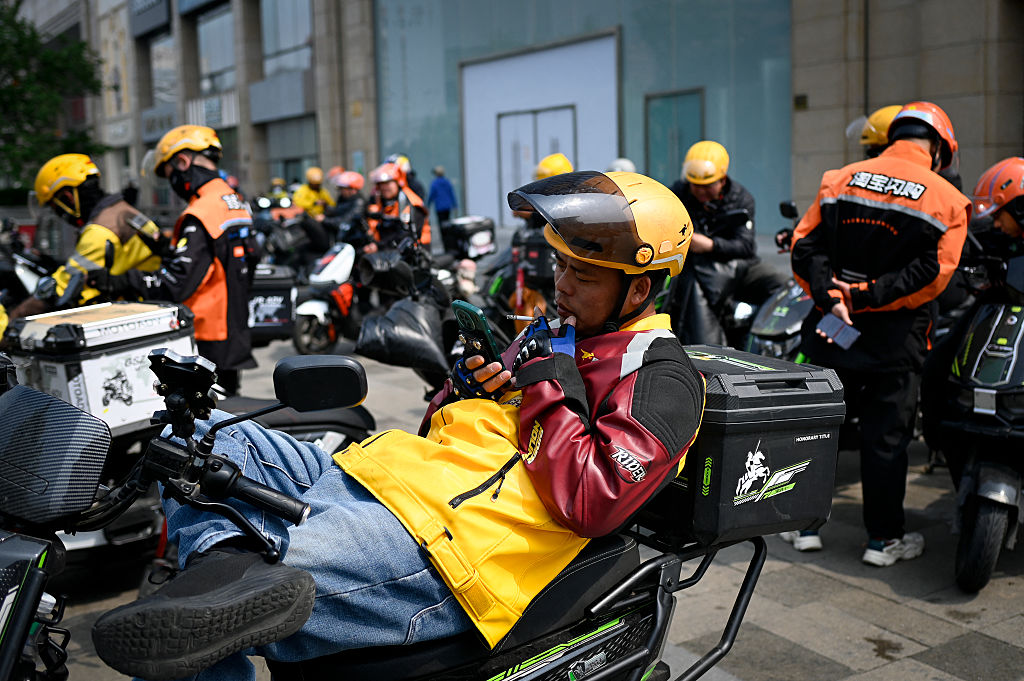
The number of low-priced takeout orders in mainland China has significantly increased. By the end of 2025, the number of online takeout users in mainland China had reached 630 million, with orders below 15 yuan accounting for about 40% of the total. At the same time, both restaurant profits and delivery rider incomes continue to be under pressure.
According to a report by “Economic Observer” on August 14, the “China Catering Development Report 2026” and the catering data platform “Red Catering Big Data” show that the size of the mainland takeout market in 2025 was 1.4191 trillion yuan, a year-on-year increase of 11.7%, accounting for approximately 24.5% of the total catering market size.
By December 2025, the number of online takeout users in mainland China had reached 630 million. A survey conducted by the Red Catering Industry Research Institute showed that the proportion of consumers who do not order takeout decreased from 2.2% in 2024 to 1.2% in 2025.
With the growth space of takeout users narrowing further, competition between platforms is gradually shifting towards existing users.
Takeout orders are also increasingly concentrating on low prices. The proportion of orders below 15 yuan has increased from 20%-30% before platforms issued large-scale coupons and subsidies to compete on prices, to about 40%. The report indicates that this change reflects consumers’ increased price sensitivity and intensifies the low-price competition between platforms and restaurants.
Consumption growth in mainland China remains low. Data from the National Bureau of Statistics of the Communist Party of China shows that in the first half of 2026, the total retail sales of consumer goods only increased by 1.3% year-on-year.
The growth rate of catering income in mainland China is also slowing down, decreasing from 5.3% in 2024 to 3.2% in 2025, further dropping to 2.8% in the first half of this year. Looking at a single month, catering revenue in June increased by only 1.2% year-on-year, with revenue from catering units above the quota growing by 0.1%.
The survey by the Red Catering Industry Research Institute also shows that cost-effectiveness and the level of discounts are key factors that consumers consider when ordering takeout.
A survey released by Li Xin Consulting at the end of February this year showed that among catering businesses surveyed in 31 provincial-level administrative regions in mainland China, 74% of businesses experienced a decrease in customer unit prices, with 53% experiencing a decrease of over 10%; nearly 70% of businesses saw a decrease in store sales compared to 2024, and 48% of businesses experienced a sales decrease of over 20%; 65% of businesses reported a year-on-year decrease in dine-in sales.
Moreover, nearly 80% of surveyed businesses saw a decline in net profits, with 35% experiencing a decrease of over 30%. Over 70% of businesses believe that the decrease in customer unit prices is the main reason for the decline in profits.
In April of this year, Lai Yang, Executive Vice President of the Beijing Commercial Economic Society, stated that platforms transferring competitive pressure to businesses and delivery riders, as well as the entire catering industry chain, have led to a decrease in business operational profits and an increase in the intensity of delivery riders’ labor.
At the end of July, several Beijing crowd-sourced delivery riders (self-registered on platforms, able to take orders online independently) told “Daily Economic News” that this year, the number of orders, unit prices, and income all experienced declines.
Delivery rider Wang Ping goes out at 6 a.m. every morning and finishes work after 10 p.m., needing to deliver over 100 orders to earn 400 to 500 yuan. Another rider, Yang Tao, stated that last summer, he and six co-rented riders each earned over 20,000 yuan per month, but this year, it is very difficult to earn 10,000 yuan per month.
These issues have sparked discussions among netizens. Some say they only order takeout below 15 yuan, stating “the cheaper, the better;” others mention choosing dine-in establishments or larger chain restaurants. Concerns have been raised about low-priced takeout potentially containing issues like high oil, high salt, and lack of nutrition. Some netizens also express that if they have sufficient income, very few would choose long-term low-priced meals below 10 yuan.