
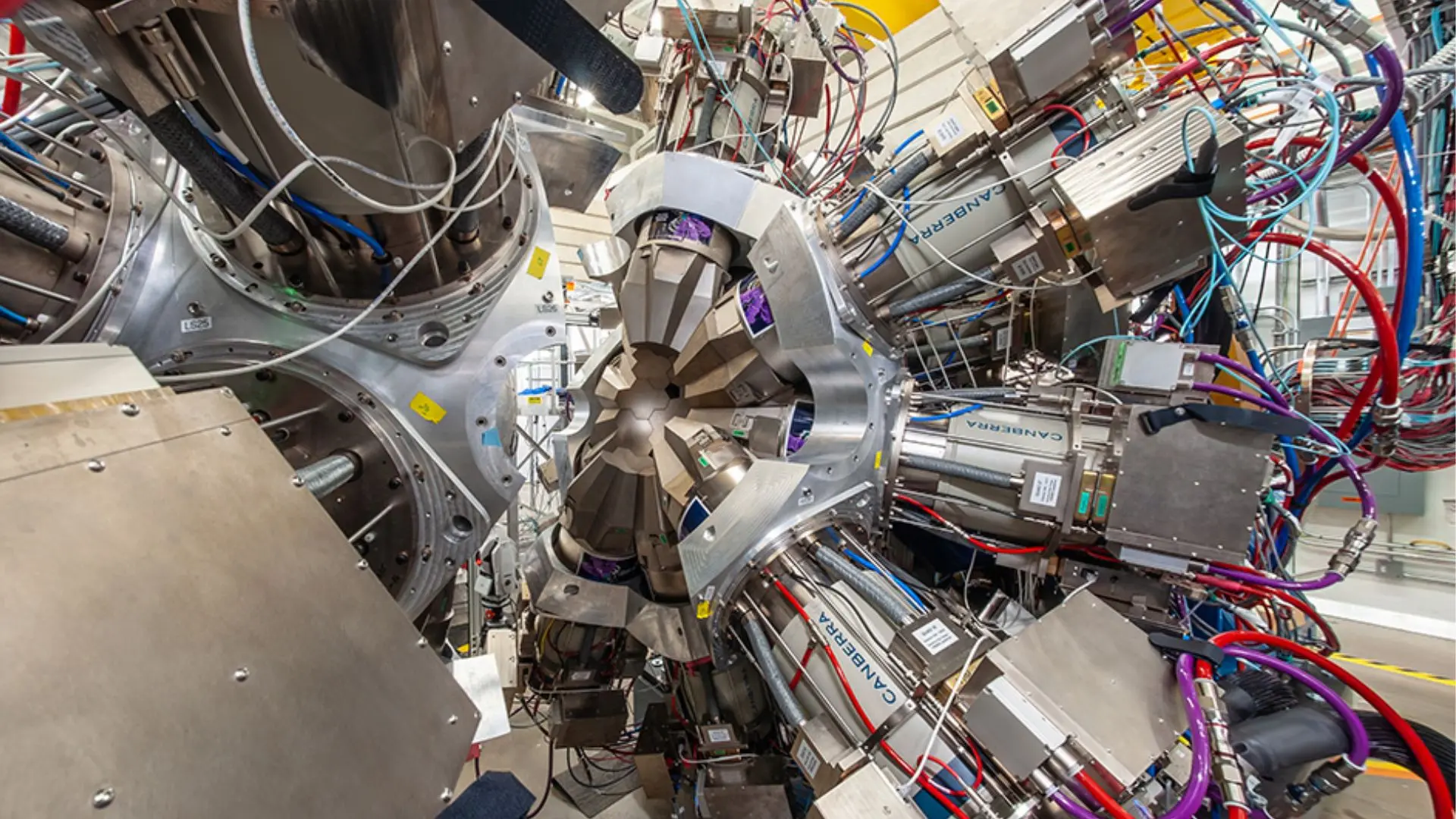
A next-generation nuclear detection system that is expected to advance nuclear physics and U.S. national security research has completed its initial operational testing and performance evaluation at the Facility for Rare Isotope Beams (FRIB) at Michigan State University (MSU). The advanced equipment, named GRETA (Gamma-Ray Energy Tracking Array), successfully met all predetermined performance indicators during early beam tests, officially marking its entry into the operational phase.
Physicists designed GRETA with the primary goal of unprecedentedly depicting subatomic structures. When atomic nuclei collide or decay, they release gamma rays (high-energy photons); by precisely recording these gamma rays, researchers can directly observe the fundamental forces that hold the nucleus together.
Traditional gamma-ray spectrometers can only measure the total energy deposited by incoming photons within a single detector block. GRETA, however, takes a completely different technological approach:
Segmented electrode design: Using high-purity germanium (HPGe) semiconductor crystals with highly segmented electrode points.
Real-time signal acquisition: When high-energy photons interact with the crystal, dedicated digital data acquisition hardware instantly records the generated electric pulses.
Three-dimensional interaction localization: The system can calculate the precise three-dimensional coordinates of each photon interaction within the crystal, thus reconstructing the photon’s scattering path.
This “energy tracking” capability enables GRETA to precisely extract weak signals in extremely high background electronic noise, a key technological threshold for studying extremely unstable and short-lived rare isotopes.
Building this massive array relied on collaborative efforts from a team spanning multiple national laboratories across the United States. The engineering team at Lawrence Berkeley National Laboratory (LBNL) assembled the core detector modules and conducted initial testing; partners from Argonne National Laboratory (ANL) and Oak Ridge National Laboratory (ORNL) constructed supporting subsystems and advanced signal processing software.
During the commissioning period, the research team successfully integrated GRETA into the ReA reaccelerator beamline of FRIB, completed full array calibration, and validated it by directing light atomic nuclei beam onto fixed targets. The excited composite nuclei produced in collisions underwent multi-stage gamma decays, and the experimental results confirmed that GRETA’s performance in time synchronization and energy resolution fully matched the expectations of computer simulations.
With the completion of the verification work, GRETA has officially become the primary instrument available for global scholars to apply for at FRIB. Researchers will utilize this facility to study extremely short-lived isotopes that exist for fractions of a second, focusing on three major areas:
Mapping the limits of nuclear stability: Measuring the “drip lines” of atomic nuclei, investigating how many protons and neutrons a single atomic nucleus can accommodate before decaying.
Unraveling the origins of cosmic elements: Tracking decay pathways similar to reactions inside stars, simulating and explaining how heavier than iron elements are synthesized in supernova explosions and neutron star collisions.
Testing fundamental physical laws: Recording tiny variations in subatomic decay processes with high precision to test the symmetry and limits of the standard model.
Paul Fallon, Director of Nuclear Science at Berkeley Lab and GRETA Project Lead, stated: “By exploring the extreme sensitivity of GRETA to ultra-weak gamma-ray transitions, we have been able to elevate its performance well beyond that of previous generations of detector arrays.”
The high-precision experimental data collected by GRETA not only improves existing nuclear theory models but also establishes a scientific foundation for continued research in nuclear physics, astrophysics, energy applications, nuclear medicine, and national security defense.