
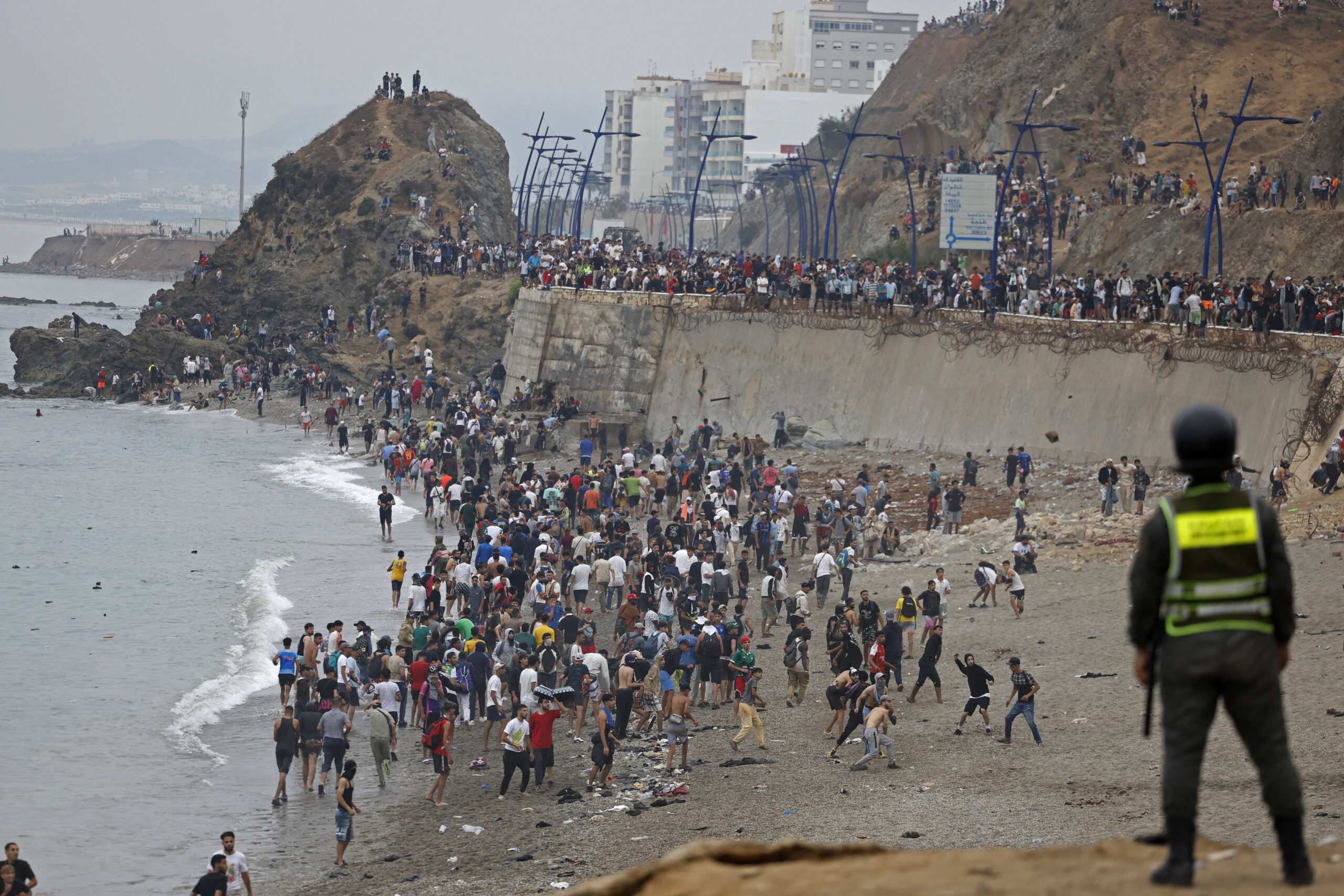
The local government officials in Ceuta, a Spanish enclave in North Africa, reported on Thursday (August 6) that the death toll resulting from the migrant crisis in the area has risen to around one hundred, with thousands of illegal immigrants still stranded.
According to a report from Fox News on Thursday, Juan Jesus Vivas, the president of the Ceuta government, disclosed during a hearing at the European Parliament’s Committee on Civil Liberties, Justice, and Home Affairs in Brussels that a large number of illegal immigrants poured into Ceuta from Morocco at the end of last month, with the death toll reaching around one hundred during this period. Currently, there are between 3,000 to 5,000 illegal immigrants still stuck in the city, which has yet to recover from this crisis.
Statistics from Spanish authorities indicate that on July 30 and 31 alone, approximately 72,000 to 80,000 mainly young male illegal immigrants entered Ceuta through swimming or walking, a scale equivalent to the entire local population, making it one of the largest migration surges in Europe in recent years.
Vivas described this influx of migrants as “an invasion,” citing the Royal Spanish Academy dictionary’s interpretation that irregular occupation of specific locations constitutes an “invasion.”
Spanish Prime Minister Pedro Sánchez, during his visit to Ceuta on July 31, also characterized the event as “an attack, a violation of the territorial integrity of Spain.”
Vivas revealed that around 75,000 individuals have voluntarily returned to Morocco. However, the top official in Ceuta emphasized that the city is far from returning to normalcy.
Currently, both migrant reception centers for adults and unaccompanied minors in Ceuta have been paralyzed due to overwhelming pressure. The migrant influx has escalated into a humanitarian crisis, causing chaos in public order and posing significant security risks.
Due to insufficient resources, the government has been unable to disclose the exact number of detained illegal immigrants or confirm whether there are extremists among the entrants who have been deported.
He disclosed that local officials had warned Madrid about the escalating number of border crossings before the crisis erupted but were not taken seriously. Throughout the crisis, the central government also refused to engage in communication with Ceuta authorities.
Vivas called for immediate strong repatriation of illegal entrants and requested the deployment of more security forces and additional resources to support local migrant accommodation facilities.
He also urged European authorities to provide further support, stating that Ceuta’s borders are “fragile and easily breached.”
European Commissioner for Migration Affairs, Magnus Brunner, stated during the same hearing on Thursday that Spain has assured the European Commission that this crisis will not affect the security of free movement in the Schengen Area.
However, he warned that the event exposed deeper issues of European borders relying too heavily on cooperation from a single neighboring country.
Earlier, on August 3, Morocco denied responsibility for the migrant surge and pointed out that Spain should have foreseen the consequences of a court ruling—stating that migrants who arrive by swimming and not by crossing physical border barriers cannot be immediately deported.