
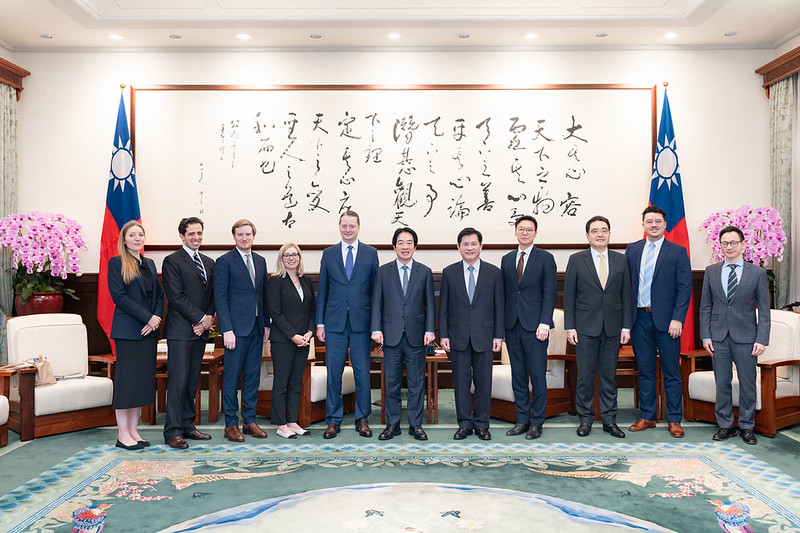
President of the Republic of China, Tsai Ing-wen, met with a delegation from the Brookings Institution and expressed her hope for the continued deepening of partnership in various fields between Taiwan and the United States to jointly maintain world peace and stability. Director Ryan Hass of the Brookings Institution also expressed his expectation for deepening cooperation between Taiwan and the United States in technology and national security.
President Tsai Ing-wen welcomed the delegation from the Brookings Institution during their visit on the afternoon of the 5th, emphasizing the longstanding relationship with Director Ryan Hass, who has led the delegation to Taiwan for five consecutive years since the COVID-19 pandemic.
Over the past five years, amidst continuously changing international situations, President Tsai Ing-wen noted Director Ryan Hass’s unwavering concern for Taiwan. She warmly welcomed Director Hass and the distinguished guests of the delegation for their visit. She also expressed gratitude for the Brookings Institution’s long-standing attention to Taiwan, acknowledging the valuable insights and research of the visiting guests as essential bridges for mutual understanding between Taiwan and the United States.
President Tsai highlighted that this year marks the 250th anniversary of the founding of the United States and the 30th anniversary of direct presidential elections in Taiwan. Commemorating democracy, freedom, and human rights development together, earlier this year, the 6th Taiwan-US Economic Prosperity Partnership Dialogue successfully took place, culminating in the signing of the “Silicon Prosperity Declaration and the Taiwan-US Joint Statement on Economic Security Cooperation,” laying a solid foundation for cooperation in semiconductors and high technology between the two nations.
Emphasizing the government’s active efforts to establish Taiwan as an “AI Island,” President Tsai stated the aim to assist all industries in integrating AI applications and to enhance the development of three key technologies: silicon photonics, quantum technology, and robotics.
“We firmly believe that there is a closer space for exchange and cooperation between Taiwan and the United States in the development of AI supply chains, digital infrastructure, and the cultivation of high-tech talents. Our goal is to make Taiwan the Asian hub for drone development,” President Tsai remarked.
President Tsai further mentioned the government’s significant investments in promoting industrial development plans and proposing a special defense budget to procure unmanned vehicles and establish a drone attack and defense system. She looks forward to Taiwan and the United States joining forces to create a non-red drone supply chain, mutually promoting industrial development and contributing to world peace and stability.
President Tsai stressed, “Taiwan stands at the forefront of the world’s democratic line of defense. We have an unwavering determination to defend national sovereignty and safeguard the lifestyle of democracy and freedom. We will continue to enhance our self-defense capabilities responsibly and maintain regional peace and stability in the Taiwan Strait through steady actions.”
She cited examples such as the ongoing Han Kuang military exercises and the upcoming “Urban Resilience Exercise” to be conducted during the exercises. The government aims to consistently integrate central and local governments, public and private sectors, and enhance military-civilian integration operations to make Taiwan more resilient in facing various challenges.
“Faced with ongoing challenges such as the expansion of authoritarianism, global supply chain restructuring, and the wave of AI, Taiwan hopes to deepen partnership with the United States in various fields. We welcome the delegation once again and wish for a fruitful and successful visit,” President Tsai concluded.
Director Ryan Hass, in his address, mentioned that the delegation from the Brookings Institution’s visit to Taiwan for the annual inspection continues a longstanding tradition. Whether during the rule of the Kuomintang or the Democratic Progressive Party, periods of the pandemic, or stable and tense moments in cross-strait relations, the delegation has consistently engaged in this visit.
Director Hass highlighted the continuation of these exchanges, demonstrating the institution’s long-standing emphasis on U.S.-Taiwan relations and reflecting the common interests, democratic values, and mutual respect on which the bilateral relationship is built.
Through this year’s research visit focusing on technology and national security themes, Director Hass expressed his hope for contributing to further strengthening the close connections between the two sides and solidifying the peace and stability that both parties cherish.