
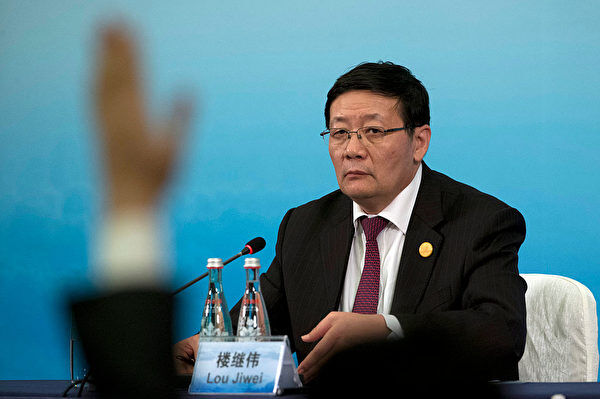
On July 31, 2026, there were reports circulating that the former Chinese Minister of Finance, Lou Jiwei, was under investigation. Recent news sources suggest that Lou Jiwei is scheduled to attend a financial seminar on August 8 and deliver a speech. Lou Jiwei, a close ally of former Premier Zhu Rongji, had criticized Xi Jinping’s administration’s economic policies such as “Made in China 2025”.
According to a post by Zhu Changzheng, the deputy editor-in-chief and macro editor of Caixin’s website, “This Saturday (August 8), there will be a closed-door seminar on revitalizing state-owned assets, and Lou Jiwei will be speaking.”
Following this, commentator Cai Shenkun posted that Lou Jiwei would be speaking at a closed-door financial seminar on August 8 on how to revitalize state-owned assets. The venue of the meeting is said to be in a location in Xicheng District, Beijing. However, this does not guarantee Lou Jiwei’s safety, as the purge of former officials has extended from Jiang Zemin, Hu Jintao, Wang Qishan, Wen Jiabao, and Li Ruihuan to Zhu Rongji. Any high-ranking officials with deep ties to the former regime could be targeted before Xi Jinping’s reelection at the 21st Party Congress.
An account named “Asian Finance” also posted on the same day that Lou Jiwei, the 75-year-old former Minister of Finance, would be participating in the closed-door seminar on financial topics related to revitalizing state-owned assets on August 8 in Beijing’s Xicheng District. Rumors had previously circulated that Lou Jiwei, like Xin Baoan and others, had been taken away for investigation.
Previously, Australian self-media person Jiang Wangzheng had leaked on X platform on July 31, 2026, that Lou Jiwei was under investigation.
On July 31, 2026, commentator Cai Shenkun posted on X platform that 75-year-old Lou Jiwei, a close ally of Zhu Rongji, was about to come forward to dispel rumors. According to the latest information, Lou Jiwei would be attending a closed-door financial seminar and delivering a keynote speech on how to revitalize state-owned assets on August 8 at a location in Xicheng District, Beijing.
Lou Jiwei, born in December 1950 in Beijing and native of Yiwu, Zhejiang, graduated from the Department of Computer Science at Tsinghua University in February 1982. He holds a master’s degree in economics from the Graduate School of the Chinese Academy of Social Sciences and is a researcher.
Lou Jiwei entered the Finance and Finance Division of the Research Office of the State Council in 1984 and was appreciated by Zhu Rongji, who was then the Deputy Director of the State Economic Commission. In 1988, shortly after Zhu Rongji became the Mayor of Shanghai, Lou Jiwei was appointed as the Deputy Director of the Shanghai Economic System Reform Office. When Zhu Rongji became the Vice Premier of the State Council, Lou Jiwei was transferred to the National Economic System Reform Commission as the Director of the Macroeconomic Control System Division. In September 1995, he was appointed as the Deputy Governor of Guizhou Province.
In March 1998, shortly after Zhu Rongji became the Premier of the State Council, Lou Jiwei was appointed as the Deputy Minister of Finance and concurrently served as the Deputy Secretary of the Party Group, continuing to oversee financial and tax reforms. In early 2007 in Wen Jiabao’s Cabinet, the 57-year-old Lou Jiwei was once again promoted to a senior position, serving as the Director of the Board of Directors of the China Investment Corporation. In March 2013, in Li Keqiang’s Cabinet, Lou Jiwei was appointed as the Minister of Finance. In November 2016, at the age of 66, Lou Jiwei stepped down as the Minister of Finance and took on the role of Chairman of the National Social Security Fund Council.
Lou Jiwei suddenly stepped down from his position as Chairman of the National Social Security Fund Council in April 2019.
Media reports speculated at the time that Lou Jiwei may have lost his position prematurely due to angering Xi Jinping, as he openly criticized the “Made in China 2025” strategy during the 2019 National People’s Congress.
According to the Hong Kong-based South China Morning Post, Lou Jiwei had stated to journalists at the time, “In any case, the strategy of ‘Made in China 2025′ should not have been proposed. I have been opposed to it from the beginning, and I am not very supportive of it.” He further criticized the strategy, saying it wasted taxpayers’ money and failed to deliver on its promises.
Lou Jiwei also mentioned that the government did not need to set goals for 2025 as it was challenging to predict trends in various industries amidst uncertainties.
The so-called “Made in China 2025” strategy introduced by the Chinese State Council in May 2015 aimed to invest $300 billion in supporting ten high-tech industries such as new energy, robotics, semiconductors, and nanotechnology. The goal was to transform China from a “manufacturing power” to a “manufacturing powerhouse” by 2025.
In September 2020, in response to Xi Jinping’s shift from supply-side reforms to the economic “dual circulation” strategy, Lou Jiwei indirectly criticized Xi Jinping during a speech at an economic forum, questioning the feasibility of true supply-side reforms under the new economic layout. He even brought up the downfall of former Premier Zhao Ziyang, who was ousted during the 1989 Tiananmen Square protests.
Lou Jiwei emphasized that genuine structural reform on the supply side required rule-based openness and governance under the law. He warned without naming names, “It should be emphasized that as an objective law, it is impossible for the government to optimize the industrial chain layout according to the ‘dual circulation’ approach. Competing to use public funds to seize new technological high grounds is not a wise move, and it will result in more losses than gains, causing misunderstandings domestically and internationally.”
Lou Jiwei also referred to a directive from Premier Zhao Ziyang in 1985 to implement the “international big cycle strategy” in coastal areas, noting it as an important turning point that led to an increase in trade dependency from 23% in 1985 to 32% in 1993.