
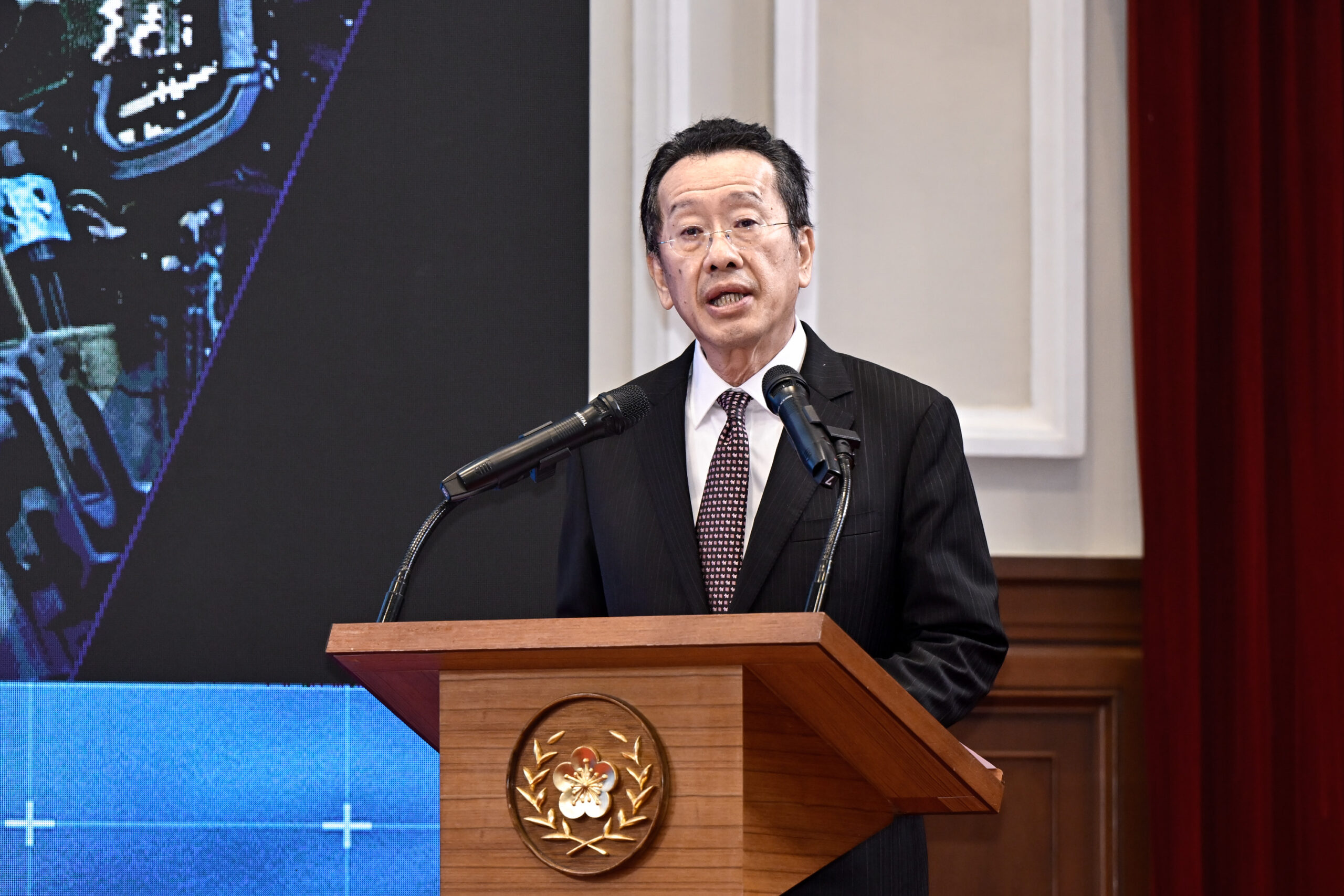
Taiwanese Minister of National Defense, Yen De-fa, stated during a joint interview with several Taiwan and foreign media outlets on Friday (July 31) that military cooperation between Taiwan and the United States may be “much closer than many people imagine.” The U.S. Indo-Pacific Command continues to assist Taiwan in enhancing its defense capabilities through various levels of military exchanges and cooperation.
Yen also mentioned that if the Chinese Communist Party were to implement a maritime blockade against Taiwan, it could not only trigger severe international sanctions but also impact the heavily trade-reliant Chinese economy, posing significant political risks to the stability and rule of the CCP.
He highlighted that the U.S. Indo-Pacific Command assists in maintaining peace and security in the Indo-Pacific region, viewing Taiwan as a key location within the first island chain.
Regarding the commonly seen participants in Taiwanese military drills, jokingly referred to as “English teachers” by outsiders, Yen stated that this is just a small part of the long-standing military exchanges between Taiwan and the United States.
He emphasized that what the public sees as “English teachers” is just a fraction, with many instances that may not be visible to the public eye.
Yen expressed gratitude for the support from the U.S., stating, “Through military exchanges and cooperation at various levels with the Indo-Pacific Command, we continue to strengthen our defense capabilities.”
Accompanying the interview, Huang Wen-chi, Director of the Department of Strategic Planning at the Ministry of National Defense, mentioned that while details of military exchanges may not be disclosed, the public can observe changes in how the military operated five years ago compared to its current training methods, reflecting the evolution towards more realistic combat training.
Spokesperson for the Ministry of National Defense, Sun Li-fang, mentioned that the combat experience shared by the U.S. is an essential reference for Taiwan’s promotion of realistic combat training. The Taiwanese military incorporates lessons from various countries according to Taiwan’s defense needs, threats posed, and changes in enemy tactics.
Sun noted that the Taiwanese military is focused on promoting realistic combat training, decentralized command structures, and distributed command. The ongoing “Han Kuang 42” military exercises will verify capabilities in battlefield medical operations and mobilization for production conversion and evacuations.
In response to increasing military pressure from the CCP against Taiwan, including maritime patrols off the Eastern Pacific coast of Taiwan, Yen stressed the importance of forming a “collective deterrence.” Taiwan believes that receiving ally supplies in the Eastern seas during combat is crucial.
Yen highlighted that the U.S. Indo-Pacific Strategy clearly articulates the principles of “collective defense” and “burden-sharing,” urging countries to increase defense budgets and enhance self-defense capabilities to establish collective deterrence in the face of potential attempts to unilaterally change the status quo in the Taiwan Strait through force.
He believed that should a collective deterrence posture be established, if Xi Jinping were to consider actions that disrupt peace in the Taiwan Strait, the calculations involved would become increasingly complex.
Regarding the scenario of a possible maritime blockade by the CCP against Taiwan, Yen pointed out that such an action would pose significant risks for Beijing.
He indicated that due to China’s heavy reliance on foreign trade and the importance of its ports for global shipping, a maritime blockade could severely impact China, especially at a time when its economy is facing challenges, potentially leading to severe international sanctions.
Yen stated, “In fact, for China, a maritime blockade would pose an even greater challenge.”
He also noted that Beijing would need to consider the significant domestic political risks associated with a blockade operation.
According to Reuters, Yen stated, “In this situation, whether the Chinese (CCP) regime can maintain stability and Xi Jinping’s rule can be solidified will be a very, very significant challenge. I believe Xi Jinping must consider this.”
Reflecting on his experience as Minister of National Defense for over two years, Yen expressed that a life turning point allowed him to enter an area he had never thought of before and have the opportunity to participate in defense affairs as a civilian, working alongside military personnel.
He mentioned that he is accelerating defense reforms at the “appropriate pace,” an experience he finds valuable, which he would remember even after retirement.
Yen also expressed Taiwan’s willingness to maintain close engagements with countries that share similar democratic principles and values.