
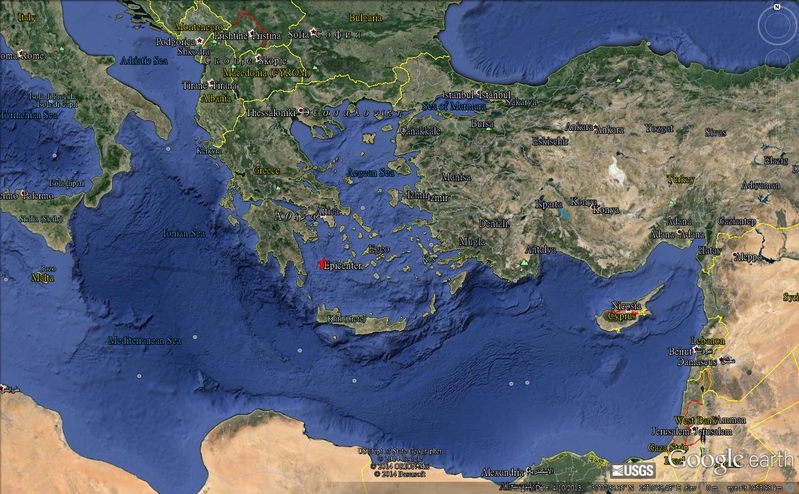
On July 30th, the American tech giant Google launched a satellite imagery artificial intelligence (AI) mapping tool, only to retract it the following day due to concerns about “deep fakes from the sky.”
According to a report by BBC on Friday, Google recently introduced a new AI feature on its Google Earth platform, allowing users to generate fictional scenes based on real satellite, aerial, or 3D images with the help of an artificial intelligence image generator called Nano Banana 2, by simply clicking a button.
Just a day later, Google released a statement on social media platform X announcing the withdrawal of the feature until “more robust protective measures are implemented.”
Google stated that they had noticed “geospatial professionals using this feature for various beneficial purposes,” but also found that “some had shared screenshots of AI-generated images that may violate our policies.”
Open-source researcher Henk van Ess informed the National Public Radio (NPR) in the United States via text message that he tried to generate AI images by entering prompts such as the Mexico border refugee crisis, an accident at an Iranian nuclear power plant, an Amsterdam air crash, and a hospital in Gaza hit by a bomb crater, and “no false scenes were rejected during the process.”
NPR reporters also successfully generated fictional images of a fire on Iran’s Kharg Island and flooding inside the U.S. Capitol building, both of which never happened in reality.
When BBC’s fact-checking tool, BBC Verify, tested the feature, it also successfully generated fake images of the Eiffel Tower collapsing, a massive sinkhole swallowing the Great Pyramids of Giza, and Russian tanks appearing in the capital of Ukraine.
Tests conducted by Singapore’s Asia News Network (CNA) showed that the feature could easily generate images of a damaged Changi Airport and a fire at Gardens by the Bay, scenes that never occurred, with no restrictions or rejections by the system.
Evan Hill, a visual investigations journalist at The Washington Post, raised concerns on platform X about whether the feature had undergone internal red team testing and pointed out its potential for misuse in spreading false information, being “virtually unrestrained.”
Jake Godin, a senior researcher at the online investigative organization Bellingcat, noted that satellite images have traditionally been a relatively reliable tool for verifying sudden events due to their difficulty in being falsified.
He gave an example of false satellite images of a U.S. military base in Bahrain being circulated during past conflicts between the U.S. and Iran or Israel, where the base was actually damaged as shown in real imagery, but the actual situation did not match the false images.
He expressed concerns that the one-click generation function could accelerate the spread of fake images and that “the speed and reach of false information dissemination always exceed any corrections.”
Hoesten Eng, Director of the Institute of National Security Studies at the S. Rajaratnam School of International Studies in Singapore, highlighted how creating realistic fake satellite images used to require certain levels of technical skills and resources, but now virtually anyone can generate images capable of causing panic or misleading the public with just one click.
He also warned that once such images spread to chat groups on platforms like WhatsApp, Telegram, or WeChat, very few individuals actively verify their authenticity.
Google mentioned that they would continue updating protective measures. Currently, all AI-generated images are watermarked with SynthID, and tools like Gemini by Google can identify them as AI-generated content. The company will also intercept image generation requests involving harmful topics.
However, despite these efforts, several interviewed experts remain unsettled, believing that without taking further actions, the long-term trust of the public in satellite imagery and Google Earth itself may be compromised.