
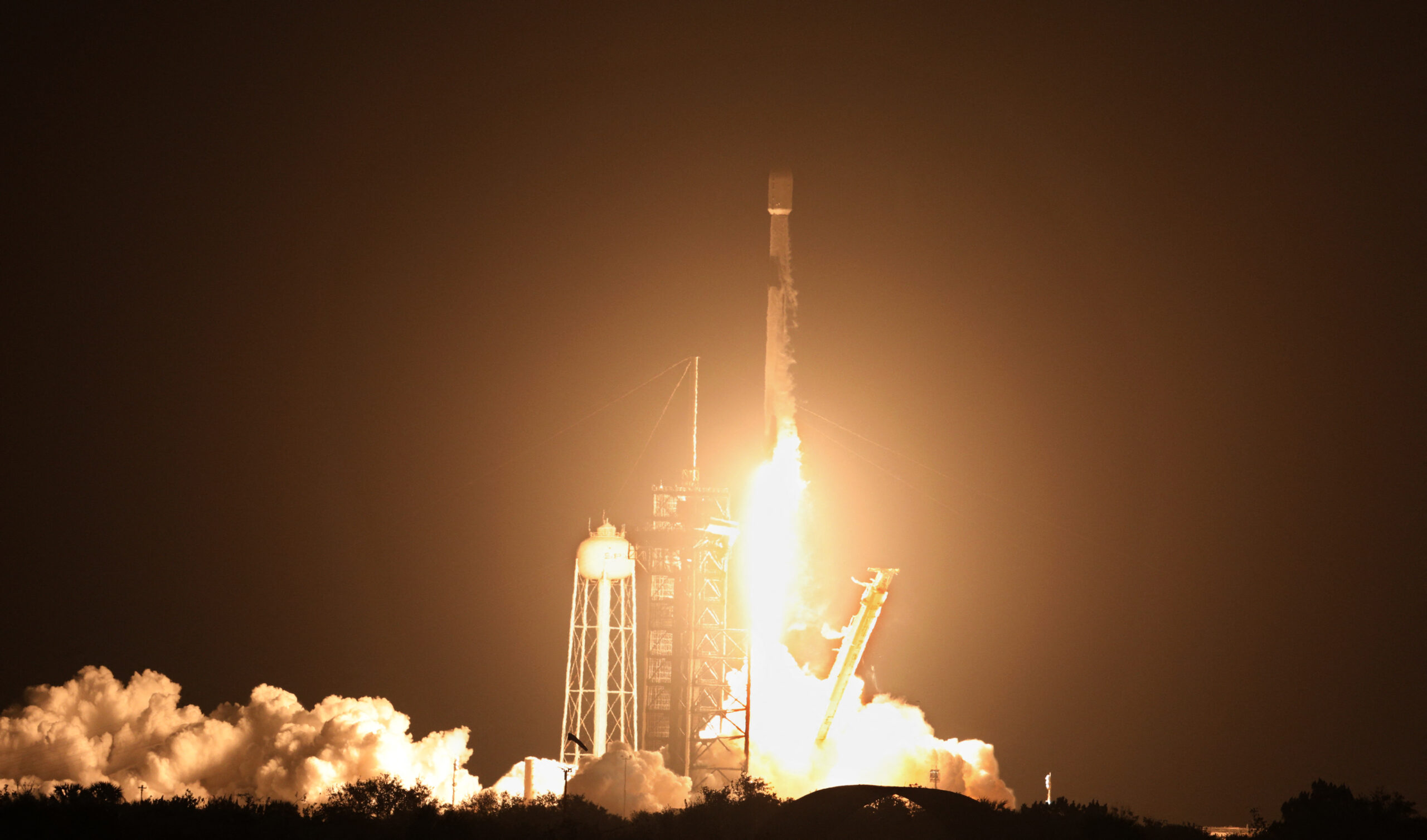
More than a year ago, the American space company SpaceX launched a pair of lunar landers. Now, a deserted SpaceX rocket is floating in space and is on a trajectory to collide with the moon. This upcoming impact event has piqued the interest of astronomers and enthusiasts alike.
The upper stage of this rocket is expected to unintentionally crash into the moon next Wednesday, August 5th. The impact will create a meteoroid crater, sending up a plume of dust and debris. Scientists and astronomy enthusiasts are eagerly anticipating this event, hoping to conduct observations.
According to a report from the Associated Press on July 31st, space tracking expert Bill Gray predicts that the impact will occur near the Einstein crater on the western edge of the moon’s visible face, at a speed of up to 5,400 miles per hour (approximately 8,700 kilometers per hour), about seven times the speed of sound. Due to the impact happening in the middle of the night, the best viewing angles will be in the eastern United States and Canada, as well as most parts of South America.
Fortunately for astronomers, this impending impact event will take place on the front side of the moon, releasing energy equivalent to three tons of TNT explosives.
Experts note that the flash generated by the impact will last less than a second, potentially making it challenging to observe due to its low brightness. However, the material ejected by the impact may extend into space for several miles or kilometers and could be observable through telescopes for minutes.
“The moon’s low gravity and lack of winds to scatter dust will be advantageous for observing the aftermath,” said Benjamin Fernando from the Los Alamos National Laboratory in the United States, encouraging both professionals and amateur enthusiasts to participate in the observations.
“One of the reasons we are monitoring this event is to understand the extent of the threat posed by debris impacts to future astronauts,” he added in an email.
Fernando anticipates that the impact will create a crater with a diameter of nearly 90 feet (27 meters) and a depth of 16 feet (5 meters). While this scale might be too small to observe from Earth, spacecraft will be able to capture clear images.
NASA’s Lunar Reconnaissance Orbiter (LRO) and South Korea’s “Danuri” lunar orbiter will take before and after images of the impact site. Fernando and his team explained that the “Danuri” will fly within one or two miles (a few kilometers) of the SpaceX rocket debris just two minutes before impact.
The abandoned rocket stage measures approximately 40 feet (12 meters) in length and weighs about 10,000 pounds (4,500 kilograms). It was launched on January 15, 2025, carrying two private lunar landers. One of them, named “Blue Ghost” by Firefly Aerospace, became the first privately-owned spacecraft to successfully land on the moon, while the other, manufactured by Japan’s ispace, unfortunately crashed.
Scientists believe that observing this upcoming impact event involving a man-made object with a trackable trajectory will hold significant scientific value. Ever since the Apollo era, NASA has intentionally crashed rocket stages and lunar modules into the moon for seismic measurements. In 2009, NASA purposely directed the LCROSS spacecraft and its upper stage rocket to impact the moon, aiming to search for ice near the moon’s south pole.