
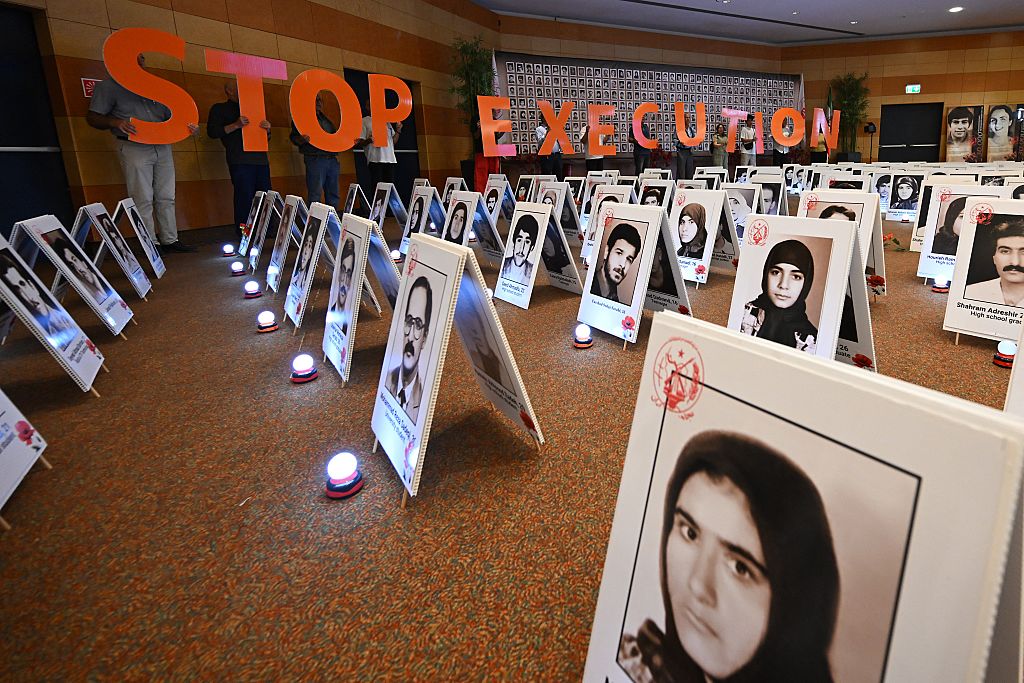
On Tuesday (28th), Iran once again publicly executed two young men who participated in nationwide protests, sparking public outcry. Meanwhile, more than a thousand prisoners near Tehran went on a hunger strike in protest, some even sewing their lips shut to express opposition to the death penalty.
According to Fox News citing the National Council of Resistance of Iran (NCRI), Abolfazl Badjani and Amirhossein Hosseinabadi were executed by hanging for allegedly participating in the nationwide anti-government protests in January.
At the time, onlookers condemned the authorities as “disgraceful”. Subsequently, security forces dispersed the protesters by firing tear gas.
Iran’s state media also reported the public execution. Iran’s semi-official Mehr news agency stated that the executions took place “in front of a crowd” at Alikhani Square.
NCRI President Maryam Rajavi stated in a post on social media X, “Fearing that this heinous crime would provoke public outrage, Iran’s regime’s repressive forces have deployed personnel on surrounding streets and rooftops.”
Human Rights Watch announced this week that in the past four months, at least 50 people in Iran have been hanged on vague “national security” charges. This execution marks an escalation of Iran’s crackdown on protesters.
Human rights organizations accuse Iranian authorities of depriving defendants of their legal rights, executing them after forced confessions and unfair trials.
Meanwhile, Iranian judiciary claimed that Badjani and Hosseinabadi participated in the demonstrations on Shahid Alikhani Square on January 8, which led to the deaths of four members of the security forces.
According to Iran’s judiciary-affiliated Mizan news agency, they were convicted of “hostility against God”, “committing evil on earth”, and crimes of destruction and burning of public property.
In the case of “Alikhani Square”, 12 protesters were sentenced to death; among them, four have been executed. In addition to Badjani and Hosseinabadi, Erfan Esfandiari and Gol Mohammad Mohammadi were publicly executed on July 19.
UN experts warned this week that the remaining 8 sentenced protesters are under imminent threat of execution by the Iranian authorities.
In a statement, UN experts said, “These young men, aged between seventeen and twenty-something, have been arbitrarily deprived of their freedom, some even subjected to enforced disappearance and abuse.”
The statement also pointed out that all defendants were sentenced to death in a closed-door trial without clarifying the specific charges against each of them.
Mahmood Amiry-Moghaddam, head of the Iranian Human Rights Organization, posted on social media X saying, “The Islamic Republic of Iran once again resorts to medieval public executions to spread fear throughout society and deter future protest activities. This is a cruel act of state terrorism that the international community cannot tolerate.”
While Iranian authorities continue to carry out public executions of protesters, in Ghezel Hesar prison near Tehran, at least 1,500 death row inmates are on a hunger strike protest, with some even sewing their lips shut to protest the execution penalties imposed on drug offenders.
According to The Guardian, this wave of protests began two weeks ago when six men were convicted of drug offenses and transferred to solitary confinement cells facing execution.
This marks the latest round of inmate-led “anti-death penalty” protests, a movement that began in January 2024 and has spread to prisons across Iran as the number of executions has sharply risen.
The non-profit organization Iranian Human Rights NGO based in Oslo stated that at least 424 people have been executed by the Iranian authorities this year, with hundreds more held in death row cells.
Relatives of the Ghezel Hesar death row inmates have staged protests outside the prison in support of their loved ones inside, but were met with violent suppression by the authorities.