
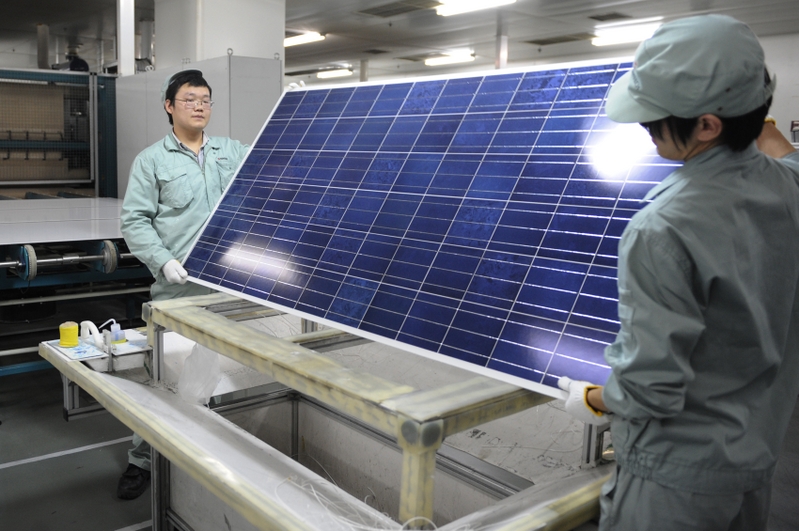
China’s photovoltaic industry has been caught in a vicious cycle of “internal competition” due to severe overcapacity, leading to intense competition. Recently, the Chinese Communist Party issued the new standard “General Rules for Cost Accounting Models in the Photovoltaic Industry” in an attempt to reverse this situation. However, market analysts believe that under the new regulations, small and medium-sized enterprises may face increased pressure in terms of costs, potentially leading to their elimination from the market.
On July 27th, the group standard “General Rules for Cost Accounting Models in the Photovoltaic Industry,” led by the China Photovoltaic Industry Association, was officially released. Based on enterprise accounting standards, this standard aims to establish a cost accounting framework that spans the entire industry chain of “silicon materials-silicon wafers-cells-modules” through standardized cost calculation ranges, coefficients, and models.
Liu Yiyang, Executive Secretary-General of the China Photovoltaic Industry Association, stated in an article on July 27th that when the market faces severe oversupply, clearing inventory quickly at low prices has become a common business practice. The new standard was created to combat the “internal competition.” Prolonged losses in certain sectors of the photovoltaic industry due to low-price competition have already impacted product quality, technological innovation, contract performance, and supply chain stability.
The current photovoltaic industry is undergoing a deep restructuring, and the new standard covers the four main manufacturing processes of silicon materials, silicon wafers, cells, and modules. It sets systematic regulations for cost ranges, cost levels, key parameters, data requirements, and calculation models. Under the unified cost red line restriction of the new standard, strategies by companies to sell off excess inventory will come under scrutiny.
Chinese media reports suggest that many small and medium-sized photovoltaic enterprises, lacking in technology and brand strength compared to large enterprises, have in the past hidden their actual losses by relying on means such as spreading period costs with limited choices. After the implementation of the new standard, when the quotes from these small enterprises are significantly lower than the costs calculated according to the new standard, they may be directly rejected during bidding evaluations, thus losing opportunities to secure orders and accelerating their elimination from the market.
For large enterprises, although the new standard clarifies methods for upstream-downstream transfer and shared cost allocation, the diverse nature of internal transactions and technological cross-subsidy models among different large enterprises may lead to disputes and gamesmanship over the fairness of “accounting coefficients” during actual implementation, data audits, and industry reference cost collection.
Currently, China’s photovoltaic industry is gradually contracting. According to the latest statistics from the National Energy Administration of the Communist Party of China, China’s newly added photovoltaic installed capacity in the first half of this year was 72.07 gigawatts (GW), a drastic decrease of about 66% compared to the same period last year.
Data shows that 21 A-share listed photovoltaic companies that have already released their semi-annual forecasts jointly expect losses ranging from 13 billion to 16.8 billion yuan. Three large enterprises, namely Longi Green Energy, Tongwei Co., and TCL Central Environmental, anticipate losses exceeding billions in the first half of the year.
In response to the causes of these losses, the listed companies generally point out that the overall imbalance in supply and demand in the industry has not fundamentally improved, product prices across different sectors remain sluggish, and there is increased operational pressure on enterprises, among other factors.
Former Secretary-General of the China Photovoltaic Industry Association, Wang Bohua, recently stated at a seminar on the “Review of Photovoltaic Industry Development in the First Half of 2026 and Outlook for the Second Half of the Year” that the photovoltaic industry is facing a triple squeeze of supply-demand imbalance, shrinking demand, and escalating trade barriers, with the industry still grappling with the fundamental issues of “internal competition.”
During the opening ceremony of the 19th (2026) International Solar Photovoltaic and Smart Energy (Shanghai) Conference held in June, Zhu Gongshan, the Executive Chairman of the conference, remarked that the past focus on expanding production, lowering prices, and seizing scale had reached its physical limits, leading the entire industry into a zero-sum game.