
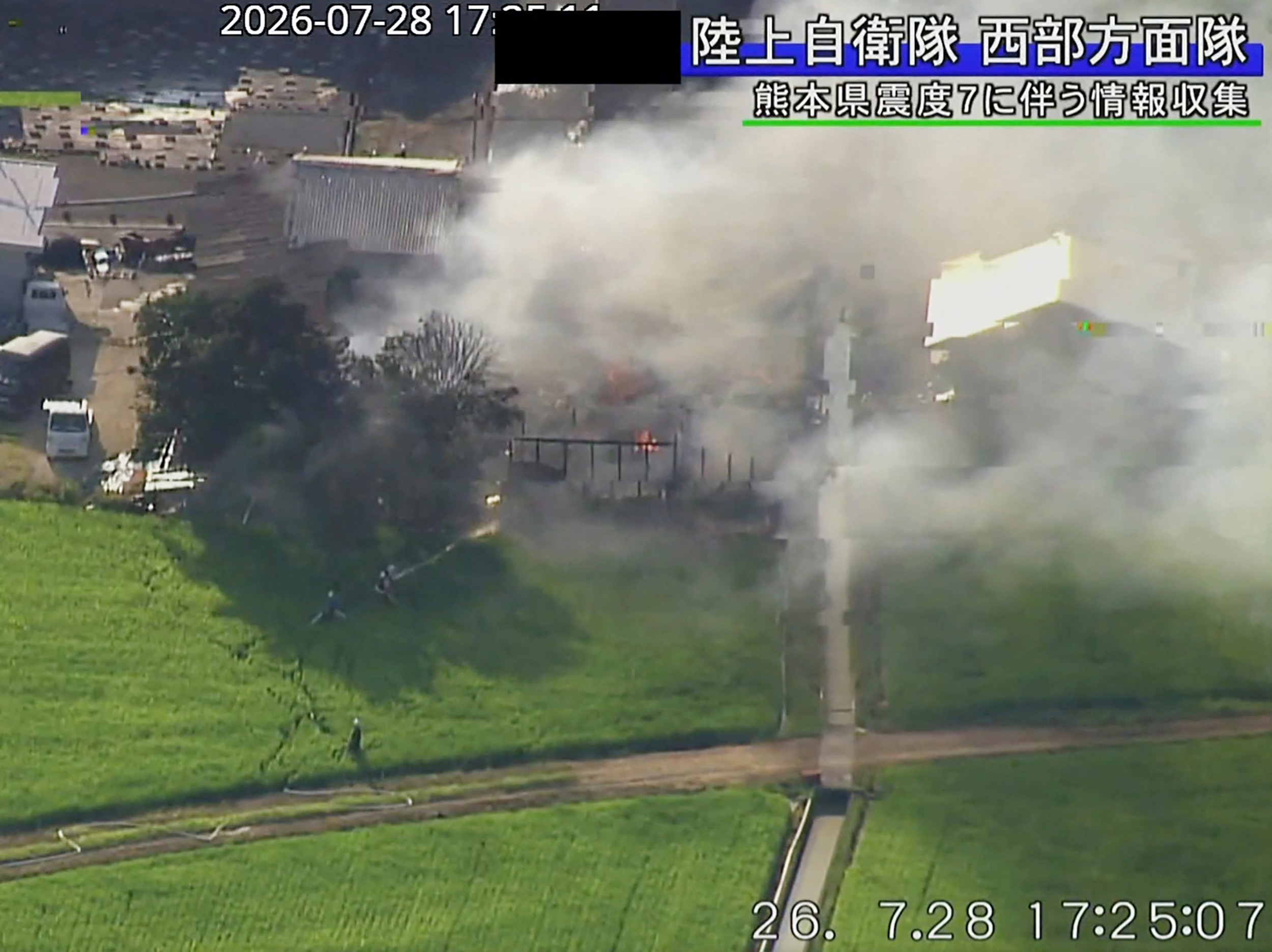
On July 28th at 4:27 PM local time, a strong earthquake with a magnitude of 7.1 struck Kumamoto Prefecture in Kyushu, Japan. The earthquake caused collapsed buildings, fires, and disrupted transportation and numerous businesses in Kyushu. Currently, over 210,000 people have been evacuated, and the Japan Meteorological Agency has officially named it the “2026 Kumamoto Earthquake of Reiwa 8.”
According to a report by the Nikkei, Defense Minister Taro Kono stated in an interview that the Self-Defense Forces have been instructed to prioritize life-saving missions and swiftly gather information on the disaster, including potential tsunamis, while providing accurate and real-time information to the public.
The Air Self-Defense Force has dispatched three F-2 fighter jets from the Chitose Base in Fukuoka Prefecture and helicopters from the Nittahara Base in Miyazaki Prefecture to conduct disaster reconnaissance and intelligence gathering. Additionally, the Ministry of Defense has sent liaison officers to Kumamoto Prefecture and the prefectural offices of Fukuoka, Nagasaki, and Saga.
As of 6:30 PM, the Fire and Disaster Management Agency has reported that seven cities and towns in Kumamoto, Nagasaki, and Fukuoka prefectures have issued evacuation orders affecting approximately 217,000 people.
The historic landmark of Kumamoto Castle has once again suffered damage, with multiple stone walls collapsed due to the strong earthquake. The castle had already been severely damaged in the 2016 Kumamoto Earthquake and was undergoing restoration work scheduled to be completed by the fiscal year 2052 before being hit hard again.
In terms of transportation, JR Kyushu immediately suspended services on the Kyushu Shinkansen and conventional lines, with reports of passengers being injured on the Shinkansen. By around 6 PM, limited service on the West Kyushu Shinkansen resumed, while conventional lines gradually returned to operation. However, some West Japan Railway lines, Kumamoto Electric Railway, and Minami Aso Railway remained suspended.
Kumamoto Airport announced its closure due to runway damage, leading Japan Airlines to cancel six round-trip flights to and from Kumamoto. All Nippon Airways also canceled eight flights and two flights scheduled for July 29th. Additionally, a JR Freight train derailed at Yatsushiro Station, fortunately without any reported casualties.
In terms of business impact, Toyota Kyushu halted production at its Fukuoka plant, and Bridgestone Kumamoto plant temporarily ceased operations pending safety checks. The chimneys at the Yatsushiro plant of Nippon Paper collapsed due to the earthquake, leading to a complete shutdown while confirming employee safety before commencing equipment inspections.
In logistics, Japan Post, Yamato Transport, and Sagawa Express announced the suspension of mail collection and delivery services in certain areas or throughout Kumamoto Prefecture.
Retail and dining establishments were also affected, with around 30 7-Eleven stores in Kumamoto experiencing power outages and some temporarily closing. Additionally, 21 locations of SUKIYA and Hamazushi in Kumamoto Prefecture temporarily suspended operations. Some stores faced power and gas outages, as well as damage to refrigerators and utensils.
In terms of communication, NTT DOCOMO, KDDI, Rakuten Mobile, and NTT West Japan reported that mobile and fixed networks in certain areas of Kumamoto were affected and being assessed for damage.
According to NHK, the Japan Meteorological Agency assigns names to disasters when they cause significant damage. The last earthquake named was the “2024 Noto Peninsula Earthquake of Reiwa 6.” The series of earthquakes in Kumamoto in April 2016 was named the “2016 Kumamoto Earthquake of Heisei 28.”
On April 14, 2016, Kumamoto Prefecture experienced a 6.5-magnitude earthquake, followed by a 7.3-magnitude earthquake early on April 16, with multiple aftershocks. A total of 278 people died in the earthquakes.
The Meteorological Agency classified this earthquake as a strike-slip event where fault lines slide past each other, causing the earthquake. Previous studies have indicated that the 2016 Kumamoto Earthquake was also a strike-slip event.
Researcher Kazunari Obara of the National Research Institute for Earth Science and Disaster Resilience stated to the Nikkei that the mechanism of this earthquake is similar to the Kumamoto Earthquake ten years ago and may result in aftershocks similar to the previous earthquake or stronger tremors.
Professor Shinichi Sakai from the University of Tokyo’s Earthquake Research Institute mentioned in a report by NHK that the 2016 Kumamoto Earthquake was caused by activity in the Futagawa Fault Zone and Hinagu Fault Zone extending to Kumamoto Prefecture. The current earthquake may be triggered by activity in the southern part of the Hinagu Fault Zone not involved in the previous earthquake.
Professor Aitaro Kato from the University of Tokyo’s Earthquake Research Institute warned that the earthquake occurred south of the 2016 earthquake area and could lead to chain reactions of fault ruptures further south, necessitating vigilance against aftershocks and related events.