
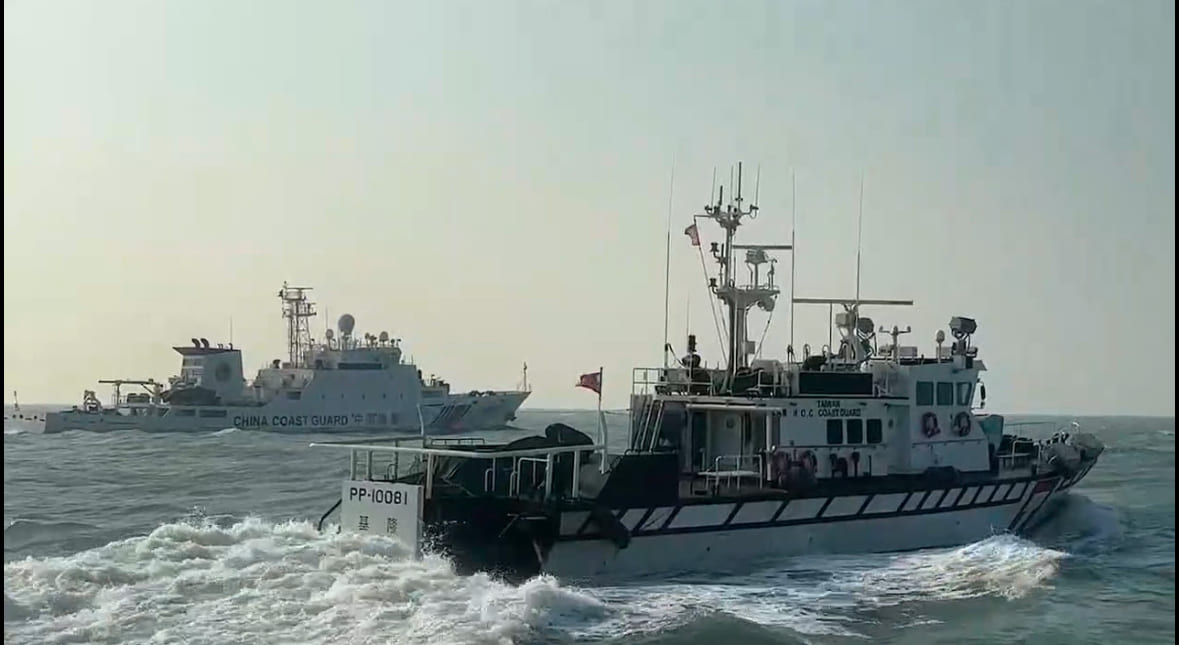
The Chinese Communist Party (CCP) officially announced last month that its coast guard vessels have initiated “routine law enforcement patrols” in the waters off the eastern coast of Taiwan, triggering ongoing backlash. Vice Chairman of Taiwan’s Mainland Affairs Council, Shen Youzhong, condemned the CCP’s actions as both illegal and unjust. A report released by the US-China Economic and Security Review Commission (USCC) on July 23rd stated that this falls under Beijing’s “legal warfare” script. Two Taiwanese experts believe that the CCP’s attempt to turn non-existent sovereignty into a fait accompli will not succeed, but they warn about the new threat of CCP coast guard potentially escalating from patrols to blockades.
The CCP’s coast guard announced on July 4th that it was conducting “normalized law enforcement patrols” in the waters off eastern Taiwan. Prior to this, in June, the CCP coast guard carried out a so-called “special law enforcement and scanning operation for maritime traffic” in this area, and in December of last year, the CCP military conducted exercises simulating a blockade of Taiwan.
Taiwan’s Vice Chairman of the Mainland Affairs Council, Shen Youzhong, attended a seminar titled “New Trends in China’s Comprehensive Pressure on Taiwan.” He responded to media inquiries before the seminar, stating that the activities of CCP coast guard vessels, research ships, and maritime vessels in the waters off Taiwan’s east coast are inherently illegal and unjust. The Taiwanese government has promptly lodged a strong protest, with countries including Japan, the Philippines, and the American Institute in Taiwan (AIT) openly refuting the CCP’s claims of law enforcement in Taiwan’s eastern waters.
Last month, the US State Department expressed concern over CCP government vessels entering the waters off eastern Taiwan for what Beijing described as law enforcement actions. The representative offices of the UK, France, and Germany in Taiwan issued a joint statement expressing concern over the situation.
US Secretary of State Mike Pompeo stated in a post on X platform last week, “No country has the right to restrict commercial transit and travel through international waters, including in the Taiwan Strait.”
In the “China Bulletin” released by the USCC on July 23rd, when examining the nature of CCP coast guard activities in the waters off eastern Taiwan, it pointed out that Beijing is using the establishment of a normalized coast guard presence to exert legal authority over Taiwan through its “legal warfare” script, all while avoiding the impression of military escalation.
Major General Su Zi-yun, director of the National Defense Strategic Studies Institute of Taiwan’s Institute for National Defense and Security Research, stated that the CCP’s normalization of law enforcement patrols by its coast guard in the waters off eastern Taiwan is an attempt to unilaterally declare its jurisdiction to the world. However, other countries are skeptical of this move.
He believes that the CCP’s attempt to turn non-existent sovereignty into a fait accompli will not succeed. Previously, the CCP routinely navigated the disputed waters around the Diaoyu Islands to assert its sovereignty, but international recognition of these claims has been lacking. The CCP is now applying this tactic, along with its experiences in the South China Sea, to the waters off eastern Taiwan. However, the challenges it faces will be greater as these are international waters, and its claims of jurisdiction will not be accepted by other countries.
However, Su Zi-yun pointed out the possibility of the CCP transitioning from patrols to blockades. The CCP military’s operational readiness patrols might shift to “transformation through warfare,” while the coast guard may shift from patrols to blockades. This represents a new threat. The CCP may temporarily refrain from specific military exercises, but through this gray zone of normalized law enforcement and the so-called “transition from patrols to blockades,” it presents a new posture.
Su Zi-yun analyzed that this normalizing action by the CCP was previously mainly focused on gray areas around Kinmen, Pratas Island, and both sides of the Taiwan Strait. This new strategic intent revealed now is the CCP’s so-called “python strategy.”
“It simply extends the normalized enforcement from Kinmen to Pratas Island, Taiping Island, and the waters off eastern Taiwan, along with its operations in the East China Sea and South China Sea, forming a ‘three seas, one line’ connection, connecting the East China Sea, Taiwan Strait, and South China Sea.” he said.
Researcher Chung Chih-tung from the Institute for National Defense and Security Research of Taiwan stated to Dajiyuan that the CCP is attempting to use conflicts in the gray zone to achieve specific political purposes, to pressure Taiwan and ultimately establish the narrative of CCP sovereignty over Taiwan.
“The CCP hopes to break through the so-called first island chain blockade, enter the waters off eastern Taiwan, and then package it as asserting sovereignty over Taiwan. This reflects the CCP’s active attempts to change the security situation in the Taiwan Strait and the region, challenging the existing security order.” he stated.
Chung Chih-tung believes that this move is undoubtedly also targeting Japan and the Philippines. Since Japan and the Philippines announced negotiations on the delineation of their exclusive economic zones in May, which involves the waters off eastern Taiwan. The CCP is also exerting pressure on the Taiwanese government, Japan, and the Philippines through near-sea management.
However, he believes that the fact remains that ships have the right to freely navigate the waters off eastern Taiwan as part of freedom of navigation. The CCP’s attempt to package this freedom of navigation as a normalized so-called “law enforcement” propaganda will only backfire. Thus, Taiwan has already sternly refuted this, and the international community also stands in opposition.
Regarding how to respond to CCP actions in the waters off eastern Taiwan, Vice Chairman of Taiwan’s Mainland Affairs Council Shen Youzhong stated that frontline coast guard personnel should maintain the baseline of 24 nautical miles and avoid escalating conflicts beyond this point; within 24 nautical miles, involving sovereignty issues, Taiwan will not compromise.
Chung Chih-tung stated that the 24 nautical miles fall within Taiwan’s adjacent zone and the defense range belonging to the sovereignty of the Republic of China (Taiwan). Currently, the CCP is unwilling to acknowledge the objective fact that Taiwan and the mainland do not belong to each other, and Taiwanese society does not accept the CCP’s unilateral rule. The mainstream public opinion in Taiwan clashes with Beijing’s claims, reflecting the ongoing standoff between the two sides in a continuing cold war situation.
Regarding Taiwan’s response, Su Zi-yun said that the first priority is to strengthen the capabilities of the coast guard because Taiwan’s coast guard budget is limited.
The second is to enhance existing international cooperation. Strengthening cooperation with the US coast guard, the Japan Coast Guard, and maritime surveillance cooperation with Canada are essential to enhance existing cooperative foundations.
Thirdly, Taiwan must emphasize that this is not just about the survival interests of Taiwan as the Republic of China, but it is crucial for the key interests of various countries in global maritime transportation. If the waters around Taiwan are controlled by the CCP, it would pose a significant potential threat to the global supply chain and maritime trade.
According to international shipping and economic data, among the top 10% of large container ships worldwide, up to 88% of vessels pass through the Taiwan Strait or the waters around Taiwan during their voyages.
Su Zi-yun emphasized that Taiwan’s top priority is to strengthen its own capabilities, including military and coast guard forces, while not ruling out dialogue. “But you must have strength to have the possibility of dialogue. True security must be in Taiwan’s own hands.”